HubSpot Custom Integration Services in Australia
Turn HubSpot to a connected workspace where your systems work as one. Amwhiz offers custom integrations that reduce data gaps, manual effort, and helps teams to operate with clarity. By integrating HubSpot with the tools that your business already relies on, we establish a setup that supports efficiency and scalability.

Integrate HubSpot with the Tools That Power Your Business
HubSpot + Salesforce
Align sales and marketing data by integrating HubSpot with Salesforce.
HubSpot + Zoho Books
Connect your CRM with Zoho Books to automate invoicing, sync customer data, and streamline your accounting workflows.
HubSpot + QuickBooks
Integrate HubSpot with QuickBooks to sync contacts, invoices, and payments for seamless sales and finance management.
HubSpot + Xero
Unify HubSpot with Xero to manage billing, track payments, and keep your customer and financial data perfectly in sync.
HubSpot + Airtable
Connect HubSpot with Airtable to control dynamic data and automate updates.
HubSpot + Zoho
Save time and effort by connecting HubSpot and Zoho for real-time data syncing.
HubSpot + Salesforce
Keep tasks and customer records up-to-date by integrating HubSpot with Notion.
HubSpot + Wrike
Translate HubSpot activity into structured project workflows by connecting it with Wrike.
Why Amwhiz?
Complete Integration Delivery
We take care of all the stages from strategy to deployment
Future-Ready Integrations
Solutions designed for growing and changing data needs
Purpose-Built Integrations
Custom integrations designed around your business operations.
Proven Integration Experience
HubSpot specialists with real-world integration expertise.

Integrations
An Enterprise-Grade HubSpot Integration Ecosystem
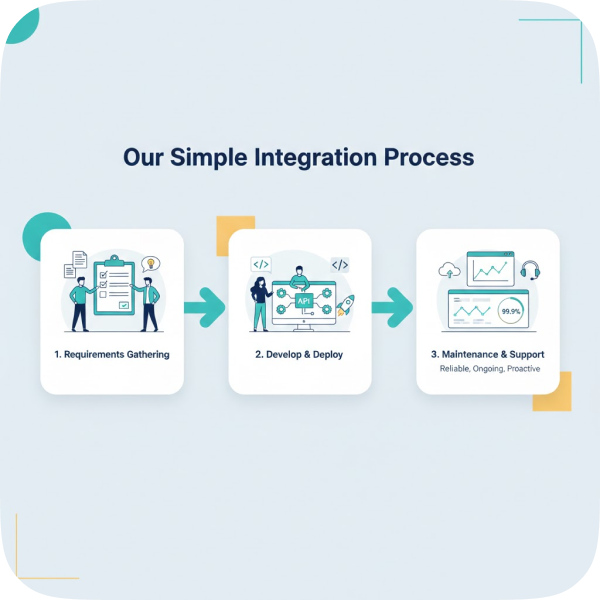
It Only TakesThree Easy Steps for Integration
Requirements Gathering
A focused discussion to gain deeper insights into your business goals, workflows, existing systems and more.
Develop & Deploy
Stage where our team develops & deploys custom integrations with precision and ensures you get sure shot performance with a secure data flow.
Maintenance & Support
A post launch support stage where we keep a check on the integration issues and deal with them proactively and provide support for optimal performance.

Donβt just take our words
Albert Flores
Albert Flores
Albert Flores
FAQ
Frequently Asked Questions
Everything you need to know about working with us.
The first step in launching a custom HubSpot integration project is an organised discovery conversation aimed at finding out what your organisation wants to accomplish, how its systems work, and what problems are impeding their work. This stage is used to assess the way HubSpot is utilized, what platforms should be integrated, and what results could be expected. This enables us to specify scope, technical feasibility and successful criteria early on.
Once the requirements have been gathered, we document integration logic, data flow guidelines, security implications, and delivery milestones. As a leading HubSpot integration service provider in Australia, we provide an explicit project roadmap which defines the timelines, responsibilities, and communication checkpoints. It is only after mutual approval that development commences. We also provide you with a dedicated contact point throughout the process who coordinates and updates you on the progress. It is a systematic way of reducing risk, eliminating scope creep and making sure that the integration serves the actual business needs and not assumptions.
Determining whether a custom integration is required depends on your workflows, data complexity, and business requirements. When processes are not complicated and are well in line with the standard functionality, standard connectors are employed. They are however usually inflexible when it comes to performing certain data logic, system dependencies, and complex automation.
As a leading provider of HubSpot custom integration development in Australia, we begin with an evaluation process where we check your HubSpot usage, what data needs to flow between systems, and whether existing connectors support those needs reliably. A custom integration is typically more suitable when the scope of your operations includes custom fields, special approval processes, and an enterprise system. Full control of data behaviour, security rules and scalability is only possible with custom integrations. They are also better in eliminating long term constraints due to hard connectors.
This analysis assists organisations to avoid overengineering while ensuring that the solution adopted promotes growth.
Looking for reliable HubSpot custom integration services in Australia? Get in touch with us today.
HubSpot can be connected with numerous enterprise systems and internal systems as long as there is a good way of accessing data. The most common integrations offered by us as part of our custom HubSpot integration services in Australia are with CRM platforms, ERP systems, finance tools, support systems, marketing platforms, analytics tools, and internal proprietary applications..
The most important aspect of any custom HubSpot integration is the way data is organised, retrieved and modified in individual systems. During the planning stage, we evaluate APIs, data formats, authentication systems and system constraints. Those platforms without current APIs can easily be incorporated through middleware or secure data exchange. Custom logic can also be used to connect internal systems designed to carry out business operations.
The aim is to maintain correct and uniform flow of data and not to interfere with the current processes. By integrating HubSpot with enterprise systems, organisations gain unified visibility, reduced duplication, and improved operational efficiency.
The time taken to complete a custom HubSpot integration is determined by the complexity of the project, the readiness of the system, and the approval process. Simple integrations that have well defined requirements can be accomplished fairly fast and multi-system or bi-directional integrations take time to assimilate and test. Generally, there are discovery, technical design, development, testing and deployment phases in a normal project. Factors such as API limitation, inconsistent data structures or internal approvals could cause significant delays.
As an experienced provider of HubSpot custom integration development in Australia, we set realistic schedules so that the expectations align with the realistic timeline. Testing is prioritised to validate data accuracy, performance, and stability before launch. This cautious method minimises post deployment problems and re-work. Being a leading provider of HubSpot custom integration services in Australia, instead of just speed, we like to provide a solid, production-ready integration that is reliable over a long period of time. Well defined milestones and communication ensures the stakeholders are aware of what is going on during the delivery process.
The scope and pricing of the project are determined with the help of a systematic evaluation of the needs, complexity, and delivery expectations. We start by understanding what systems should be linked, what the flow of data should be and the business results to be obtained. Based on this, we specify integration logic, security requirements, testing requirements or expectations and support requirements.
The pricing is usually based on the effort required to deliver a reliable and maintainable solution. As the leading HubSpot integration service provider in Australia, we offer fixed-scope pricing, which applies when the requirements are clear and such requirements are not likely to change. We also offer flexible pricing models for projects involving multiple systems or evolving needs. An elaborate proposal is presented prior to commencing work, which shows deliverables, assumptions and schedule. This disclosure assists organisations in allocating budgets for the project and confidently go ahead with the integration without any surprises. The focus is always on aligning investment with long-term value rather than short-term technical delivery alone.
Yes. As a leading provider of custom HubSpot integration services in Australia, we design integrations that can be implemented without causing any disruption to the business operation. To achieve this, we review your current systems, workflows and live data use to determine risks. At Amwhiz, integrations are developed and tested in a controlled environment to make sure that they do what they are supposed to do before they come in contact with live operations. Data sync rules are well stipulated to avoid overwriting of important information or duplication.
Deployment is planned during low-impact windows wherever possible, and any necessary modification is discussed beforehand. Being a seasoned and trusted provider of HubSpot custom integration development in Australia, we offer post-launch monitoring services, which assists in detecting and eliminating problems in a short time. This organized strategy ensures continuity of operations for teams that are relying on HubSpot and interconnected systems in their daily operations. The goal is to enhance functionality without interrupting ongoing operations. By prioritising stability and validation, integrations deliver added value while preserving existing workflows and business continuity throughout the implementation process.
A custom integration does not necessarily involve modification of existing workflows and user processes. HubSpot integrations are aimed at enhancing the usage of HubSpot as it is and not to make any operational adjustments. During the discovery stage, we look at existing workflows to make sure that the integration aligns with the existing processes. While small changes can be suggested in some cases to enhance efficiency or precision of data, these are discussed and agreed to in advance.
All changes are also introduced at a slow pace to reduce disruptions and maintain user adoption. The aim is to improve functionality and still make teams familiar with the new platform. Clear documentation and communication ensure users understand how the integration supports their work. This approach helps organisations gain additional capabilities without creating confusion or resistance. Ultimately, the integration should feel like a natural extension of HubSpot rather than a disruptive system change.
Yes, we are a leading provider of HubSpot custom integration development in Australia, helping businesses evaluate, optimise, and revamp existing HubSpot integrations. We achieve this through technical audits which helps us determine problems like data mismatch, sync failures or logic efficiency. In some instances, optimisation is enough, but there are instances that require a complete rebuild to ensure long-term stability. Rebuilding allows outdated assumptions or limitations to be corrected and aligned with current business needs. Improvements focus on performance, maintainability, and clarity. Extensive testing is used to make sure that problems are fixed prior to re-deployment. This structured approach helps restore confidence in the integration and ensures it continues supporting operations effectively. Whether optimising or rebuilding, the goal is to deliver a dependable integration that aligns with current workflows and future scalability requirements.
Our support services include monitoring, troubleshooting, performance optimisation, and regular updates to accommodate system changes. Support can be structured as ongoing maintenance or on-demand assistance depending on organisational needs. Proactive monitoring helps identify issues early before they affect operations.
Once the integration is complete, we offer extensive documentation and organised knowledge transfer. All data flows, integration logic, dependencies, and maintenance guidelines are documented carefully and internal teams are taken through the integration during a handover session. We help your teams understand how to operate the newly revamped systems efficiently and how to resolve any issues. This allows your teams to handle the integration with a sense of confidence without necessarily depending on external support. Clear documentation supports continuity when responsibilities change and simplifies future enhancements. The objective is to leave organisations with a solution that is easy to understand, manage, and scale. Proper knowledge transfer reduces operational risk and ensures long-term success beyond initial delivery.