-1.png?width=134&height=66&name=amwhiz-logo%20(1)-1.png)


HubSpot Data Hub is the new name for Operations Hub: the HubSpot product that syncs data with other...
written by: Renuka M
Overview
Did you know, according to a report published by McKinsey Global, businesses that utilize data analytics experience experience a 23% higher profitability compared to their competitors?
But here’s the catch - In today’s fast paced digital landscape, having data alone is not enough. Over time, businesses across the globe are realizing that intelligent use of this data is essential to drive sustainable growth and determine success.
And what better way to do it than with HubSpot!
With more than 200000+ paying customers worldwide, HubSpot has become one of the most trusted platforms for turning raw data into actionable insights. It offers numerous built-in analytics tools which help businesses figure out the right strategies, identify gaps, and make informed decisions faster. Whether you are a startup trying to find your footing or an established firm scaling operations, HubSpot Analytics simplifies complex data into clear, visual stories.
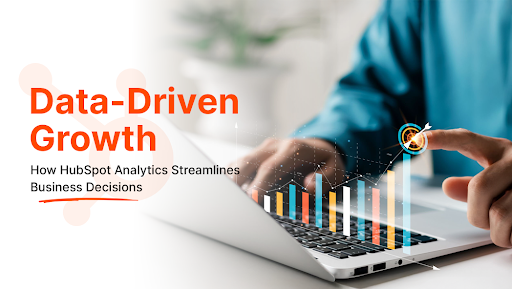
Here, in this blog, we will discuss how data-driven growth functions, the way HubSpot simplifies decision-making, and the importance of adopting analytics in order to flourish in today’s competitive business world.
Why Data-Driven Decision-Making Matters
Every business gathers data including online visits to websites and email clicks, or reviews of customers and conversion of sales. But to gather it is not sufficient. The true potential lies in leveraging the information to make wiser decisions. Research indicates that data-driven organizations have 19 times higher chances of making profits and 23 times higher chances of getting customers compared with those that make decisions entirely based on intuition.
When you make decisions based on facts rather than by intuitions, you gain better control over the outcomes. You begin to know what is actually motivating the outcomes and where to put resources. As an example, a marketing department will be able to monitor campaigns that generate the highest number of qualified leads and sales will be able to determine which steps in the deal process should be optimized. The outcome? Groups cease to operate in silos and begin to pull towards quantifiable growth objectives.
How HubSpot Analytics Supports Streamlined Business Decisions
This is what HubSpot does to make use of the data and turn it into actionable insights:
1. Unified Dashboard and Real-Time Insights
HubSpot collects marketing, sales, service and website data to display a complete picture of what is happening. With a single source of reliable insights, mis-alignments reduce and conversations become more targeted. As an example, instead of making different marketing and sales reports which are not aligned everybody uses the same metrics. Real-time dashboards allow you to track the progress of campaigns in real time, identify problems in campaigns early and rectify them before they lead to significant expenses.
2. Custom reports tailored to your business
Every business is unique, which is why HubSpot enables you to build custom reports that best suit your interest, be it lead-to-customer conversion, customer lifetime value, churn rate, average deal size or campaign ROI. It is due to this flexibility that you are not stuck with irrelevant metrics. Rather you concentrate on what is working for your business. And when everyone sees the metrics that matter, alignment and accountability improve.
3. Predictive analytics and forecasting
Once enough data is accumulated, HubSpot analytics allow you to make the move from “what happened” to “what is likely to happen”. As an example you can predict the sales according to existing pipelines, identify which leads are more likely to convert and estimate the revenue that will be earned as a result of future campaigns. This helps in finalising budget allocation, which markets to aggressively enter and what to scale back. In the modern world with tight budgets and increased risks, forecast-readiness gives you an edge.
4. Integrations and automation
HubSpot is not designed to work in isolation. It is used in conjunction with CRMs, advertisement sites, service applications etc. By combining data from various touchpoints, your analytics become more comprehensive and you get a more complete picture. Also, workflow automation that is driven by analytics will decrease lag time and increase responsiveness.
Why HubSpot Analytics Matters in Today’s Business Landscape
Markets today are more competitive and unpredictable than ever before. At this stage business leaders face pressure from multiple directions: changing customer behaviour, stricter budget, global competition, hastened changes, and more. In such a competitive landscape, analytics is not a luxury, it is a necessity. In any industry, firms that have a strong data-analytics culture can adjust to change more effectively, seize growth opportunities and address disruption better. Hence, it wouldn’t be wrong to say that decision-makers in data-driven companies are better placed to identify the trend of improvement, modify the price dynamically and personalise the experiences efficiently.
For example, a mid-sized B2B company using HubSpot may find out that a particular source of leads is converting only at 1-2 percent, and another particular source is converting at 8-10 percent. With such information in hand, the company starts to redistribute budget between the weak and strong source and increases marketing effectiveness by 30 percent or more. The clarity in this decision because HubSpot offers both conversion and cost information.
In another situation: a business is experiencing increased customer loss. Through service-ticket data, NPS scores and product usage in HubSpot, they determine a section of customers who are demonstrating early disengagement. They develop an automated customer re-engagement process which involves initiatives like delivering a survey, calling to check-in, giving them a renewal incentive, etc., which in turn helps them minimize churn before it grows into a significant problem.
Best Practices to Make the Most of HubSpot Analytics
Following are some of the best practices in order to derive the most out of HubSpot analytics:
- Select the right metrics: Select between 3 and 5 key measures (KPIs) that match your growth objectives and do not pursue all the available measures. This helps in focusing attention, preventing confusion as well as letting everyone know what to act on.
- Assure quality data: Garbage input means garbage output. Ensure that your data is clean, complete and consistently entered. Low quality of data compromises the credibility of analytics and complicates decision-making.
- Drive adoption across the team: Analytics can only benefit you when your entire team uses it. Promote sales, marketing and service teams to visit dashboards on a regular basis, talk about what they learn during weekly meetings and commit to actions based on what they observe.
- Make actionable insights: A splash of red or green on a dashboard is good, but what makes the needle really move is taking that and converting it into action such as reallocating expenditure, refining communication, increasing outreach to customers.
- Review trends: One month’s data could be misleading, but when you review long term trends, you get a better idea of what could be going wrong and what could be changed. See how things are moving, what is getting better, what is beginning to go down and change your tactics accordingly.
- Iterate and optimize: Test and refine HubSpot reporting to use the channels to your advantage. Analytics is not a one-time affair; it is a process of measure-learn-adjust.
Overcoming Common Challenges
Despite the availability of excellent tools such as HubSpot, companies do not use analytics due to several reasons:
1. In a lot of cases marketing, sales and service teams operate in silos with different data systems which makes analytics fragmented. This can be easily resolved by using HubSpot’s integrated platform.
2. The existence of dashboards is one thing. Using them is another. You will have to have leadership buy-in, frequent review meetings and an expectation that decisions will be data-driven.
3. Vanity measures such as total visits to a web site or hits on social-media sites are good but do not necessarily correlate with business. Pay attention to metrics such as the conversion rate, cost per acquisition, churn rate or the customer lifetime value.
4. With so much data, teams can get bogged down. That’s why it’s better to pick key metrics and schedule regular review cycles rather than diving into every data point every day.
5. There could be a number of reasons why your team doesn’t trust the data. It could be because the data is inconsistent, badly managed, or something else. This is why data governance, education and clarity matter a lot.
Final Thoughts!
Expecting your business to grow sustainably, continuously and with clarity while relying on guess work is too far-fetched an idea in the current business landscape. HubSpot analytics gives you a platform that brings together your marketing, sales and service data, provides you with custom reports, real-time dashboards and predictive insights. When you combine that with a culture that values measurement, simplicity, accountability and action, the results follow.
Data-driven growth does not imply being able to have all the charts. It is the possession of the right chart, making it visible to the right people, and using it to determine your next action, that drives growth. In doing so, you eliminate the element of guesswork, minimize risk and maximize your growth opportunities in a world where change is the only constant factor.