-1.png?width=134&height=66&name=amwhiz-logo%20(1)-1.png)



The Simple Distinction A Shopify Partner is any agency or developer registered in Shopify's...
The Verdict
Freelancers are cheapest but least predictable. Agencies are reliable but slow and expensive. In-house hires only make sense at real scale with ongoing development needs. For most small and mid-size stores, the better option is a lean, process-driven studio offering agency-level reliability at freelancer-adjacent pricing, delivered faster, which is exactly the gap Amwhiz fills with a flat rate build in 7 days.
The Three Traditional Options
Freelancers
Cost: Rs. 20,000 - Rs. 1,00,000 | Timeline: 2-6 weeks (variable)
Freelancers give you the lowest entry cost, and they can be a great fit for very simple projects, or if you already know exactly who you're hiring and have seen their work firsthand. The risk is variability. Quality, reliability, and communication all ride entirely on that one person, and there's no backup plan if they go quiet mid-project.
Traditional Agencies
Cost: Rs. 1,00,000 - Rs. 5,00,000+ | Timeline: 4-10 weeks
Agencies bring process, accountability, and a team structure that removes the single-point-of-failure risk freelancers carry. That reliability comes at a real price though: higher costs to cover account management and multiple stakeholders, plus longer timelines driven by internal review cycles and a big client roster competing for the same team's attention.
In-House Hire
Cost: Rs. 40,000 - Rs. 1,50,000+/month salary | Timeline: Ongoing
Hiring an in-house Shopify developer only makes financial sense once you've got enough ongoing work, new features, regular updates, custom app maintenance, to actually justify a full-time salary. For most stores, that point arrives well after the initial launch, if it ever arrives at all.
The Real Trade-off Table
| Freelancer | Agency | In-House | Amwhiz | |
| Cost (single project) | Rs. 20,000 - Rs. 1,00,000 | Rs. 1,00,000 - Rs. 5,00,000+ | Rs. 40,000+/month | Flat Rate |
| Timeline | 2-6 weeks | 4-10 weeks | Ongoing | 7 days |
| Reliability | Variable | High | High (if hired well) | High |
| Process/structure | Minimal | Strong | Depends on team | Strong |
| Best for | Very simple, low-stakes projects | Large, complex, ongoing projects | High-volume, continuous dev needs | Most small-mid stores needing a fast, solid launch |
Why This Decision Actually Matters
Get this choice wrong and it doesn't just cost money, it costs time you don't get back. A freelancer who disappears mid-project pushes your launch back by weeks while you scramble to find someone else. An agency's 8-week timeline means two extra months of lost sales while your store just isn't live yet. The right call comes down to matching the option to your actual situation, not defaulting to whatever's cheapest or most familiar-sounding.
When Each Option Genuinely Makes Sense
Choose a freelancer if you've got a very simple, low-stakes project, a personal referral you genuinely trust, and enough slack in your timeline to absorb delays if they happen.
Choose an agency if your project is genuinely complex, enterprise-scale, multi-team stakeholder coordination, heavy custom development, and budget matters less to you than process and accountability.
Hire in-house if you've got continuous, high-volume development needs, frequent feature releases, ongoing custom app maintenance, enough to justify a full-time salary instead of project-based work.
Choose a lean, process-driven studio (like Amwhiz) if you want a fast, reliable, professionally built store without agency pricing or agency timelines, which honestly describes most small and mid-size Shopify store owners out there.
What Makes a Lean Studio Model Work
The reason a model like Amwhiz's can offer agency-level reliability at freelancer-adjacent pricing comes down to process, not corner-cutting. A standardized, repeatable build process, theme customization, app configuration, testing, launch, executed efficiently, without the overhead of large account management teams or drawn-out internal review cycles. The flat flat-rate price and 7-day timeline reflect a tightly scoped, well-practiced process. It's not a discount version of agency work, it's a different way of running the same job.
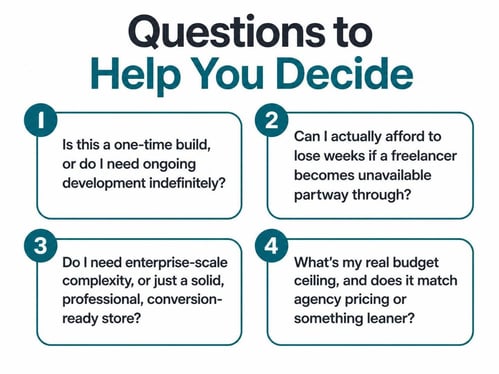
Questions to Help You Decide
- Is this a one-time build, or do I need ongoing development indefinitely?
- Can I actually afford to lose weeks if a freelancer becomes unavailable partway through?
- Do I need enterprise-scale complexity, or just a solid, professional, conversion-ready store?
- What's my real budget ceiling, and does it match agency pricing or something leaner?
The Cost of Getting This Decision Wrong
The real cost of picking the wrong option isn't always obvious upfront. A freelancer who underbids and then disappears leaves you needing to find, brief, and pay a new developer to pick up unfamiliar half-finished work, often costing more in total than a realistic quote would have from the start. An agency hired for a simple project that never needed that much overhead means paying for account management and review cycles that added zero real value to the outcome. Matching the option to the actual complexity and stakes of your project, instead of defaulting to whatever feels familiar or came recommended by a friend, is what actually protects your budget and timeline.
How to Vet Any Option Before Committing
Whichever path you're leaning toward, the vetting process should look pretty similar: ask for a portfolio of live, currently operating stores in a similar category or scale to yours, get a flat or clearly itemized quote instead of an open-ended estimate, confirm a specific delivery timeline in days or weeks, and get commitments on post-launch support and code ownership in writing before any money changes hands. Amwhiz's own Shopify store audit checklist is a decent reference point for what "quality" should actually mean once you're looking at a finished build.
Frequently Asked Questions
Is a freelancer always riskier than an agency?
Not always. A well-vetted, experienced freelancer with a strong portfolio can be perfectly reliable. But there's no built-in backup if something goes wrong, which is what agencies and studios with real team structure give you.
When does hiring in-house make sense for a Shopify store?
Generally once you've got continuous, high-volume development needs, frequent new features, ongoing custom app maintenance, rather than a single launch project you'll finish and move on from.
Why is Amwhiz's pricing lower than typical agencies?
A standardized, efficient build process scoped for what most stores actually need, minus the overhead of large account management teams or extended review cycles that drive traditional agency pricing up.
Does a faster timeline mean lower quality?
Not when the speed comes from process efficiency instead of skipped steps. Amwhiz's 7-day builds still include full testing of checkout, payments, and mobile responsiveness before anything launches.
How do I know if a "lean studio" is actually reliable, and not just cheap?
Look for the same signals you'd want from an agency: a live portfolio, clear pricing, defined timelines, written commitments on ownership and support. Reliability comes from process, not from how big the company is.
What if my project genuinely needs ongoing, continuous development?
That's exactly the scenario where in-house hiring or a retained agency relationship makes more sense. Project-based models like Amwhiz's are built for defined-scope launches, not indefinite ongoing work.
Skip the Trade-off
Most stores don't actually need to choose between speed, reliability, and cost. They just haven't found the option built for all three at once. Amwhiz delivers a fully tested, sales-focused Shopify store at a flat rate in 7 days. Reach out and let's see if it's the right fit for your project.