-1.png?width=134&height=66&name=amwhiz-logo%20(1)-1.png)



Why B2B Ecommerce in GCC Is Growing but Still Complex The GCC region including UAE, Saudi Arabia,...
written by: Renuka M
GCC Ecommerce,
Middle East Wholesale,
B2B Ecommerce GCC,
Credit Based Commerce,
Shopify B2B,
Multi Vendor Marketplace,
Marketplace Automation
Why Shopify Needs to Go Beyond a Single Store Model
Shopify is one of the most powerful ecommerce platforms, but by default it is built for single brand retail stores.
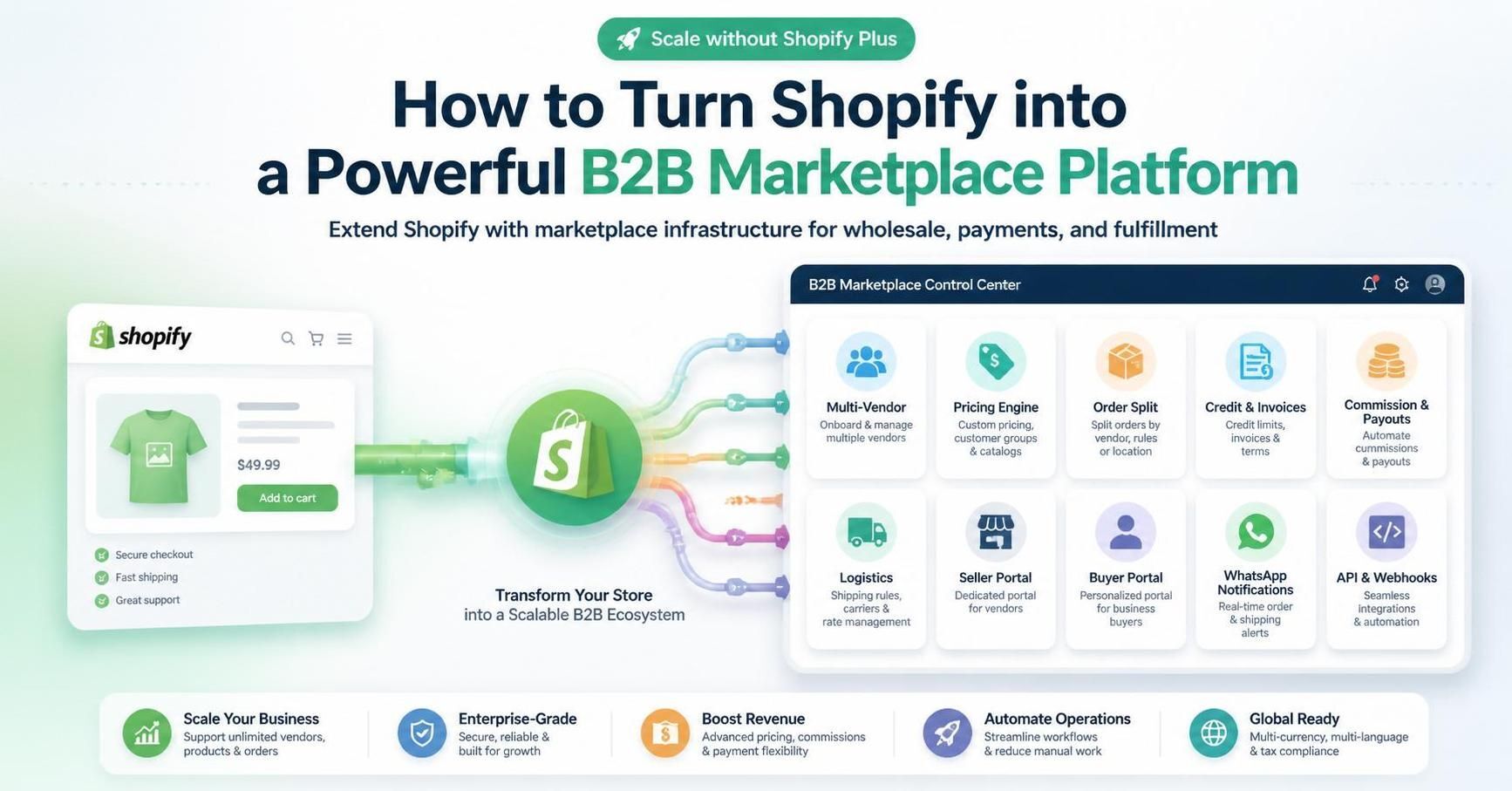
Modern B2B businesses need something more advanced. They need a multi vendor marketplace system that can handle:
- Wholesale pricing
- Multiple sellers
- Credit based payments
- Commission automation
- Order splitting
- Seller payouts
This is why many businesses extend Shopify into a full B2B marketplace platform instead of using it as a simple store.
Understand What a Shopify Marketplace Really Is
A Shopify marketplace is not just a store with products. It is an ecosystem where:
- Multiple sellers operate under one platform
- Buyers purchase from different vendors in one checkout
- Orders are split automatically by seller
- Platform earns commission on transactions
This transforms Shopify from a store into a digital distribution network.
Add Multi Vendor Marketplace Capability
The first step is enabling multi seller functionality.
You need to implement:
- Seller registration system
- Seller approval workflow
- Vendor dashboards
- Product upload and management tools
This allows multiple businesses to operate inside one Shopify ecosystem.
Platforms like TradeBridge by Amwhiz Media Private Limited help extend Shopify into a fully functional multi vendor marketplace system.
Build a Strong B2B Pricing Engine
B2B pricing is not fixed. It is dynamic and relationship based.
A strong system must support:
- Customer specific pricing
- Tier based pricing such as reseller and distributor levels
- Volume based discounts
- Minimum order quantity rules
This ensures flexible pricing for different buyer segments.
Enable Credit Based Commerce
One of the most important features in B2B is buy now pay later functionality.
Your system should support:
- Net 15, Net 30, Net 60 payment terms
- Credit limit controls per buyer
- Invoice generation
- Outstanding balance tracking
This makes Shopify suitable for enterprise wholesale operations.
Implement Order Splitting Logic
In a marketplace, a single order may include products from multiple sellers.
To handle this you need:
- Automatic order splitting
- Seller specific fulfilment workflows
- Separate tracking numbers per seller
- Unified order view for buyers
This removes operational confusion and improves delivery efficiency.
Create Dedicated Seller and Buyer Portals
A scalable marketplace needs separated experiences.
Seller Portal includes:
- Product management
- Inventory tracking
- Order fulfilment
- Earnings and payout tracking
Buyer Portal includes:
- Company registration
- Wholesale ordering
- Invoice downloads
- Order tracking
This improves usability and operational clarity.
Automate Commission and Payout Systems
A marketplace cannot scale without automation in finance.
You need a system that supports:
- Flat commission models
- Category based commissions
- Product level commission rules
- Seller wallet system
- Automated payout scheduling
This ensures transparent and scalable revenue management.
Integrate Logistics and Fulfilment Systems
B2B ecommerce requires strong logistics coordination.
You should include:
- Multi carrier integration
- Real time shipment tracking
- Split shipment handling
- Regional delivery optimization
This is especially important for cross border markets like GCC.
Add Communication Automation
Modern marketplaces rely on real time communication.
You should implement:
- WhatsApp order notifications
- Email alerts
- Payment reminders
- Shipment updates
This improves engagement and reduces manual coordination.
Use API Driven Architecture for Scalability
To make Shopify work as a marketplace, backend systems must handle complexity using:
- APIs
- Webhooks
- Cloud infrastructure
- Real time synchronization
This ensures Shopify focuses on storefront while backend systems manage operations.
Optimize for GCC and Global B2B Markets
If you are targeting GCC or international markets, your system must support:
- Arabic and English languages
- VAT and tax compliance
- COD workflows
- Regional logistics integrations
This ensures global readiness for B2B scaling.
Why TradeBridge Is Important in This Transformation
Instead of building everything from scratch, platforms like TradeBridge by Amwhiz Media Private Limited help businesses convert Shopify into a full B2B marketplace system.
It enables:
- Multi vendor infrastructure
- Automated commissions
- Seller and buyer portals
- Credit based workflows
- Order splitting engine
- Marketplace analytics
This reduces development time and accelerates launch speed.
Conclusion
Turning Shopify into a powerful B2B marketplace platform requires more than simple apps. It requires a complete system that manages sellers, buyers, pricing, logistics, and financial automation.
With the right architecture and solutions like TradeBridge by Amwhiz Media Private Limited, businesses can scale faster and operate more efficiently in 2026.