


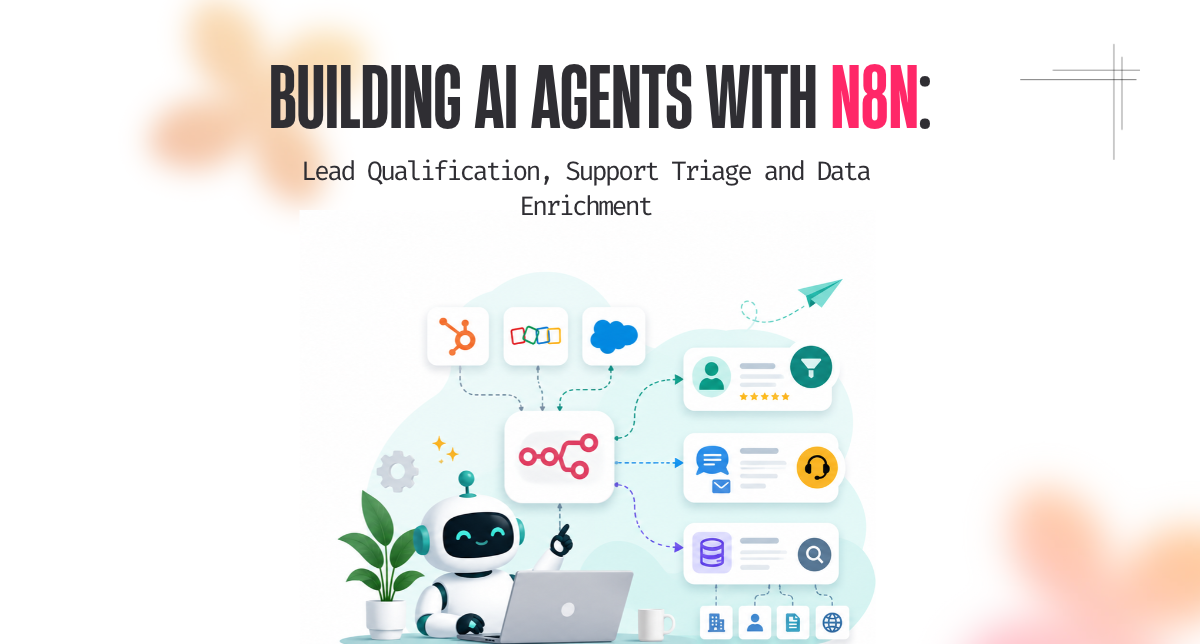
An n8n AI agent is a workflow step where a large language model, such as an OpenAI, Anthropic or Google model, reads incoming data, decides which tools to use and takes action, for example scoring a lead or routing a ticket. The three most practical first builds are lead qualification, support triage and data enrichment, and each typically takes 1–4 weeks to design, test and launch with human approval on sensitive actions.
The value of building agents in n8n is that the AI sits inside the same workflow as your CRM, helpdesk and messaging tools. This guide explains how n8n agents work, walks through the three builds step by step, and shows the human-in-the-loop controls that keep AI decisions safe.
Key takeaways
- Agents are workflows with judgement: an n8n AI agent combines a chat model, instructions, memory and tools inside a normal workflow.
- Start narrow: lead qualification, support triage and data enrichment have clear inputs, outputs and success measures.
- Keep people in control: n8n can pause for human approval before an agent runs a sensitive tool, via Slack, email, WhatsApp and more.
- Test before trusting: use evaluations with real examples and log every decision before you let an agent act on its own.
What is an n8n AI agent?
An n8n AI agent is a node that gives a language model a goal, instructions and a set of tools, then lets it decide which tools to call to reach that goal. According to n8n’s guide to building agents, an agent is made of four parts:
- Model: the language model that reasons and writes responses
- Instructions: the system prompt that sets role, tone and limits
- Tools: actions the agent can take, such as CRM nodes, sub-workflows or custom code
- Memory: context kept within a conversation or across sessions
The difference from a plain OpenAI workflow step is autonomy. A single prompt returns text; an agent can look up a record, call an API, check the result and decide what to do next. That flexibility is also why guardrails matter.
How do you build an AI lead qualification agent in n8n?
A lead qualification agent reads each new lead, researches it and scores it against your ideal customer profile, then routes it. It works best on top of clear CRM rules, like those in our guide to building a lead qualification engine in HubSpot.
- Trigger: a new form submission or CRM lead starts the workflow.
- Enrich: tools fetch the company website, size and industry from an enrichment API.
- Reason: the agent compares the lead with your ICP and returns a score, a reason and a recommended owner as structured output.
- Act: n8n writes the score and reason to HubSpot, Zoho or Salesforce and assigns the owner.
- Review: borderline scores go to a sales manager for approval before routing.
Ask the agent to always explain its score in one or two sentences. Sales teams trust scores they can read, and the reasons make errors easy to spot.
How do you build a support triage agent in n8n?
A support triage agent reads incoming emails, chat or WhatsApp messages, identifies the customer and intent, and either drafts a reply or routes the ticket. Our AI customer support for a fragrance brand shows this pattern in ecommerce.
| Intent | Agent action | Human step |
|---|---|---|
| Order status | Look up order, draft reply | Auto-send if order found |
| Refund or return | Collect details, create ticket | Support lead approves refund |
| Product question | Answer from knowledge base | Review low-confidence answers |
| Complaint or legal | Summarise and escalate | Always handled by a person |
Connect the agent to messaging through a proper WhatsApp Business API integration so replies use approved templates and stay within Meta’s messaging rules.
How do you build a data enrichment agent in n8n?
A data enrichment agent fills gaps and fixes messy records at scale. Typical jobs include standardising job titles, classifying companies by industry, extracting fields from documents and matching duplicates that share no email address.
Run it in batches on a schedule, write changes to a staging field first, and let a person approve bulk updates before they overwrite live CRM data. Our work on AI automation for insurance claims processing used a similar extract, check and update pattern.
How does human-in-the-loop work for n8n AI agents?
Human-in-the-loop means the workflow pauses before the agent runs a sensitive tool, and a person approves or rejects the action. n8n’s documentation on human-in-the-loop for AI tool calls explains that the reviewer sees the tool name and parameters; if approved the tool runs, and if denied the action is cancelled and the agent is told.
Approval requests can be sent through n8n Chat, Slack, Microsoft Teams, Discord, Telegram, Google Chat, Gmail, Outlook or WhatsApp Business Cloud. Use approvals for these actions:
- Sending messages to customers or prospects
- Issuing refunds, discounts or credits
- Deleting or bulk-updating CRM records
- Changing deal stages, owners or contract values
Some newer agent features are marked as preview in n8n’s docs at the time of writing, so confirm the status of any feature you depend on before go-live.
How much does it cost to build an n8n AI agent?
Costs come from three places: the build, the n8n plan or server, and model usage billed by your AI provider per token. For short classification and routing tasks, model costs are usually small compared with the build.
| Scope | Typical build cost | Timeline |
|---|---|---|
| Single-purpose agent, one CRM | USD 2,000–6,000 | 1–2 weeks |
| Agent with approvals and several tools | USD 5,000–12,000 | 2–4 weeks |
| Multi-agent support or sales system | USD 12,000–25,000+ | 4–8 weeks |
How do you keep an n8n AI agent accurate and safe?
Treat an agent like a new team member: give it narrow tasks, check its work and widen its scope as it proves itself. n8n’s evaluations feature lets you test agent output against a set of known examples before and after each change.
- Use structured outputs so the agent returns fields, not free text
- Limit tools to what the task needs, with read-only access where possible
- Log every decision, input and tool call for audit
- Keep customer data in your region, or self-host n8n, where regulation requires it
If you run HubSpot, compare an n8n agent with HubSpot’s native options in our complete guide to HubSpot Breeze AI; native agents are often simpler when the work stays inside HubSpot.
Why choose Amwhiz for n8n AI agents?
Amwhiz is a HubSpot Diamond Solutions Partner, a Shopify Partner and a Zoho Authorized Partner, so our AI agents are built around the CRM and commerce systems where your data lives. Our in-house developers design agents with narrow scopes, approval steps, logging and evaluations, and hand over clear documentation. When an agent needs deeper system access, we pair it with custom HubSpot integration services.
Want an AI agent that qualifies leads or triages support with a human in control? Talk to our AI workflow automation and integration team.
See what you could automate
Book a free 30-minute call and we will map the workflows that would save your team the most hours.
Book a free consultationFrequently asked questions
What is an AI agent in n8n?
It is a workflow node that gives a language model instructions, memory and tools, so it can decide which actions to take to reach a goal. It runs inside a normal n8n workflow alongside your other apps.
Which AI models can n8n agents use?
n8n supports chat models from providers such as OpenAI, Anthropic and Google, as well as locally hosted models. You choose the model when you set up the agent and can change it later.
Can n8n AI agents ask for human approval?
Yes. n8n can pause before an agent runs a tool and send an approval request through channels such as Slack, email, Microsoft Teams or WhatsApp. If the reviewer denies it, the action is cancelled.
Is it safe to connect an AI agent to my CRM?
It can be, with the right controls. Limit the agent’s tools and permissions, require approval for writes that matter, log every action and test with evaluations before going live.
Do I need an AI automation agency to build n8n agents?
Not for simple experiments. For agents that touch customer data, CRMs or payments, a partner with integration experience helps you design guardrails, testing and monitoring from the start.


