-1.png?width=134&height=66&name=amwhiz-logo%20(1)-1.png)


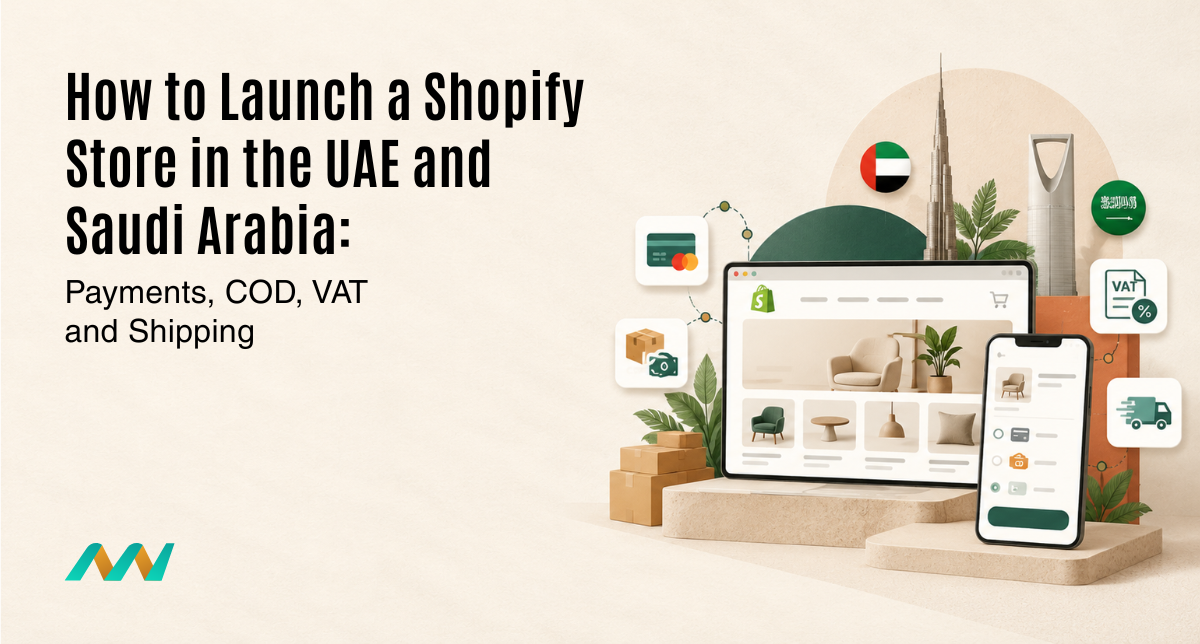
To launch a Shopify store in the UAE and Saudi Arabia, you need a GCC-ready payment stack (cards, Apple Pay, Mada in KSA, plus Tabby or Tamara for buy now, pay later), cash on delivery rules, correct VAT setup at 5% in the UAE and 15% in Saudi Arabia, an Arabic right-to-left storefront and local couriers. Most well-scoped GCC launches take 4–10 weeks from kickoff to go-live.
The platform is the easy part. What decides conversion in the Gulf is how customers pay, how fast parcels arrive and whether the store feels local. This guide covers each decision in the order we tackle it on Shopify store builds for GCC brands.
Key takeaways
- Payments differ by country: Shopify Payments is available in the UAE, but Saudi stores need a third-party gateway for cards and Mada.
- BNPL is expected: Tabby supports Shopify stores selling to the UAE and KSA, and should be hidden for customers outside those markets.
- COD needs rules: cash on delivery still matters, so control it with payment customizations, order limits and WhatsApp confirmation.
- Tax and language are launch blockers: set VAT at 5% (UAE) and 15% (KSA), and use a theme that fully supports Arabic right-to-left layouts.
Can you use Shopify in the UAE and Saudi Arabia?
Yes. Shopify is fully available to merchants in both countries, and many regional D2C brands run on it. The main differences between the two markets are payments, tax rules and customer expectations around delivery and COD.
If you are weighing a local build partner, our guide to ecommerce website development in Dubai explains what to expect from agencies in the region. The rest of this post focuses on the Shopify decisions that matter most for a GCC launch.
Which payment gateways work for Shopify in the UAE and Saudi Arabia?
In the UAE, Shopify Payments is available and supports credit and debit cards plus accelerated checkouts. Shopify lists the details on its Shopify Payments for the UAE page. Using Shopify Payments also avoids the extra transaction fee Shopify charges when you use a third-party gateway.
Saudi Arabia is not on Shopify’s list of Shopify Payments countries at the time of writing, so Saudi-registered stores use a third-party payment provider. Choose one that supports Mada, Apple Pay and SAR settlement, and check that its Shopify app is current before you commit.
| Need | UAE | Saudi Arabia |
|---|---|---|
| Cards and Apple Pay | Shopify Payments or a regional gateway | Third-party gateway |
| Local debit scheme | Not usually required | Mada via your gateway |
| Buy now, pay later | Tabby, Tamara | Tabby, Tamara |
| Cash on delivery | Manual payment method with rules | Manual payment method with rules |
| Settlement currency | AED | SAR |
How do you add Tabby and Tamara to Shopify?
Tabby and Tamara are the two main buy now, pay later providers in the Gulf, and both offer Shopify apps. Shoppers expect to see them on product pages and at checkout, especially for fashion, beauty and electronics.
Tabby’s Shopify installation guide walks through the setup. Key points to plan for:
- Tabby processes payments in AED and SAR and accepts orders only for billing addresses in the UAE and KSA
- Hide the method for other countries with a checkout payment customization so customers don’t hit errors
- Make the phone number a required field in shipping address settings
- Configure the required webhooks on the latest API version and disable test mode before launch
- Add on-site messaging to product pages so the instalment price is visible before checkout
Running both providers is common. Order them at checkout by average order value and approval rates once you have a few weeks of data.
How should you handle cash on delivery on Shopify in the GCC?
Cash on delivery is still expected by many Gulf shoppers, especially in Saudi Arabia and for first-time buyers. In Shopify you enable it as a manual payment method, then control it so it doesn’t drive up failed deliveries and returns.
- Enable COD as a manual payment method only for the markets that need it
- Hide COD above a set order value or for high-risk products using a payment customization
- Confirm every COD order on WhatsApp before dispatch, and cancel unconfirmed orders automatically
- Offer a small prepaid incentive, such as free shipping, to shift buyers to card or BNPL
- Track COD refusal rates by city and courier, and adjust rules monthly
WhatsApp confirmation is the single biggest lever for COD. See how we used it in our GCC WhatsApp commerce automation case study, and how the same channel supports WhatsApp automation for Shopify sales and support.
How do you set up VAT for a Shopify store in the UAE and Saudi Arabia?
The standard VAT rate is 5% in the UAE and 15% in Saudi Arabia. Both countries require mandatory VAT registration once taxable supplies pass 375,000 in local currency, and GCC shoppers expect prices to be shown including VAT.
- Set up separate Shopify Markets for the UAE and KSA with tax-inclusive pricing
- Enter your VAT registration numbers and check rates on test orders before launch
- Show your VAT number on invoices and in store policies
- Plan e-invoicing early: Saudi Arabia’s FATOORA rules already apply to VAT-registered businesses, and UAE e-invoicing becomes mandatory in phases starting 2027
Shopify calculates and displays tax, but it doesn’t file returns or issue ZATCA-compliant e-invoices on its own. Most brands connect Shopify to an accounting or ERP system that handles compliant invoicing. ZATCA publishes the rules on its e-invoicing portal.
How do you build an Arabic and right-to-left Shopify storefront?
An Arabic storefront needs more than translated text. Layouts, icons, sliders and number formats must mirror correctly in right-to-left mode, and many third-party apps break when they do not support RTL.
- Choose a theme that supports RTL languages and test every template in Arabic
- Translate product data, checkout text, notifications and policies, not just navigation
- Use Arabic-friendly fonts and check line heights on mobile
- Add country-specific checkout fields, such as a national address or landmark, where couriers need them
Checkout needs the same care. Our guide to optimising Shopify checkout for international markets covers localisation, and our country-specific checkout field case study shows how extra address data can be collected cleanly.
Which couriers should a Shopify store use in the UAE and Saudi Arabia?
Most GCC stores use a mix of a regional network courier for nationwide coverage and a same-day or next-day partner in major cities. Aramex, SMSA Express and Naqel are widely used for Saudi and cross-GCC delivery, while UAE stores often add a local same-day provider for Dubai and Abu Dhabi.
Pick couriers on COD cash remittance speed, failed-delivery handling and API quality, not just rate cards. A proper Shopify shipping integration with your couriers automates labels, tracking and COD reconciliation, which saves hours of manual work every week once order volume grows.
How long does a Shopify GCC launch take and what does it cost?
A single-country GCC store typically takes 4–6 weeks; a UAE plus KSA launch with Arabic, multiple gateways and courier integrations usually takes 6–10 weeks. Partner fees vary widely with design and integration scope.
| Scope | Includes | Timeline | Typical cost (USD) |
|---|---|---|---|
| Starter | Theme setup, one market, gateway, COD | 4–6 weeks | 3,000–8,000 |
| Growth | UAE and KSA, Arabic RTL, BNPL, courier apps | 6–8 weeks | 8,000–20,000 |
| Advanced | Custom theme, ERP and courier integrations, WhatsApp | 8–10+ weeks | 20,000–50,000+ |
Brands planning to expand beyond the Gulf later should design markets and catalogs for scale from the start, as we did in our Shopify multi-market architecture project.
Why choose Amwhiz for your Shopify UAE and Saudi launch?
Amwhiz is a Shopify Partner working with clients across the Middle East and GCC. Our in-house developers handle the parts that usually slow Gulf launches down: payment gateways and BNPL, COD rules, Arabic RTL themes, courier integrations and WhatsApp commerce. You get one team for the store, the checkout logic and the integrations behind it.
Planning a Gulf launch? Talk to Amwhiz about Shopify development for the UAE and Saudi Arabia and get a launch plan within a week.
Talk to a Shopify developer
Book a free 30-minute call with our Shopify team to review your store and plan the next build.
Book a free consultationFrequently asked questions
Is Shopify Payments available in the UAE?
Yes. Shopify Payments is available in the UAE and supports credit and debit cards and accelerated checkouts. At the time of writing it is not available in Saudi Arabia, so Saudi stores use a third-party gateway.
Can I offer cash on delivery on Shopify in the UAE?
Yes. You add COD as a manual payment method. Most stores then limit it by order value or product and confirm COD orders on WhatsApp to reduce failed deliveries.
Does Tabby work with Shopify?
Yes. Tabby has a Shopify payment app for stores selling to customers in the UAE and Saudi Arabia, with payments in AED and SAR. Tamara also offers a Shopify integration.
What VAT rate should a Shopify store charge in the UAE and Saudi Arabia?
The standard VAT rate is 5% in the UAE and 15% in Saudi Arabia. Prices are usually shown including VAT, and each market should be set up separately in Shopify.
Can a Shopify store be in Arabic?
Yes. You can translate your storefront into Arabic and use a theme that supports right-to-left layouts. Test every page, app and checkout step in Arabic before launch.