-1.png?width=134&height=66&name=amwhiz-logo%20(1)-1.png)



Introduction Canadian tax compliance just got easier for vape product sellers. On April 17, 2026,...
written by: Renuka M
GST PST QST Shopify,
Shopify Tax Canada,
Ecommerce Tax Automation,
Shopify PST Calculator,
Canadian Ecommerce Tax,
Shopify Tax 2026,
Canadian Tax Compliance,
Shopify Canada Update,
Shopify GST Compliance,
Shopify Ecommerce Solutions
Managing ecommerce taxes in Canada has never been simple.
For Shopify merchants selling across provinces, Canadian tax compliance often becomes one of the most time consuming and frustrating parts of running an online business. Between GST, HST, PST, QST, and RST, many businesses struggle to calculate taxes correctly, stay compliant with provincial regulations, and avoid costly reporting mistakes.
Most merchants either spend hours manually managing tax calculations or rely on outdated setups that create compliance risks as they scale.
Now, Shopify has introduced a major update that could completely change how Canadian ecommerce businesses manage taxes.
On May 13, 2026, Shopify officially expanded Shopify Tax Canada, bringing advanced automated tax calculations, smarter product categorization, and province level compliance insights directly into the Shopify ecosystem.
For Canadian ecommerce businesses, this is more than just a feature update. It is a major operational improvement that helps merchants reduce errors, save time, and scale more confidently.
Why Ecommerce Tax Compliance in Canada Is So Complicated
Unlike countries with a single nationwide sales tax system, Canada uses multiple provincial tax structures.
Depending on where customers are located, merchants may need to collect:
- GST (Goods and Services Tax)
- HST (Harmonized Sales Tax)
- PST (Provincial Sales Tax)
- QST (Quebec Sales Tax)
- RST (Retail Sales Tax)
Every province has different rules, thresholds, and reporting requirements.
The complexity becomes even greater when product specific tax rules are involved.
For example:
- A single donut may be considered a taxable snack
- Six donuts may qualify as a zero rated grocery product
These classifications are part of actual Canadian tax regulations.
Without proper categorization, merchants risk:
- Overcharging customers
- Underpaying taxes
- Filing incorrect reports
- Triggering compliance penalties
- Creating accounting inconsistencies
Shipping taxes add another layer of complexity, especially for mixed product orders that contain both taxable and zero rated items.
For growing ecommerce brands, managing all of this manually can quickly become unsustainable.
What Shopify Tax for Canada Actually Changes
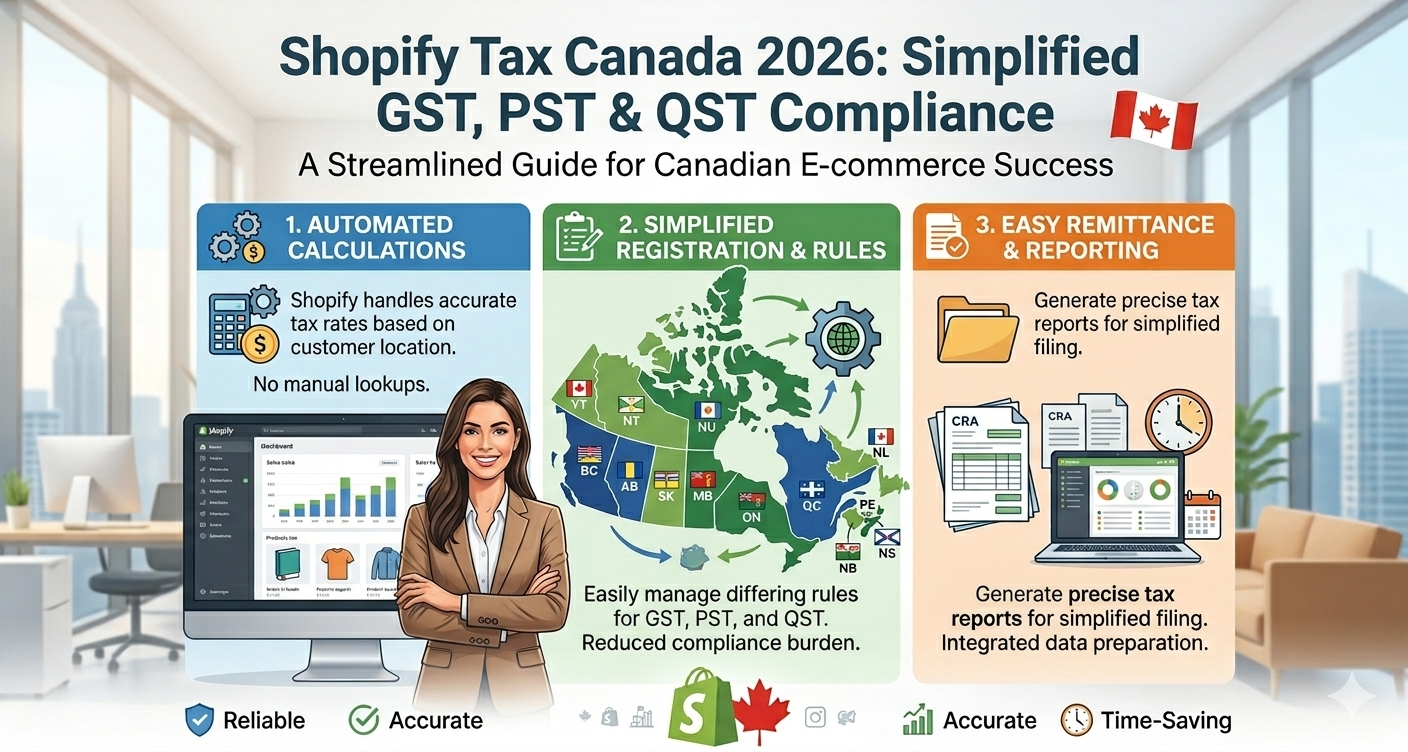
1. Automatic Provincial Tax Calculations
One of the biggest updates is Shopify’s ability to automatically calculate provincial taxes based on the customer’s location.
Shopify Tax Canada now supports:
- GST
- HST
- PST
- QST
- RST
The platform automatically applies the correct rates during checkout and displays each tax separately for improved transparency.
This helps merchants:
- Reduce manual tax setup
- Improve checkout accuracy
- Stay compliant across provinces
- Create better customer trust
Instead of managing complicated tax rules manually, Shopify handles calculations automatically in the background.
2. Smart Product Tax Categorization
Tax categorization can be one of the most confusing parts of Canadian ecommerce tax compliance.
Different products follow different taxation rules, and many merchants struggle to identify the correct categories.
Shopify now automatically suggests appropriate product tax categories based on Canadian tax regulations.
This feature helps merchants simplify compliance for:
- Food products
- Grocery items
- Apparel
- Tax exempt products
- Province specific product rules
Rather than researching every tax scenario manually, merchants can use Shopify’s recommendations to improve tax accuracy and reduce operational errors.
3. Smarter Shipping Tax Calculations
Shipping taxes have traditionally created major accounting challenges for ecommerce businesses.
Mixed tax rate orders often require complicated manual adjustments.
With Shopify’s latest update, shipping taxes are now automatically calculated according to the tax status of each product within the order.
This means:
- Zero rated products remain tax free
- Taxable products maintain proper tax calculations
- Mixed orders calculate correctly
- Manual shipping tax corrections become unnecessary
For merchants processing large order volumes, this can significantly reduce accounting complexity and reporting issues.
4. Province Level Tax Liability Insights
One of the most valuable additions is Shopify’s province level tax liability analysis.
Shopify now reviews your sales activity and compares it against provincial tax registration thresholds.
Merchants can identify:
- Which provinces require tax registration
- Where compliance obligations exist
- When tax collection responsibilities begin
- Which regions need immediate attention
This transforms tax management from a reactive process into a proactive compliance strategy.
Instead of discovering tax issues after receiving notices or penalties, merchants gain visibility before problems occur.
Why This Matters for Canadian Shopify Merchants
For businesses operating across multiple provinces, this update delivers both operational and financial advantages.
Shopify Tax helps reduce:
- Manual tax calculation errors
- Compliance risks
- Spreadsheet dependency
- Administrative workload
- Tax reporting confusion
- Provincial filing surprises
While improving:
- Checkout transparency
- Customer confidence
- Business scalability
- Tax reporting accuracy
- Operational efficiency
As ecommerce businesses grow, manual tax processes become increasingly difficult to maintain. Automating compliance allows teams to focus more on growth and customer experience rather than backend administrative tasks.
The Real Impact on Ecommerce Growth
Tax complexity often becomes an invisible barrier to ecommerce expansion.
Many businesses hesitate to expand into additional provinces because managing tax obligations becomes difficult and time consuming.
With Shopify Tax for Canada, merchants can scale more confidently while maintaining accurate tax compliance.
This is especially important for:
- Multi province ecommerce brands
- High volume Shopify stores
- Subscription businesses
- DTC brands
- Businesses expanding nationwide
Automated tax management helps reduce operational friction while supporting long term growth.
How to Access Shopify Tax for Canada
New Shopify stores in Canada can access Shopify Tax Canada immediately.
Existing stores are receiving access gradually as Shopify continues its rollout process.
Merchants should:
- Check their Shopify admin dashboard
- Look for Shopify Tax notifications
- Contact Shopify support if access has not yet been enabled
Additional Canada focused ecommerce tax features are expected to be introduced in future Shopify updates.
Final Thoughts
Shopify’s expansion of Shopify Tax Canada solves one of the most complicated operational problems facing Canadian ecommerce merchants today.
By automating provincial tax calculations, improving product categorization, simplifying shipping taxes, and providing proactive compliance insights, Shopify is helping merchants reduce risk while saving valuable time.
For businesses currently handling ecommerce taxes manually, this update offers a smarter and more scalable approach to compliance management.
As Canadian ecommerce continues to grow, automation tools like Shopify Tax will become essential for maintaining operational efficiency and staying compliant across provinces.
Let’s Talk Ecommerce Growth
At Amwhiz , we help Shopify merchants build scalable, high performance ecommerce solutions designed for long term business growth.
Our Shopify experts can help you with:
- Shopify tax configuration
- Multi market ecommerce setup
- Checkout optimization
Whether you are launching a new store or scaling across multiple regions, our team can help simplify your ecommerce operations.
Email: sales@amwhiz.com
Discussion Point: What is the biggest tax compliance challenge your ecommerce business currently faces in Canada?