-1.png?width=134&height=66&name=amwhiz-logo%20(1)-1.png)


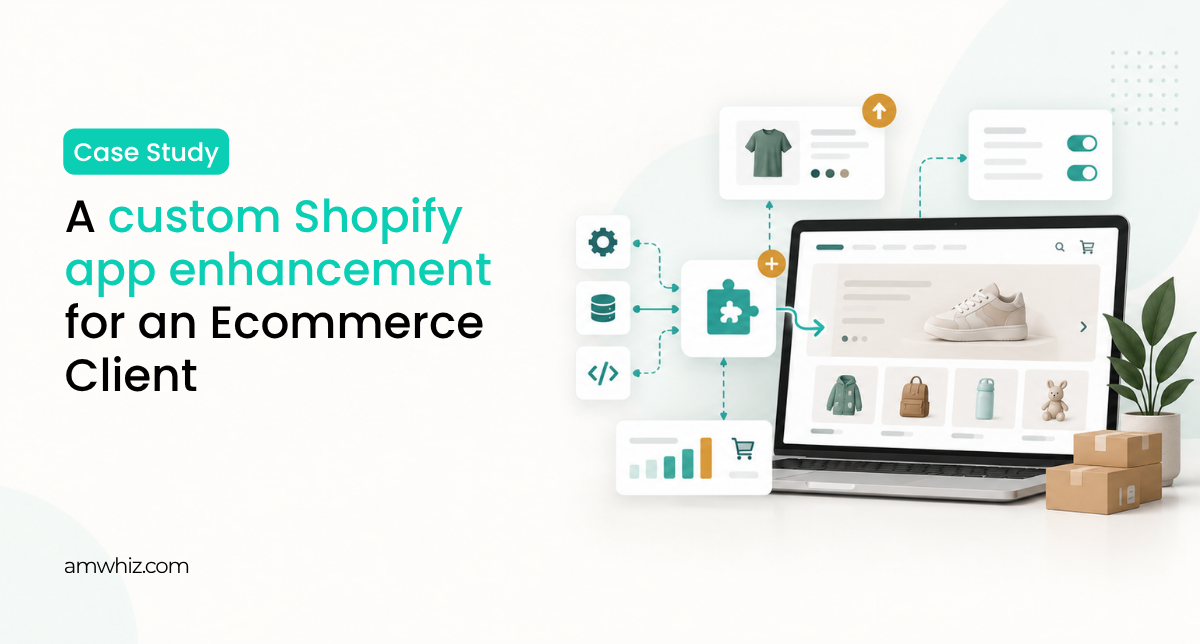

Quick answer: An ecommerce client wanted to build a new embedded Shopify app that uses AI to generate a complete store, branded landing pages, product pages, and theme sections, from a short merchant onboarding flow. Amwhiz positioned this against its own Shopify app studio, Zuperapps, where it has already built and published apps combining Shopify app architecture with AI integration and Billing API-based subscriptions.
What Was the Brief?
The client wanted to build a new embedded Shopify app similar to an existing AI store builder tool. The concept: merchants answer a few onboarding questions, and the app uses AI to generate a complete, high-converting store, including branded landing pages, product pages, and theme sections they can preview and publish directly to their store.
The scope included:
- An embedded Shopify app built with App Bridge and Polaris, using OAuth and the GraphQL Admin API
- An onboarding wizard connected to an AI generation flow through an LLM API
- A library of pre-built sections and templates merchants could apply, built on Online Store 2.0 app blocks
- A merchant dashboard with subscription plans, integrated with Shopify's Billing API
- A build capable of passing Shopify App Store review
How Did Amwhiz Approach the Project?
Amwhiz also runs Zuperapps, its own Shopify app studio, so an AI-driven embedded app like this sits right at the intersection of what the team already builds: Shopify app architecture plus AI integration, rather than two separate skill sets bolted together for this one project.
At Zuperapps, Amwhiz has built and published four public Shopify apps, including two built on Shopify Functions with full Billing API integration for tiered subscription plans, along with four custom merchant apps, all working within Polaris and App Bridge conventions.
Given the real scope of this project, the AI generation flow, a live preview and editor, a template library, billing, and App Store review, Amwhiz proposed a short scoping call before committing to a fixed timeline, since a build like this typically breaks into distinct milestones, starting with the app foundation before layering in generation, editing, and billing.
What Would the Technical Approach Look Like?
The proposed stack combined Remix, Polaris, and App Bridge for the embedded app shell, the GraphQL Admin API for store data, Online Store 2.0 app blocks for the template library, Shopify's Billing API for subscriptions, and an LLM API, either Claude or GPT depending on the client's preference and cost targets, for the generation engine itself.
Amwhiz proposed leading development personally as the primary developer, with design and QA support from its team as needed, so the client would have one consistent technical owner throughout the project rather than a rotating cast of contributors.
Before finalizing scope, Amwhiz asked which LLM the client was leaning toward for the generation engine, and roughly how much control merchants should have to edit AI-generated output versus simply regenerating it, since that decision shapes how much of the editor needs to be built.
What Results Did the Project Aim to Deliver?
- Reduced manual work through automated, reliable data flow between systems
Conclusion
By scoping the work precisely against the brief and drawing on directly comparable past projects, Amwhiz helped move the engagement from an unfinished brief to a professional, ready-to-launch result.
Frequently Asked Questions
What does it take to build an embedded Shopify app?
An embedded Shopify app typically requires App Bridge and Polaris for the interface, OAuth for authentication, and the GraphQL Admin API to read and write store data, all built to meet Shopify App Store review requirements before it can be listed.
Can an AI generation engine be built directly into a Shopify app?
Yes. An onboarding flow can be connected to an LLM API, such as Claude or GPT, to generate content like landing pages, product pages, and theme sections, which merchants can then preview and either publish directly or edit before publishing.
How does Shopify's Billing API support subscription-based apps?
Shopify's Billing API lets an app charge merchants through tiered subscription plans directly within Shopify's own billing system, which avoids building separate payment infrastructure for the app itself.
Why does a complex Shopify app project need a scoping call before a fixed quote?
Projects that combine several distinct pieces, such as an AI generation engine, a live editor, a template library, and billing, usually need clearer requirements on scope and decision points, like which LLM to use and how much editing control to offer merchants, before a fixed timeline or price makes sense.
Start Your Shopify App Build
Building a Shopify app that combines AI with real store functionality? Connect with Amwhiz to scope a build tailored to your goals.
Email: sales@amwhiz.com | Phone: +91 91500 65500