-1.png?width=134&height=66&name=amwhiz-logo%20(1)-1.png)


How HubSpot’s Smart CRM Associations Improve Data Management As businesses grow, customer...
Building a Customer Success Process Using HubSpot Service Hub
You close a deal. Customer is excited. You hand them off to support. Then silence. No onboarding plan. No implementation timeline. No check ins. Six months later, customer is frustrated. Adoption is slow. They're thinking about canceling at renewal.
This is what happens without a customer success process. Sales closes deals. Customer success is reactive firefighting. Customers feel abandoned after purchase.
A customer success process built in HubSpot Service Hub changes everything. It's proactive. It keeps customers engaged and successful. It reduces churn. It increases net revenue retention. It turns customers into advocates.
Why Customer Success Determines Business Growth
Revenue growth comes from two sources: new customers and existing customers. Sales drives new customers. Customer success drives existing customers. If existing customers churn, you need constant new customers just to stay flat. If existing customers grow, you compound revenue.
Companies with strong customer success have lower churn, higher renewal rates, and higher net revenue retention. They grow faster with lower customer acquisition cost. Customer success is not just cost center. It's profit center.
The Customer Success Process Framework
Phase 1: Onboarding
Customer just signed. First 30 to 60 days are critical. Onboarding gets them live and successful quickly. Fast time to value. Clear implementation plan. Dedicated support. Regular check ins.
Phase 2: Adoption
Customer is live but adoption is slow. Some teams use it. Others don't. Your job is driving adoption. Training. Best practices. Helping teams see value. Moving from pilot to production.
Phase 3: Expansion
Customer is successful with core product. Now expand. New departments use it. New features get implemented. Upsell opportunities. Expansion revenue grows account value.
Phase 4: Renewal
Contract renewal approaching. Customer is happy. Adoption is strong. Expansion has grown their usage. Renewal is easy. Or customer is struggling. Renewal is at risk. Your job is preventing churn and closing renewal.
Phase 5: Advocacy
Customer is thriving. They're your biggest advocate. They give referrals. They give case studies. They recommend you to peers. Advocacy drives new business.
Setting Up Customer Success in HubSpot Service Hub
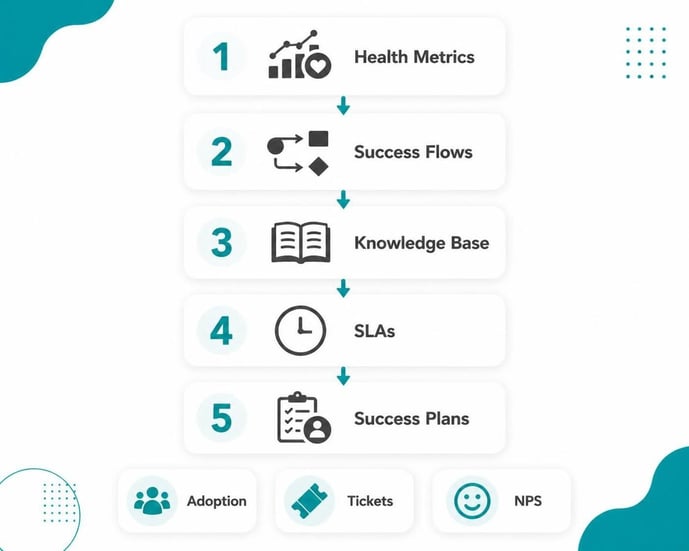
Step 1: Define Customer Health Metrics
What indicates a healthy customer? Feature adoption rate. Support ticket volume. Active users. Days since login. Revenue expansion. NPS score. Create a health score formula combining these metrics. Update it automatically.
Step 2: Create Customer Success Workflows
Onboarding workflow: send welcome email, schedule kickoff call, send training materials, check in at day 30, check in at day 60. Adoption workflow: track feature usage, send tips for low adoption features, schedule office hours. Renewal workflow: review health score, reach out to at risk customers, celebrate successful years.
Step 3: Build a Knowledge Base
Your customers need self service resources. How to set up features. How to troubleshoot issues. Best practices. FAQs. Build a knowledge base in Service Hub. Customers help themselves. Your team handles complex issues.
Step 4: Set Up Service Level Agreements (SLAs)
Define SLAs for support tickets. Enterprise customers get 1 hour response time. Mid market gets 4 hours. SMB gets 24 hours. Critical issues get escalated. SLAs keep support consistent and accountable.
Step 5: Create Success Planning Templates
Each customer gets a success plan. Business objectives for the next quarter. Metrics you're measuring. Milestones you're hitting. Success criteria. Customer success manager reviews it with customer at kickoff. Updates quarterly.
Customer Success Best Practices
Assign a Customer Success Manager
Enterprise customers need dedicated CSM. Mid market needs shared CSM. SMB can be managed via software and self service. But someone needs to own each customer relationship. Without ownership, customers fall through cracks.
Conduct Regular Business Reviews
Quarterly or semi annual. Review how customer is using product. Measure progress against success plan. Celebrate wins. Address challenges. Identify expansion opportunities. Show ROI customer is getting.
Monitor Health Scores Continuously
Don't wait for renewal to discover customer is unhappy. Monitor health scores weekly. If score drops, reach out. Understand what's wrong. Solve it proactively. Early intervention prevents churn.
Create a Knowledge Base of Best Practices
Most successful customers follow certain practices. Document those best practices. Share with new customers. Help customers avoid common mistakes. Best practices compound success.
Celebrate Customer Wins
Customers hit milestones. Departments go live. Adoption targets hit. Celebrate them. Send congratulations. Share success stories. Build emotional connection. Customers who feel appreciated stay loyal.
Common Customer Success Mistakes
Treating All Customers the Same
Enterprise customers need hands on support. SMB customers need efficient support. You can't give everyone the same attention. Segment customers by size or revenue. Give different levels of service.
No Onboarding Plan
Customer signs and gets nothing. No implementation plan. No training. No check ins. Customer struggles. By the time you reach out, customer is frustrated.
Only Reaching Out at Renewal
You ignore customer for six months. Only contact them at renewal. By then, they're already thinking about leaving. Stay engaged continuously. Check in monthly.
No Health Scoring
You don't know if customer is healthy or struggling. You react when they reach out or threaten to leave. With health scoring, you see problems early and intervene proactively.
Underinvesting in Knowledge Base
Customers call support with simple questions. Your team answers same questions over and over. Build a knowledge base. Customers help themselves. Your team handles complex issues. Everyone wins.
FAQ About Customer Success Process
How do I measure customer success?
Track key metrics: onboarding completion rate, time to live, feature adoption rate, support ticket volume, NPS score, churn rate, renewal rate, net revenue retention. These metrics show whether customers are successful and satisfied. Monthly tracking shows trends. Year over year comparison shows improvement. If churn is declining and net revenue retention is growing, your customer success process is working.
What's a good churn rate?
Varies by industry and segment. SaaS average is 5 percent monthly. Enterprise SaaS might be 1 to 2 percent. SMB might be 7 to 10 percent. Higher churn in SMB is normal because customers are price sensitive and might go out of business. Know your benchmark. If your churn is higher than benchmark, you have a problem. Invest in customer success to bring it down.
How do I calculate health score?
Combine multiple factors. Feature adoption rate: are customers using core features? (0 to 40 points). Support engagement: are they reaching out with questions? (0 to 20 points). Usage frequency: are active users growing or shrinking? (0 to 20 points). Revenue expansion: are they buying more? (0 to 20 points). NPS score: are they satisfied? (0 to 20 points). Red flags: have they mentioned leaving? (minus 50 points). Weight factors based on what matters most to your business. Automate calculation in HubSpot.
Should customer success report to sales or operations?
Ideally, customer success reports to a Chief Customer Officer or Chief Revenue Officer who oversees both sales and success. This aligns incentives. Sales owns new customers. Success owns existing customers. Both drive revenue. If forced to choose, customer success reports to operations. Reporting to sales creates incentive misalignment. Sales pushes growth. Success needs to push retention. Different goals require different reporting structures.
How do I prevent churn?
Proactive monitoring. When health score drops, reach out. Understand why customer is struggling. Help them succeed. Sometimes it's product issue that needs to be escalated to product team. Sometimes it's training issue that requires more support. Sometimes it's business issue where customer is restructuring. Tailor your response. Early intervention prevents most churn. Once customer says they're leaving, it's too late.
What should be in a customer success onboarding plan?
Kickoff meeting: align on objectives and timeline. Training: how to use product. Implementation: getting live. Quick wins: early successes to build confidence. Regular check ins: weekly or bi weekly. Success metrics: what success looks like. Escalation path: who to contact if problems. Timeline: 30, 60, 90 day milestones. Onboarding takes 60 to 90 days depending on product complexity. Document the plan. Share with customer. Stick to it.
How do I handle at risk customers?
Health score drops. Customer is at risk. Call them immediately. Don't email. Talk to them directly. Ask what's wrong. Listen. Understand their specific issue. Sometimes it's product. Sometimes it's implementation. Sometimes it's organizational change. Once you understand, help solve. Offer to bring in specialized resources. Offer discount on renewal if needed to save relationship. Not every at risk customer can be saved. But many can if you intervene early.
Should I have customer success for SMB customers?
Yes, but differently. You can't give each SMB customer dedicated CSM. But you can have scalable programs. Email onboarding sequences. Automated health monitoring. Self service knowledge base. Group webinars. Office hours for questions. SMB customers need help too. Just not one on one attention like enterprise customers.
How do I expand within existing accounts?
First, make customer successful with core product. Adoption has to be strong. Once they're successful, identify expansion opportunities. New departments that could use product. New features they haven't enabled. Upsell to higher tier. When customer is happy and successful, they're open to expansion. When customer is struggling, they won't expand. Success first, expansion second.
What's the difference between customer success and support?
Support is reactive. Customer has problem. Support helps solve it. Success is proactive. Success manager helps customer achieve their goals. Success uses support data as one input but proactively drives adoption and growth. Support handles tactical questions. Success handles strategic relationship. Both matter. Together they drive retention and growth.
Ready to Build a Customer Success Process?
Customer success is the difference between one time customers and lifetime customers. When you invest in customer success, churn decreases, renewal rates increase, and customers expand. Revenue compounds.
At Amwhiz, we're a HubSpot Diamond Solution Partner specializing in customer success strategy and Service Hub implementation.
Book a HubSpot consultation with Amwhiz today. We'll help you build a customer success process that drives retention and expansion.