-1.png?width=134&height=66&name=amwhiz-logo%20(1)-1.png)


Amwhiz, an authorized Zoho partner, builds complete customer journeys in Zoho Marketing Automation,...
Amwhiz, an authorized Zoho partner, builds hire to retire HR systems on Zoho, where the entire employee journey lives in one connected place. This guide explains what that actually means in practice, stage by stage, rather than as a buzzword.
What Is Hire to Retire HR?
The Short Answer
Hire to retire is the idea of managing the complete employee lifecycle, from the moment you start recruiting someone to the day they leave, in one connected system. In Zoho, that means Recruit for hiring, People for onboarding and ongoing HR, Payroll for pay, and the links between them, so an individual's data follows them through every stage without being re-entered. It replaces a patchwork of disconnected tools with a single, continuous journey.
The phrase matters because most HR pain comes from the gaps between stages. A candidate hired in one system, onboarded in another, paid in a third, with data re-keyed at each handover, is where errors and delays live. Hire to retire closes those gaps by making the whole lifecycle one flow.
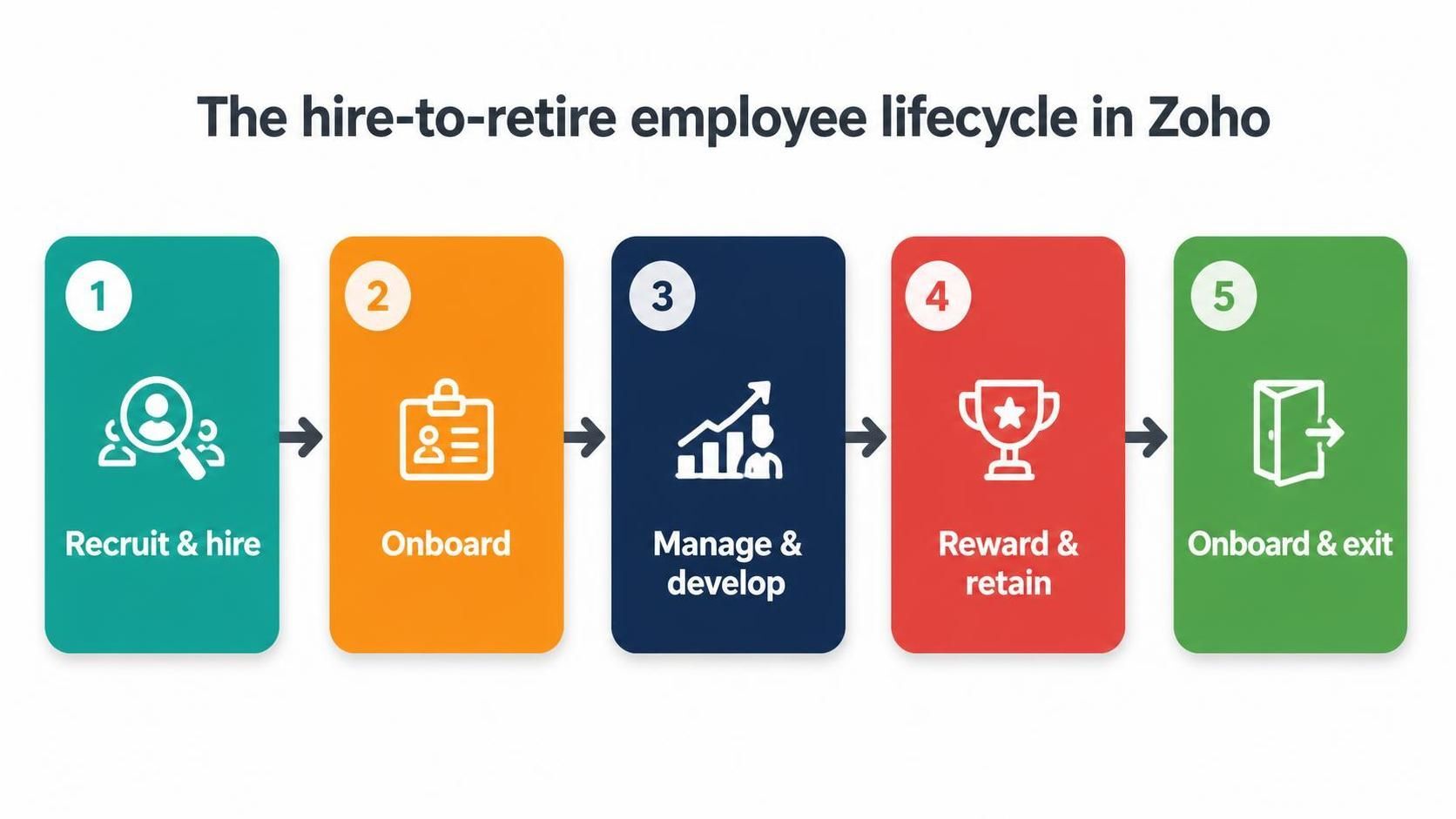
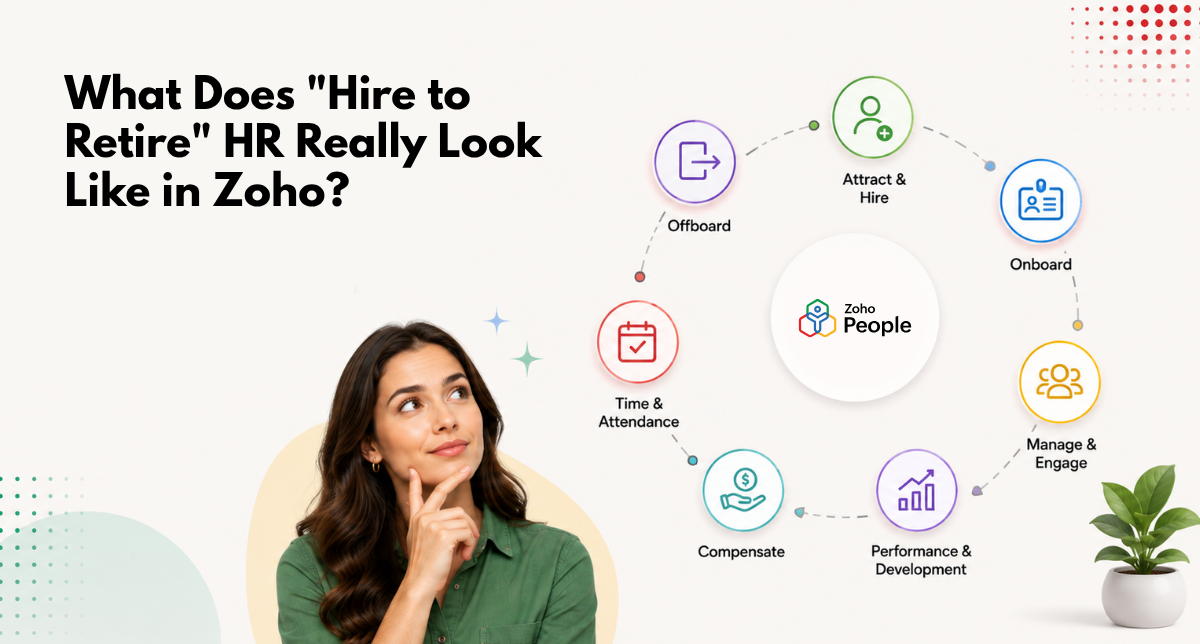
Zoho connects recruiting, onboarding, management, retention, and exit into one continuous journey.
Stage One: Recruit and Hire
The journey starts in Zoho Recruit, where you attract, track, and hire candidates. A structured pipeline replaces scattered spreadsheets and email, so no applicant is lost and every hiring decision is recorded. When an offer is accepted, the candidate's details are ready to flow forward rather than being typed again into a separate HR system.
This clean handover is the first proof that hire to retire is more than a slogan. The information captured during recruitment, from contact details to role and start date, becomes the starting point for onboarding, so the new employee's record is built once and carried forward.
Stage Two: Onboarding
In Zoho People, onboarding turns a new hire into a productive employee smoothly. Document collection, policy acknowledgements, equipment requests, and introductions can all be structured into a workflow, so nothing is forgotten and the new joiner has a professional first experience. A good onboarding process sets the tone for the whole relationship.
Because onboarding builds directly on the recruitment data, HR is not starting from a blank page. The employee record grows naturally from candidate to team member, and the new hire is not asked to re-supply information they already gave during hiring.
.jpeg?width=1672&height=941&name=Duck-ai-image-2026-08-04-08-46%20(1).jpeg)
Recruit, onboarding, attendance, performance, payroll, and exit all share one employee record.
Stage Three: Manage and Develop
The longest stage is the working relationship itself. Zoho People manages leave, attendance, records, and performance, while integration with Zoho Payroll handles pay. Day to day, this is where hire to retire proves its worth: leave flows into payroll, attendance feeds pay, and performance reviews are tracked against goals, all from one connected employee record.
Development belongs here too. Performance reviews, goal setting, and training records give managers a real picture of each person's growth, and because it all sits in the same system, there is a continuous history rather than scattered notes. That continuity is what lets you actually manage careers rather than just administer employment.
Stage Four: Reward and Retain
Retention depends on getting the basics right and recognising good work. Accurate, on-time pay through Zoho Payroll, fair leave handling, transparent performance reviews, and responsive HR through self-service all contribute to an experience that makes people want to stay. When the operational side works smoothly, employees can focus on their jobs instead of chasing HR.
A connected system also surfaces the signals that matter for retention, such as leave patterns, performance trends, and engagement with self-service. Having this in one place helps you spot issues early and act, rather than discovering a problem only when someone resigns.
Stage Five: Offboard and Exit
Finally, when someone leaves, Zoho People manages the exit: final approvals, handover checklists, access removal, and the exit interview. A structured offboarding process protects the business, ensures nothing is missed, and closes the employee record cleanly. The same system that welcomed them handles their departure professionally.
- Structured exit checklists so nothing is forgotten.
- Final settlement data flowing to payroll.
- Access and asset recovery tracked.
- Exit interviews captured for future learning.
Why Disconnected HR Tools Cost You
To appreciate hire to retire, it helps to see what disconnected HR tools cost. When recruiting, onboarding, HR management, and payroll live in separate systems, every boundary between them becomes a manual handover. A new hire's details are typed from the recruitment tool into the HR system, then again into payroll. Each re-entry is slow and each is a chance to introduce an error that then has to be found and fixed downstream.
The costs are not just administrative. Disconnected systems mean no single view of an employee, so managers piece together information from several places, and reporting across the lifecycle is nearly impossible. Data drifts out of sync, decisions are made on incomplete pictures, and HR spends its time being the glue between tools rather than supporting people. A connected hire to retire system removes that entire burden by design.
Getting the Data Foundation Right
A hire to retire system is only as good as the data flowing through it, so the foundation matters. The employee record created at hiring becomes the spine of everything that follows, which means it must be structured correctly from the start. Clean, consistent data captured once and carried forward is what makes the whole lifecycle trustworthy, and it is why implementation should never be rushed.
This is also where migrating from older systems needs care. If you are moving existing employee data into Zoho, it has to be cleaned and mapped properly so the connected lifecycle starts from an accurate base. Get the foundation right and every stage downstream benefits; get it wrong and the errors follow each person through their whole journey. A partner's job is to make sure that foundation is solid before the lifecycle is switched on.
How Amwhiz Builds Hire to Retire on Zoho
Amwhiz is an authorized Zoho partner, and we build connected hire to retire HR systems using Zoho Recruit, People, and Payroll. We map your full employee lifecycle, implement each stage, and connect them so data flows from first application to final exit without re-entry. The result is HR that operates as one continuous journey rather than a set of disconnected tools.
We usually build this in phases rather than all at once, starting with the stage that hurts most and expanding outward. That keeps each step adoptable and lets you see value early, while always working toward the connected whole. A hire to retire system is a destination reached deliberately, and we plan the route with you.
Frequently Asked Questions About Hire to Retire in Zoho
Which Zoho Apps Make Up Hire to Retire?
Primarily Zoho Recruit for hiring, Zoho People for HR management, and Zoho Payroll for pay, connected so data flows across the whole lifecycle.
Do I Have to Implement Everything at Once?
No. Most businesses phase it, starting with the biggest pain point and adding stages over time, which keeps each step manageable and adoptable.
Does Employee Data Really Flow Between Stages?
Yes. A candidate in Recruit becomes an employee in People without re-entry, and leave and attendance flow into Payroll, so the record follows the person throughout.
Is This Only for Large Companies?
No. Even small businesses benefit from a connected lifecycle, and Zoho scales down affordably, so hire to retire is not just for enterprises.
How Does This Reduce HR Errors?
By removing the re-keying between stages. Most HR errors happen at handovers, and a connected system eliminates those handovers, so data stays consistent from hire to exit.
Can Hire to Retire Connect to the Rest of My Business?
Yes. Because it is built on Zoho, the HR lifecycle can connect to finance, CRM, and other Zoho apps, so employee data supports the wider business rather than sitting in an isolated silo.
What Is the First Step to Building It?
Usually a review of your current employee lifecycle to find the biggest gaps and the stage that hurts most. That becomes the starting point, and the connected system grows outward from there in planned phases.
Conclusion
Hire to retire in Zoho means the whole employee journey, from recruiting to exit, lives in one connected system built on Recruit, People, and Payroll. Data follows each person through every stage without re-entry, closing the gaps where errors and delays usually live. It is best built in phases toward that connected whole.
The businesses that benefit most are those tired of stitching separate tools together and re-keying the same employee details at every stage. By making the lifecycle one continuous flow, hire to retire turns HR from a patchwork of admin into a joined-up function that actually supports people, and it scales cleanly as your headcount grows.
Book a free hire-to-retire HR consultation.
Amwhiz, an authorized Zoho partner, will map and build your connected employee lifecycle on Zoho. Visit amwhiz.com or email sales@amwhiz.com to get started.