-1.png?width=134&height=66&name=amwhiz-logo%20(1)-1.png)



Key Highlights In this article, we explore what Shopify's April 2026 B2B update actually means for...
written by: Renuka M
TradeBridge Shopify,
Shopify multi vendor marketplace without Plus,
Shopify split order fulfillment,
Shopify B2B marketplace no Plus,
Shopify commission automation
The Quick Version
In this article, we explain exactly how TradeBridge lets a Shopify store run as a multi-vendor B2B marketplace, and why that has never actually required Shopify Plus in the first place.
- Shopify has no native multi-vendor marketplace, commission, or seller payout system at any plan tier, including Plus
- Shopify's April 2026 update made B2B pricing and payment terms free on every plan, so the real gap isn't pricing anymore, it's marketplace infrastructure
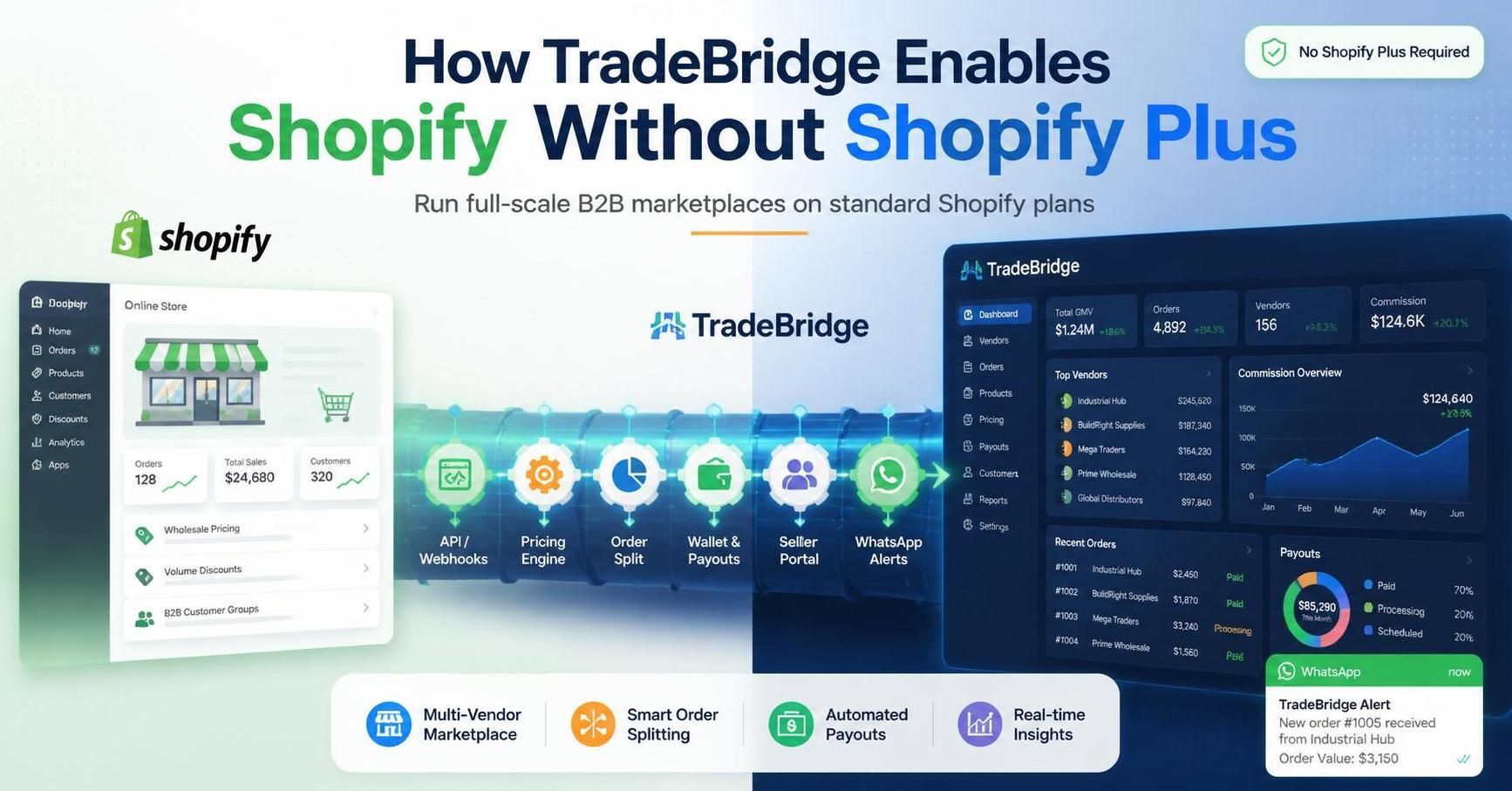
- TradeBridge runs as an external layer connected through Shopify's Admin API, Storefront API, and webhooks, handling what Shopify was never built to do
- The three mechanics that matter most: split-order fulfillment, automated commission calculation, and separate seller/buyer portals
- For the full module-by-module breakdown, see TradeBridge Explained
The Question We Get Asked a Lot
“We want multiple sellers on one Shopify store. Do we need Shopify Plus for that?”
The honest answer surprises most people: no plan of Shopify, including Plus, gives you multi-vendor marketplace functionality out of the box. Ask in any Shopify community forum and you'll get the same answer from developers who've tried to build one from scratch: it isn't there natively, at any tier. Plus buys you checkout customization, higher API limits, and enterprise support. It doesn't buy you seller onboarding, commission splitting, or a buyer portal.
That's the gap TradeBridge, built by Amwhiz Media Private Limited, fills, and it's worth being precise about why, because “without Shopify Plus” isn't really a pricing story anymore. Since April 2026, Shopify made core B2B tools like company profiles, volume pricing, and Net payment terms free on every paid plan. So the old argument, that you need Plus just to offer wholesale pricing, doesn't really hold up today. The actual reason merchants reach for something like TradeBridge is different: they want several independent sellers running through one storefront, with orders splitting automatically and commissions calculating themselves. That's infrastructure Shopify has never shipped, on any plan.
Where TradeBridge Actually Sits
Shopify is genuinely good at what it does, storefront, checkout, payments, inventory for a single seller. TradeBridge doesn't try to replace any of that. It runs alongside it as a separate system that talks to Shopify through the Admin API, the Storefront API, and webhooks, and handles the parts of a marketplace Shopify was never designed to do.
In practice that split looks like this: a buyer still checks out through your Shopify storefront like normal. The moment that order is placed, TradeBridge picks it up through a webhook, works out which seller or sellers it belongs to, and takes over from there.
| Shopify handles | TradeBridge handles | |
|---|---|---|
| Storefront, checkout, payments | Yes | No |
| Single-seller inventory | Yes | No |
| Multi-vendor seller management | No | Yes |
| Split-order fulfillment | No | Yes |
| Commission calculation & payouts | No | Yes |
| Seller and buyer portals | No | Yes |
Under the Hood: How It Actually Works
Most coverage of multi-vendor tools lists a wall of features without explaining how any of them work. Here's what's actually happening under the hood for the three that come up most.
Splitting One Checkout Into Multiple Seller Orders
A buyer might order three products from three different sellers in a single checkout, exactly like they would on any marketplace. Shopify itself only sees one order. Here's what TradeBridge does with it afterward:
- Reads every line item in the order
- Matches each one back to the seller it belongs to
- Generates a separate sub-order per seller
- Assigns fulfillment independently to each one
- Syncs tracking and status updates back into Shopify as sellers ship their portion
The buyer still sees one clean order history, even though three different sellers fulfilled it.
Commission Calculation Without Manual Spreadsheets
Every sale needs a cut worked out for the platform and a payout worked out for the seller, and doing that by hand is the first thing that breaks once you're past a handful of vendors. TradeBridge calculates this automatically at the point of sale, using whatever rule structure fits your business:
- A flat percentage across every sale
- Different rates by product category
- Product-level overrides for negotiated deals
Refunds and payment gateway deductions get factored in too, so what lands in a seller's wallet already accounts for what was actually collected, not just the gross order value.
Separate Portals Instead of One Shared Admin
Handing every vendor a login to your actual Shopify admin isn't realistic once you have more than one or two sellers. TradeBridge splits that into three separate views instead:
- Sellers get their own portal for product uploads, inventory, and earnings
- Buyers get theirs for company registration, tiered pricing visibility, and invoice tracking
- Your team keeps a separate view for approvals, payouts, and platform-wide analytics
None of the three touch your core Shopify admin.
So, Which Shopify Plan Do You Actually Need?
Since the multi-vendor layer runs outside Shopify entirely, TradeBridge works the same way on Basic, Grow, or Advanced as it would on Plus. You're not paying Plus-level pricing to unlock marketplace functionality, because Plus was never the thing that provided it. The only reason to still consider Plus alongside TradeBridge is if you separately need its checkout customization via Shopify Functions, not for anything related to running multiple sellers.
For merchants who've been quoted a Plus upgrade specifically to “support multiple vendors,” it's worth getting a second opinion on what's actually required before committing to that cost.
How This Compares to a Marketplace App
Off-the-shelf multi-vendor apps exist in the Shopify App Store, and for the right setup, they're the faster choice.
An off-the-shelf app usually works well when:
- You're running a handful of sellers
- Commission rules are simple and uniform
- There's no regional complexity to account for
TradeBridge fits better once:
- Commission logic needs to vary by category, product, or negotiated deal
- You're running credit-based B2B buying, not just standard checkout
- Workflows need to match a specific region's carriers and payment habits
The trade-off is setup time. An app installs in minutes; TradeBridge is a custom-built layer shaped around exactly how your marketplace needs to operate.
Quick Answers to What Merchants Ask
Do I need Shopify Plus to run a multi-vendor marketplace with TradeBridge?
No. TradeBridge connects to Shopify through the Admin API, Storefront API, and webhooks, which are available on Basic, Grow, and Advanced. Plus isn't required for any part of the marketplace layer.
Does TradeBridge replace Shopify, or work alongside it?
It works alongside it. Shopify still handles your storefront, checkout, and payments. TradeBridge manages seller onboarding, order splitting, commissions, and the buyer and seller portals.
How is this different from a Shopify multi-vendor app?
Off-the-shelf apps cover common marketplace patterns well. TradeBridge is built around your specific commission rules, credit terms, and regional workflows, which matters once your setup gets more particular than a standard app supports.
What happens to an order once a customer checks out?
Shopify processes the checkout as usual. TradeBridge then reads the order via webhook, splits it by seller, generates sub-orders, and syncs fulfillment and tracking updates back into Shopify as each seller ships their portion.
Where can I see the full list of what TradeBridge includes?
TradeBridge Explained covers every module in detail, from the admin portal to regional shipping integrations.
Thinking About Multi-Vendor for Your Shopify Store?
Amwhiz's team can walk through your seller structure, commission rules, and regional requirements to work out whether TradeBridge fits, and what it would take to set up. From order-splitting logic to seller payouts, we handle the build so you're not left stitching apps together.
The Bottom Line on TradeBridge and Shopify Plus
- No Shopify plan, Plus included, comes with native multi-vendor marketplace, commission, or payout functionality
- TradeBridge adds that layer externally through Shopify's APIs and webhooks, which works the same on Basic, Grow, or Advanced as it does on Plus
- The three mechanics that matter most are split-order fulfillment, automated commission calculation, and separate seller and buyer portals
- It's a custom-built alternative to off-the-shelf marketplace apps, worth it once your commission logic, credit terms, or regional workflows get more specific than a standard app can handle