-1.png?width=134&height=66&name=amwhiz-logo%20(1)-1.png)


Shopify shipping integration services typically cost $2,500 to $20,000+, depending on how many...
A typical Shopify custom app integration project runs roughly $3,000 to $25,000 or more, depending on how many systems it connects, how complex the data mapping is, and whether the app needs Shopify App Store review. Amwhiz builds these as part of its Shopify custom app integration services, connecting Shopify to ERPs, WMS platforms, CRMs, and shipping carriers that off-the-shelf apps usually can't handle cleanly. This post breaks down exactly what's included in a custom integration engagement and what pushes the price up or down, so you can budget realistically before requesting a quote.
What's Actually Included in Shopify Custom App Integration Services?
The Short Answer
Shopify custom app integration services typically include discovery and data mapping, API and authentication setup between Shopify and the target system(s), custom business logic (sync rules, transformations, error handling), a lightweight admin UI where needed, QA/testing across edge cases, and deployment plus documentation. Most projects fall between $3,000 and $25,000+, with the total driven mainly by the number of systems connected and how much custom logic the sync requires, not by Shopify's own fees.
What a Custom Integration Build Actually Covers
A custom Shopify integration is not just "connecting two APIs." A properly scoped engagement, like the ones covered in Amwhiz's guide to custom Shopify app development, moves through several distinct phases, each with its own deliverables:
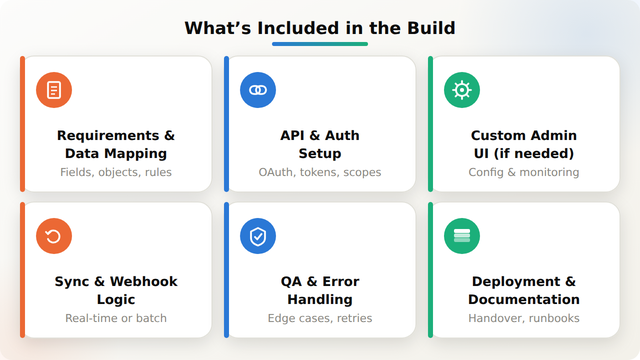
Compare this against a public app install and the difference becomes clear, Amwhiz's custom app vs. public app breakdown covers when a store actually needs the custom route instead of an off-the-shelf listing.
What Drives the Cost Up or Down
Within any given project, a handful of variables account for most of the price spread:
- Number of systems connected, a single Shopify-to-ERP sync costs far less than a three-way sync across ERP, WMS, and a shipping carrier.
- Data complexity, flat product/order syncs are cheap; multi-currency pricing, variant-level inventory, or custom metafields add development time.
- Real-time vs. batch sync, webhook-driven, near-instant sync costs more to build and test than a nightly batch job.
- Admin UI needs, a purely backend integration is cheaper than one with a merchant-facing settings screen or dashboard.
- App Store distribution, a private/unlisted app skips review overhead; a public listing adds compliance and review-cycle time.
- Legacy or undocumented systems, connecting to an older ERP or a system without a clean API can add significant discovery time.
Illustrative Cost Ranges by Project Type
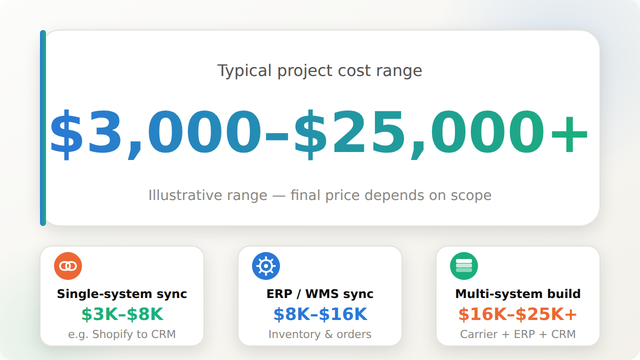
These figures are illustrative planning ranges based on typical project scopes, not fixed quotes. A store with clean data and a modern API on the other end can land at the low end of a bracket; a store with legacy systems or heavy customization can exceed the high end.
What's Typically Not Included
To keep a quote accurate, it helps to know what usually falls outside the base integration price:
- Shopify subscription fees and app-listing fees charged by Shopify itself.
- Ongoing hosting or server costs for the middleware, if it runs outside Shopify's infrastructure.
- Post-launch monitoring and maintenance beyond an initial warranty period.
- Data cleanup on the source system before the sync begins (e.g., deduplicating a messy CRM).
- Major scope changes discovered mid-build, such as a newly-required third system.
How Long a Custom Integration Takes
Simple, single-system integrations commonly take 2-4 weeks from kickoff to launch. Multi-system builds with custom admin UIs and real-time sync more typically run 6-10 weeks. Timelines stretch when a target system lacks clean documentation, when data needs significant cleanup first, or when the app requires Shopify App Store review before it can go live for other merchants.
How Amwhiz Helps
Amwhiz's Shopify custom app integration services cover the full build, discovery, data mapping, API development, QA, and deployment, for stores connecting Shopify to ERPs, WMS platforms, CRMs, and carriers. Recent work in this space is documented in the custom Shopify shipping app case study, which shows a similarly-scoped build end to end.
Frequently Asked Questions About Shopify Custom App Integration Cost
How much does a Shopify custom app integration cost?
Most Shopify custom app integration projects fall between $3,000 and $25,000 or more. Single-system syncs (like Shopify to a CRM) tend to land at the lower end, while multi-system builds connecting an ERP, WMS, and shipping carrier together tend to land at the higher end.
What's included in Shopify custom app integration services?
A typical engagement includes discovery and data mapping, API and authentication setup, custom sync/business logic, an admin UI where needed, QA and error handling, and deployment with documentation.
How long does a custom Shopify integration take to build?
Simple, single-system integrations typically take 2-4 weeks. Multi-system integrations with real-time sync and custom UI typically take 6-10 weeks, depending on how clean the source systems' data and APIs are.
Do I need a custom app if a free Shopify app already exists?
Not necessarily. If a public Shopify App Store listing covers your exact workflow, it's usually cheaper and faster to install it. Custom integration makes sense when your business logic, data structure, or combination of systems doesn't match what any existing app supports.
Does a custom integration require Shopify App Store approval?
No, not if it's built as a private or custom (unlisted) app for internal use, which is the most common setup. App Store review is only required if you intend to publish the app publicly for other merchants to install.
What ongoing costs come after the integration is built?
Expect potential costs for hosting the middleware (if it runs outside Shopify), monitoring, and maintenance once any initial warranty period ends. These are typically a small fraction of the original build cost and are usually quoted separately.
Conclusion
Shopify custom app integration costs vary widely because the scope varies widely, but with a clear picture of what's included (data mapping, API work, sync logic, QA, deployment) and what drives price, you can scope a realistic budget before you talk to a vendor. The right integration partner will map your specific systems to a specific range rather than quoting blind.
Amwhiz scopes and builds Shopify custom app integrations end to end, from discovery through deployment, so the systems your store depends on actually talk to each other. Visit amwhiz.com or email sales@amwhiz.com to get started.