-1.png?width=134&height=66&name=amwhiz-logo%20(1)-1.png)


Shopify shipping integration services typically cost $2,500 to $20,000+, depending on how many carriers connect, whether rates need to be calculated in real time, and whether the build includes custom rules like price-based or currency-based shipping. Amwhiz delivers this work through its Shopify shipping integration services, replacing the flat or generic rates Shopify ships with by default with logic that actually matches how a merchant ships. This post covers what's included in a typical build and what moves the price.
What's Included in Shopify Shipping Integration Services?
The Short Answer
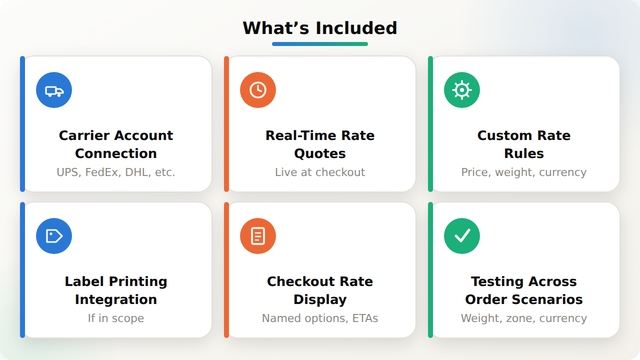
A Shopify shipping integration typically includes carrier account connections (for real-time rate quotes and label printing), custom rate rules (by weight, destination, price, or currency), checkout-level rate display logic, and testing across order scenarios. Most projects run $2,500-$20,000+, with cost driven mainly by the number of carriers connected and how complex the rate rules are, a single-carrier, standard-rate integration sits at the low end; a multi-carrier build with custom price/currency rules sits at the high end.
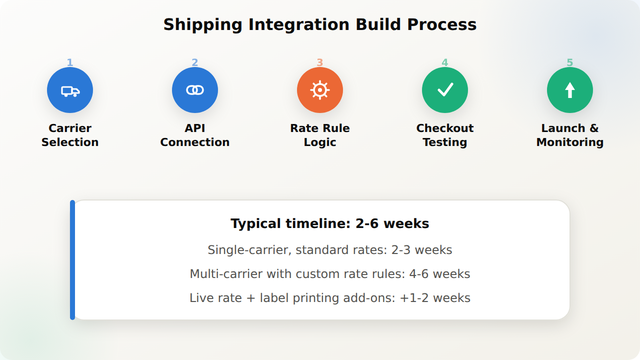
The Build Process, Start to Finish
What's Included in a Typical Build
What Drives the Cost
Within the $2,500-$20,000+ range, the biggest cost drivers are:
- Number of carriers, connecting one carrier is far cheaper than orchestrating rate comparison across three or four.
- Rate logic complexity, flat or table-based rates are cheap; price-based, weight-based, and currency-based rules together add significant logic.
- Real-time vs. cached rates, live carrier API calls at checkout cost more to build and test than periodically-updated rate tables.
- Label printing and fulfillment sync, adding label generation or 3PL/WMS sync extends scope beyond rate display alone.
- International/multi-currency shipping, cross-border rate and duty calculation adds meaningfully more complexity than domestic-only shipping.
A recent example of this kind of build is covered in the dynamic shipping calculation with logistics partner integration case study, and a price/currency-rules build is detailed in the custom shipping app with price and currency rules case study.
What's Typically Not Included
To scope a quote accurately, note what usually sits outside the base shipping integration price:
- Carrier account fees and negotiated shipping rates themselves (these are billed by the carrier, not the integration vendor).
- Ongoing carrier API usage costs, if the carrier charges per rate lookup.
- Physical fulfillment or warehouse operations changes.
- Post-launch monitoring beyond an initial support window.
How Amwhiz Helps
Amwhiz's Shopify shipping integration services cover carrier connections, custom rate logic, and checkout-level testing so shipping costs and delivery promises match reality instead of Shopify's generic defaults. Explore the case studies above to see the range of complexity this can cover, from single-carrier setups to multi-partner logistics integrations.
Frequently Asked Questions About Shopify Shipping Integration Cost
How much does a Shopify shipping integration cost?
Typical pricing runs $2,500 to $20,000+. A single-carrier integration with standard rates sits at the low end; a multi-carrier build with custom price, weight, or currency-based rate rules sits at the high end.
What's included in a Shopify shipping integration?
A typical build includes carrier account connections, real-time rate quotes, custom rate rules, checkout-level rate display, and testing across weight, zone, and currency scenarios. Label printing and fulfillment sync are common add-ons.
How long does a shipping integration take to build?
Single-carrier integrations with standard rates typically take 2-3 weeks. Multi-carrier builds with custom rate rules typically take 4-6 weeks, with an extra 1-2 weeks if live rate lookups and label printing are added.
Do I need a custom integration, or does Shopify Shipping already cover this?
Shopify's built-in shipping tools cover standard, table-based, and basic carrier-calculated rates well. A custom integration becomes worthwhile when you need rules Shopify doesn't natively support, price-based free-shipping thresholds combined with weight tiers, multi-currency rate logic, or multiple carriers compared live at checkout.
Can a shipping integration include multiple carriers?
Yes. Multi-carrier integrations are common and let checkout show live-compared rates across carriers like UPS, FedEx, and DHL, or regional/local courier APIs, rather than a single carrier's rates.
What ongoing costs come after launch?
Expect the carrier's own account fees and any per-lookup API costs to continue as normal business costs. Integration monitoring or rule changes beyond an initial support window are typically billed separately and are usually a small fraction of the build cost.
Conclusion
Shopify shipping integration cost tracks directly with how many carriers you connect and how custom your rate logic needs to be, knowing that upfront lets you scope a realistic budget instead of comparing quotes that cover very different amounts of work.
Amwhiz builds Shopify shipping integrations from single-carrier rate connections through multi-partner logistics builds with custom pricing rules. Visit amwhiz.com or email sales@amwhiz.com to get started.