-1.png?width=134&height=66&name=amwhiz-logo%20(1)-1.png)


Shopify shipping integration services typically cost $2,500 to $20,000+, depending on how many...
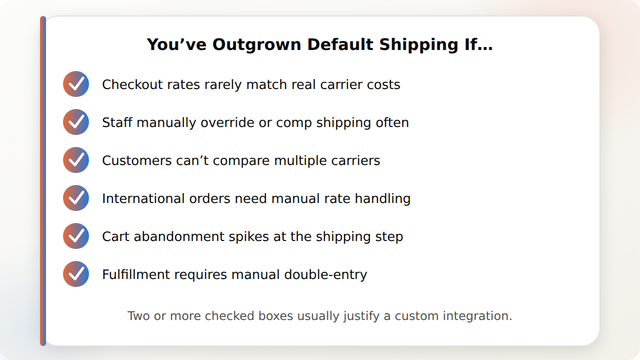
Common signs a Shopify store has outgrown its default shipping setup include inaccurate or flat rates that no longer match real carrier costs, manual rate overrides at checkout, an inability to compare multiple carriers, and cart abandonment tied specifically to shipping cost surprises. Amwhiz sees these patterns constantly through its Shopify shipping integration services work, and each one has a specific, fixable root cause. Here are the six clearest signs, and what fixes each.
How Do You Know Your Shopify Store Has Outgrown Its Shipping Setup?
The Short Answer
A Shopify store has typically outgrown its default shipping setup when: rates no longer reflect real carrier costs, the team manually overrides shipping charges regularly, multiple carriers can't be compared at checkout, international or multi-currency orders need manual rate handling, shipping-related cart abandonment is rising, and fulfillment/label workflows require manual double-entry. Any two or more of these signs point toward needing a custom shipping integration rather than Shopify's built-in rate tools.
Six Signs to Watch For
Sign 1-2: Inaccurate Rates and Manual Overrides
Shopify's built-in shipping tools work well for flat-rate or simple table-based pricing. But once your actual carrier costs vary by weight, dimensional weight, zone, or negotiated volume discounts, flat rates start either overcharging customers (hurting conversion) or undercharging you (eating margin). If your team is regularly stepping in to manually adjust or comp shipping charges, that's a clear sign the automated rate logic no longer matches reality.
Sign 3-4: No Multi-Carrier Comparison and Manual International Handling
Growing stores often need to show customers a genuine choice, a cheaper, slower carrier next to a faster, pricier one, calculated live at checkout. Shopify's defaults don't easily support comparing multiple carrier accounts side by side. Similarly, once international orders become a meaningful share of volume, manually calculating duties, customs, and multi-currency shipping for each order is a sign the store needs real integration logic instead of workarounds.
Sign 5-6: Rising Cart Abandonment and Fulfillment Double-Entry
Shipping cost surprise at checkout is one of the most common causes of cart abandonment, if analytics show drop-off specifically at the shipping step, mismatched or unclear rates are a likely cause. On the operations side, if your team re-enters order and shipping data into a separate carrier portal or 3PL system by hand, that manual step is exactly what a shipping integration automates away.
How These Systems Connect Once You Upgrade
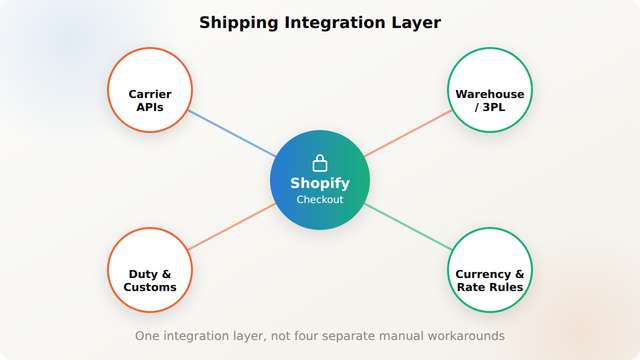
A custom shipping integration typically sits between Shopify and several other systems at once, rather than being a single point-to-point connection:
What to Do Once You Recognize These Signs
Start by tracking which specific signs apply and how often, checkout drop-off rate at the shipping step, frequency of manual rate overrides, and share of international orders are all measurable. That data becomes the scoping input for a shipping integration project, and it's the same data an integration partner needs to size the build accurately. For a sense of what such a build actually costs once scoped, see Amwhiz's Shopify shipping integration services page.
How Amwhiz Helps
Amwhiz's Shopify shipping integration services replace flat, generic rates with carrier-connected, rule-based shipping that matches your real costs and customer expectations. Recent examples include the dynamic shipping calculation with logistics partner integration case study and the custom shipping app with price and currency rules case study.
Frequently Asked Questions About Outgrowing Shopify's Default Shipping
What are the clearest signs a Shopify store has outgrown its shipping setup?
Inaccurate checkout rates, frequent manual rate overrides, no multi-carrier comparison, manual international rate handling, rising cart abandonment at the shipping step, and manual double-entry into a fulfillment or carrier system.
How many of these signs need to be true before it's worth upgrading?
There's no strict threshold, but two or more consistently present signs usually justify scoping a custom shipping integration, at that point, manual workarounds are typically costing more in staff time and lost conversions than the integration would cost to build.
Can Shopify's built-in shipping settings fix these problems without a custom build?
Sometimes, for simpler cases, adjusting shipping zones or table rates can resolve basic accuracy issues. But multi-carrier comparison, price/weight/currency-combined rules, and live international duty calculation typically require custom integration work beyond Shopify's default settings.
Does shipping cost surprise really affect cart abandonment that much?
Unexpected or high shipping costs revealed late in checkout are one of the most commonly cited reasons for cart abandonment in ecommerce. If analytics show a spike in drop-off specifically at the shipping-rate step, it's a strong signal worth investigating.
What's the first step if I recognize several of these signs?
Start by measuring the specific problem, shipping-step drop-off rate, frequency of manual overrides, or share of international orders needing manual handling. That data sizes the project accurately during a scoping conversation with an integration partner.
Will upgrading disrupt my current checkout while it's being built?
No, not if it's built and tested properly. A shipping integration is typically developed and tested on a duplicate or staging setup before going live, so the current checkout keeps working normally until the new logic is verified and switched on.
Conclusion
None of these six signs are dramatic on their own, a manual override here, a slow international order there, but together they add up to real cost in staff time, margin, and lost sales. Recognizing the pattern early is what turns an ad hoc fix into a properly scoped shipping integration.
Amwhiz helps Shopify merchants diagnose these shipping gaps and build the carrier connections and rate logic to close them. Visit amwhiz.com or email sales@amwhiz.com to get started.