-1.png?width=134&height=66&name=amwhiz-logo%20(1)-1.png)


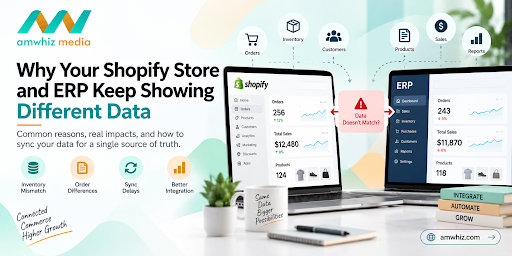
Your Shopify store shows 42 units available. Your ERP shows 27. The warehouse says 31. Then a customer places an order for 10 units and your operations team has to figure out which number they can trust. A reliable Shopify ERP integration needs more than an API connection. It needs clear data ownership, consistent identifiers, defined synchronization rules, error handling, monitoring, and a process for resolving exceptions.
Key Takeaways
- Shopify and ERP data mismatches usually come from mapping, timing, ownership, or integration logic.
- Inventory, products, pricing, customers, orders, fulfillment, and returns all need defined synchronization rules.
- The right source of truth can differ by data type and business process.
- Real-time or near-real-time synchronization is most important for customer-facing events such as inventory availability and order status. Other information can often move in scheduled batches.
- A production Shopify ERP integration should include validation, retries, monitoring, reconciliation, and clear exception handling.
This is a familiar problem for growing Shopify businesses. The storefront is working. The ERP is working. Orders are moving. Inventory is being updated. Yet the information across the systems does not always agree.
Most companies initially treat these situations as isolated technical issues. Someone fixes the inventory count, updates a product, corrects an order, or manually reconciles a spreadsheet. The immediate problem goes away, but another mismatch appears a few days later.
That usually means the underlying issue is not the number itself. It is the way information moves between Shopify, the ERP, inventory systems, warehouses, and other applications.
Shopify's current guidance specifically recommends defining which system owns each data type, how fields map between systems, how frequently data should synchronize, and how failures are handled.
Two Systems Can Be Correct and Still Disagree
One of the first things we tell businesses dealing with integration problems is to stop asking which system is "right."
The better question is: which system is responsible for this piece of information?
Your ERP may own inventory quantities for accounting and purchasing. Your warehouse management system may know the physical stock on a shelf more accurately. Shopify knows what inventory is exposed to customers for online purchasing. Your CRM may own sales and account information.
In a modern commerce stack, there may not be one database containing every version of the truth. Different systems can legitimately own different parts of the business. Shopify's recent guidance on ecommerce data integration makes the same point: the goal is reliable propagation of changes between systems rather than forcing every operational record into a single application.
The problem begins when those responsibilities are not clearly defined.
Imagine your ERP is supposed to control inventory, but an employee manually changes available stock in Shopify because a warehouse worker reported damaged units. The next ERP synchronization pushes its number back into Shopify.
Both systems are behaving exactly as they were configured to behave.
The business process is what is broken.
Inventory Is Usually Where the Problem Becomes Visible
Customers do not see your ERP architecture. They see the product page.
That makes inventory synchronization one of the most visible signs of a weak Shopify ERP integration.
A customer sees "In Stock" and expects to complete the purchase. If the warehouse cannot fulfill the order because the real available quantity is lower, the problem becomes a customer experience issue immediately.
Inventory becomes particularly difficult when a business has multiple warehouses, stores, 3PL locations, reserved inventory, incoming purchase orders, damaged goods, returns, bundles, or manual adjustments.
Shopify's enterprise guidance identifies inventory availability as one of the data flows where low-latency synchronization matters because stale information can affect whether an order can actually be placed and fulfilled.
Consider a company with three fulfillment locations:
| Location | Physical Stock | Reserved Stock | Available Stock |
|---|---|---|---|
| New Jersey | 120 | 30 | 90 |
| Texas | 85 | 20 | 65 |
| California | 60 | 15 | 45 |
| Total | 265 | 65 | 200 |
The customer should not necessarily see 200 units everywhere.
Your Shopify setup may need to expose inventory based on shipping rules, fulfillment locations, reservations, channel allocation, or other business logic. If the ERP simply sends a total number into Shopify without considering those rules, the storefront can look accurate while still producing incorrect fulfillment expectations.
That is why "sync inventory every five minutes" is not a complete integration strategy.
The inventory model itself needs to be correct.
SKU Mapping Is a Small Detail With Large Consequences
Product synchronization often looks easy during the initial integration project.
Then the edge cases start appearing.
Your Shopify product may use a SKU such as TSHIRT-BLK-M, while the ERP identifies the same item as 1004587. The product title may match. The image may match. The customer may see exactly the same product.
The systems still need a reliable way to understand that both records represent the same item.
When that mapping is missing or inconsistent, an integration can create duplicate products, fail to update inventory, attach an order to the wrong item, or leave certain products permanently out of sync.
This becomes even more complicated with variants, bundles, kits, discontinued products, replacement SKUs, and products sold through multiple channels.
A proper Shopify integration should therefore establish a product identity model before large-scale synchronization begins.
Pricing Can Drift Just as Easily as Inventory
Inventory gets most of the attention because customers see it immediately.
Pricing errors can be just as damaging.
Suppose the ERP holds contract pricing for a B2B account, while Shopify contains the online selling price. If the systems do not agree on who owns the price and when updates should happen, customers can see incorrect prices or sales teams can end up correcting orders manually.
For B2B businesses, pricing can be even more complex because the store may need to account for customer-specific catalogs, price lists, volume pricing, payment terms, or location-based purchasing rules. Shopify's B2B integrations can synchronize catalogs and price lists with supported external systems, but those flows still need to be designed around the company's commercial rules.
A useful rule is simple: do not synchronize pricing merely because both systems contain a price field. Synchronize it because you have defined which price belongs in which customer-facing context.
Orders Need a Complete Lifecycle
A basic integration often looks like this:
Shopify order → ERP
That works for a demo.
It is not enough for a production commerce operation.
A real order can be created, edited, paid, partially fulfilled, canceled, refunded, returned, or replaced. The warehouse may ship only part of the order. The customer may change quantities. Finance may need transaction and payout information.
The integration therefore needs to understand the complete order lifecycle:
Shopify → ERP → WMS/3PL → Fulfillment → Shopify → Customer
Shopify's current ERP integration guidance identifies orders, order updates, fulfillment, returns, refunds, and customer data as common synchronization domains.
That is why a one-directional order export can become a problem as soon as the business becomes more operationally complex.
Real-Time Does Not Mean Everything Must Move Instantly
Another mistake we regularly see is the assumption that every field needs real-time synchronization.
It does not.
The right synchronization model depends on how quickly stale data creates business risk.
| Data Type | Typical Priority | Why |
|---|---|---|
| Inventory availability | Near real-time | Prevent overselling |
| New orders | Near real-time | Start fulfillment quickly |
| Fulfillment status | Near real-time | Keep customers informed |
| Order cancellations | Near real-time | Prevent unnecessary fulfillment |
| Product content | Scheduled or event-based | Usually less time-sensitive |
| Pricing | Event-based or scheduled | Depends on pricing ownership |
| Customer records | Event-based or scheduled | Depends on account workflow |
| Financial reconciliation | Batch | Immediate updates often unnecessary |
| Historical reporting | Batch | Lower operational urgency |
Shopify's current guidance specifically notes that inventory availability and order events are examples where low latency matters, while reporting and some reconciliation processes can run in batches.
The important point is to define synchronization frequency by business impact rather than applying the same rule to every data type.
The Source of Truth Should Be Defined Before the API Is Built
One of the most valuable exercises in a Shopify ERP integration project is creating a simple ownership matrix.
For example:
| Data | Possible System of Record | Shopify's Role |
|---|---|---|
| Product master | ERP or PIM | Publish storefront product |
| Inventory | ERP or WMS | Display sellable inventory |
| Online merchandising | Shopify | Customer-facing presentation |
| Pricing | ERP, PIM, or Shopify | Apply relevant customer price |
| Ecommerce order | Shopify | Capture purchase |
| Fulfillment | WMS/ERP/3PL | Return status to Shopify |
| Customer account | ERP or CRM | Connect to storefront identity |
| Financial records | ERP | Receive commerce transactions |
| Marketing profile | CRM/CDP | Use ecommerce customer events |
This does not mean every business should use the same architecture.
The point is that the ownership decision should happen before the data starts moving.
Shopify's integration guidance recommends defining data ownership and conflict-resolution rules to avoid competing updates and synchronization loops.
APIs and Webhooks Are Only the Plumbing
A common misconception is that once the API connection exists, the integration is finished.
The API is simply one mechanism for moving information.
Shopify supports APIs for reading and changing data and webhooks for receiving notifications when relevant events happen. Shopify describes webhooks as a way to receive near-real-time notifications and avoid continuously polling the platform for changes.
For example, when an order is created, an integration can receive an event and map the Shopify order into the ERP's data structure. When inventory changes, the appropriate downstream system can receive the update.
But the important engineering work sits around those connections.
What happens when the ERP API is unavailable?
What happens when a required field is missing?
What happens when the same order is submitted twice?
What happens when a webhook is delayed?
What happens when Shopify has a product that does not exist in the ERP?
Those questions determine whether the integration is dependable.
Failed Synchronization Needs a Recovery Process
Integration failures are inevitable.
A network can fail. An API can time out. A record can be rejected. An administrator can delete or change something manually. A third-party service can become unavailable.
A production integration should treat those events as expected scenarios.
A useful error-handling framework looks like this:
| Failure | Example | Appropriate Response |
|---|---|---|
| Temporary API failure | ERP timeout | Automatic retry |
| Rate limit | Too many API requests | Backoff and retry |
| Missing mapping | Shopify SKU not found in ERP | Exception queue |
| Invalid data | Required ERP field missing | Validation failure |
| Duplicate order | Same order submitted twice | Idempotency check |
| Partial sync | Order created, fulfillment missing | Reconciliation |
| Persistent failure | Repeated record rejection | Alert operations team |
Shopify's current ERP guidance also emphasizes monitoring failures, synchronization latency, retries, validation problems, and reconciliation gaps.
That is an important distinction between an integration that merely works under normal conditions and one that is ready for production.
Returns Are Where Weak Integrations Often Get Exposed
Many teams spend most of their integration effort on product, inventory, and order creation.
Then returns begin causing problems.
A returned item can affect Shopify, warehouse inventory, the ERP, accounting, refunds, and customer records. If the return workflow is only designed from the storefront perspective, the back-office systems may continue showing the old state.
That creates another reconciliation problem.
Returns, refunds, cancellations, and exchanges should therefore be treated as core integration flows rather than secondary features added after launch.
B2B Shopify Adds Another Layer of Complexity
For B2B stores, synchronization can extend beyond basic product and inventory data.
A business customer may have its own catalog, negotiated price, payment terms, company location, tax setup, and purchasing permissions. Shopify supports external integrations for B2B customer data, orders, inventory, product catalogs, pricing information, and related workflows.
This matters because a B2B store can appear technically connected while still delivering the wrong commercial information to customers.
For example, inventory may be correct, but the buyer sees the wrong price list.
The order may sync correctly, but the customer's ERP account is not matched properly.
The customer account may exist in Shopify, but the company location is missing from the downstream system.
For B2B businesses, customer and pricing data deserve the same architectural attention as orders and inventory.
What a Healthy Shopify ERP Integration Should Look Like
A good integration should make routine data movement predictable.
You should know where product data originates, how SKU mappings are maintained, which system controls inventory, how prices are determined, how orders move into fulfillment, and how changes make their way back to Shopify.
A practical integration checklist looks like this:
| Area | What Good Looks Like |
|---|---|
| Product data | Consistent product and SKU mapping |
| Inventory | Defined ownership and location-aware synchronization |
| Pricing | Clear pricing source and update rules |
| Orders | Reliable creation, updates, cancellation and status flow |
| Customers | Matching and duplicate prevention |
| Fulfillment | Accurate shipment and delivery updates |
| Returns | Refund and inventory synchronization |
| APIs | Authentication, rate-limit handling and validation |
| Webhooks | Event-driven updates where appropriate |
| Errors | Retry, logging and exception workflows |
| Monitoring | Visibility into failures and sync latency |
| Reconciliation | Regular comparison of critical records |
This is where Shopify ERP integration moves from a development task into an operational capability.
Connector, Middleware, or Custom Shopify Integration?
There is no universally correct integration method.
Some businesses can use a supported connector from the Shopify App Store. Others benefit from an iPaaS platform that sits between Shopify and the ERP. Companies with complex business rules may need a custom API-led architecture.
Shopify currently describes direct integrations, iPaaS solutions, partner-led implementations, and API-led custom integrations as viable approaches depending on the systems and business requirements.
A practical decision framework looks like this:
| Situation | Likely Approach |
|---|---|
| Standard ERP with straightforward requirements | Certified connector |
| Several systems need orchestration | Middleware or iPaaS |
| Complex transformations | Middleware or custom integration |
| Non-standard ERP | Custom API integration |
| Complex B2B rules | Custom or hybrid architecture |
| High transaction volume | Architecture designed for scale |
| Existing connector causes recurring failures | Integration redesign |
The mistake is choosing the technology first.
Start with the data flows and business rules. The appropriate architecture usually becomes much easier to identify after that.
A Practical Shopify ERP Integration Roadmap
A strong implementation is usually easier to manage in phases.
| Phase | Focus | Deliverable |
|---|---|---|
| 1 | System audit | Current-state integration map |
| 2 | Data analysis | SKU, customer and field mapping |
| 3 | Data ownership | Source-of-truth matrix |
| 4 | Architecture | Connector, middleware or custom design |
| 5 | Core integration | Products, inventory, customers and orders |
| 6 | Operational flows | Fulfillment, returns, refunds and pricing |
| 7 | Reliability | Retries, alerts, logs and reconciliation |
| 8 | Optimization | Performance and exception analysis |
This sequence prevents a common mistake: building a technically impressive integration around a poorly understood business process.
The Warning Signs Are Usually Already There
Businesses rarely wake up one morning with a completely broken integration.
There are usually warning signs first.
Someone maintains a spreadsheet to compare Shopify inventory with the ERP. Customer service regularly asks operations to confirm stock. Developers manually replay failed orders. Sales notices that customers occasionally see the wrong pricing. Finance spends time reconciling transactions.
Those activities are signals.
| Warning Sign | Likely Underlying Issue |
|---|---|
| Frequent inventory corrections | Weak inventory ownership or mapping |
| Manual order re-entry | Incomplete order integration |
| Duplicate customers | Poor matching logic |
| Different prices across systems | Unclear pricing ownership |
| Delayed fulfillment updates | Weak status synchronization |
| Spreadsheet reconciliation | Lack of trusted cross-system reporting |
| Frequent developer intervention | Fragile integration logic |
| Problems spike during traffic peaks | Capacity or queueing issue |
| Failed records are discovered late | Missing monitoring |
When these patterns become normal, the cost of the integration is no longer just technical.
It is operational.
Build a Shopify Architecture Your Operations Team Can Trust
Your Shopify store and ERP are supposed to play different roles.
Shopify provides the commerce experience and captures customer activity. The ERP, WMS, CRM, accounting platform, and other systems handle the operational processes behind the transaction.
The integration connects those systems so information moves accurately between them.
When that architecture is well designed, your team should not have to wonder whether Shopify or the ERP is correct every time inventory changes. They should know which system owns the information, how it is synchronized, and what happens when the process fails.
That is the standard a production Shopify ERP integration should aim for.
For businesses dealing with recurring data mismatches, failed order syncs, inaccurate inventory, duplicate customer records, or manual reconciliation, an integration audit is often more valuable than immediately replacing the existing connector.
Start by mapping the current systems, data flows, ownership rules, mappings, synchronization timing, and failure points. Then decide whether the right answer is a connector improvement, middleware, or custom Shopify integration.
The objective is simple: your Shopify store and ERP should tell the same business story, even when they remain separate systems.
Final Takeaway
Shopify and your ERP do not need to store identical information.
They need to exchange the right information at the right time, according to rules your business understands.
When product mapping, inventory ownership, pricing, orders, customer records, fulfillment, returns, APIs, webhooks, and exception handling are designed properly, the systems can work together without constant manual reconciliation.
That is what a reliable Shopify ERP integration should deliver: accurate data, predictable workflows, fewer operational surprises, and a commerce stack your team can trust.
FAQs
Why does Shopify show different inventory from my ERP?
The most common reasons include delayed synchronization, incorrect SKU or location mapping, manual adjustments, reservations, returns, multiple inventory systems, or unclear inventory ownership. The first step is to identify which system is responsible for sellable inventory and how that value reaches Shopify.
What data should sync between Shopify and an ERP?
Most Shopify ERP integrations handle products and SKUs, inventory, pricing, orders, customers, fulfillment, returns, refunds, and financial information. B2B businesses may also need company accounts, catalogs, price lists, payment terms, and other account-specific data.
Should Shopify or the ERP be the source of truth?
There is no single answer for every business. The ERP may own financial and inventory records, Shopify may own ecommerce order activity and storefront merchandising, and a WMS may own physical warehouse stock. What matters is clearly defining ownership for each data type and how changes flow between systems.
Does Shopify ERP integration need to be real-time?
Some data benefits strongly from near-real-time synchronization, especially inventory availability, orders, cancellations, and fulfillment status. Other information, such as certain reports and financial reconciliation, can often be synchronized in batches.
Should I use a Shopify ERP connector or build a custom integration?
A certified connector is often appropriate when the ERP and business requirements are straightforward. Middleware or a custom Shopify API integration becomes more useful when you have complex transformations, multiple systems, specialized B2B workflows, high transaction volumes, or gaps in the available connector.
How do I troubleshoot Shopify and ERP data mismatches?
Start with the specific record that is incorrect and trace its complete journey. Check identifier mapping, system ownership, transformation rules, synchronization timing, API or webhook failures, manual changes, and integration logs. Then use reconciliation and monitoring to determine whether the problem is isolated or recurring.