-1.png?width=134&height=66&name=amwhiz-logo%20(1)-1.png)


Overview In performance driven ecommerce, paid acquisition often becomes a scaling constraint...

A merchant had a fully designed Shopify store - products uploaded, collections created, content complete - but the technical plumbing wasn't done. We connected the Meta and Google sales channels, got the product catalog synced and approved, and ran a full technical SEO audit, with no design or development rebuild. Here's exactly what we did and what merchants should realistically expect.
Executive Summary
What Did the Shopify Integration and SEO Setup Actually Deliver?
We completed the final technical setup on a finished Shopify store - Meta and Google sales channels connected, catalogs synced, and a full technical SEO pass done.
The objective was narrow and clear: get the sales channels and search integrations working correctly without touching the store's design or content.
Below is what we connected, how we handled catalog approvals, and where results depend on platform review queues outside anyone's control.
The Problem We Were Trying to Solve
Why Does a Finished Shopify Store Still Not Sell Everywhere?
The store looked complete from the front end, but a designed store and a launch-ready store are two different things. Design gets the shop looking right; integrations are what make products discoverable and shoppable across Meta, Google, and search.
That gap created a few specific problems:
- Products weren't shoppable on Facebook and Instagram because the catalog wasn't synced through Meta Commerce Manager.
- Products couldn't appear in Google Shopping without a connected, approved Merchant Center feed.
- Instagram Shopping eligibility can stall on unresolved feed errors even after a catalog is submitted.
- Common Merchant Center disapprovals - missing GTIN/MPN, policy flags, image quality - block products silently.
- Technical SEO gaps like missing Product schema, weak metadata, or broken canonicals quietly hurt rankings.
None of this is design work. It's the technical readiness layer that a store needs before it can actually compete for traffic and sales.
What We Actually Set Up
Which Integrations and Channels Were Configured?
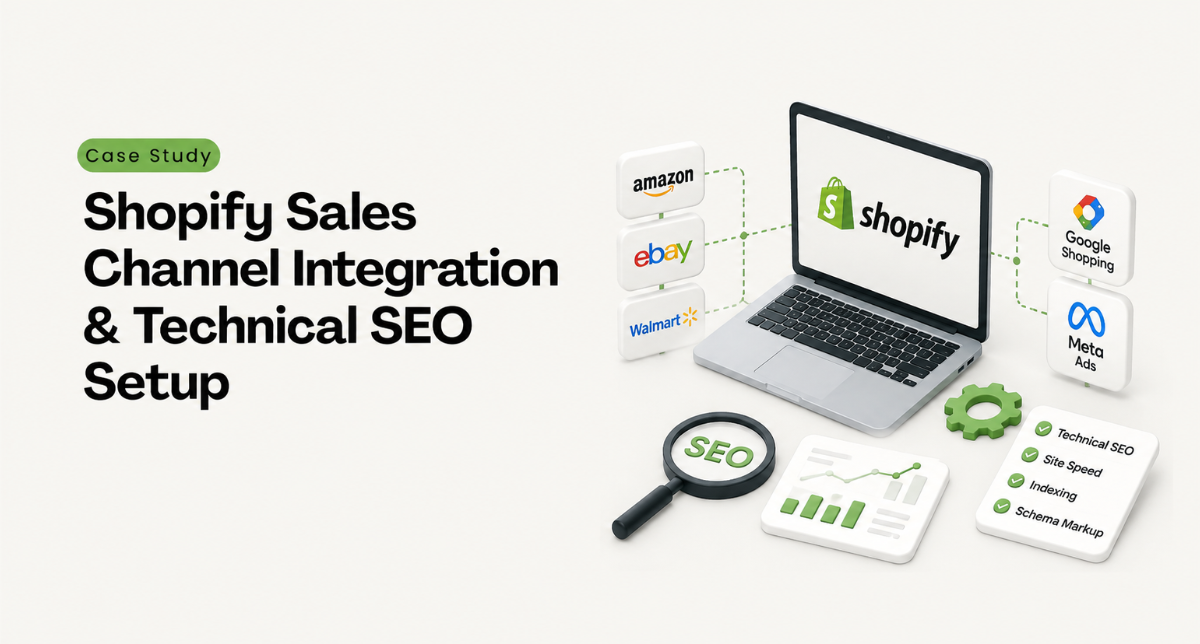
We handled three areas: Meta, Google, and technical SEO - integrations and optimization only, no rebuilds.
What we connected:
- Meta (Facebook & Instagram): Shopify connected to Meta Business Manager, both sales channels live, full catalog synced via Commerce Manager
- Meta tracking: domain verification (Brand Safety) confirmed, and Meta Pixel / Conversions API events verified in Events Manager
- Google: Merchant Center connected, Google & YouTube channel set up, product feed synced and eligible for Google Shopping
- Google tracking: GA4 and Google Search Console verified where needed, sitemap submitted for indexing
- Technical SEO: a full audit covering metadata, alt tags, schema, sitemap, robots.txt, canonicals, and crawlability
What we did not touch:
- Store design, theme, or layout - the store was already finished
- Product content, pricing, or collection structure
- Any custom development or rebuild the brief explicitly ruled out
Setting It Up
How Do You Connect Meta and Google Without Feed Errors?
We started by confirming the current status of any existing Meta and Google connections - even partial ones - so we knew exactly what needed fixing versus building from scratch. The work then broke into three tracks.
1. Meta (Facebook & Instagram)
We connected Shopify to Meta Business Manager, set up both sales channels, and synced the full catalog through Commerce Manager. We verified domain verification (Brand Safety) was complete, confirmed ViewContent, AddToCart, and Purchase events fire correctly in Events Manager test events, and drove feed errors down to zero where within Shopify's control - because unresolved feed errors are the most common reason Instagram Shopping eligibility stalls even after catalog submission.
2. Google
We connected Google Merchant Center, set up the Google & YouTube channel, and checked feed status closely. Most disapprovals trace to missing GTIN/MPN data, policy violations like restricted category flags, or image quality issues, so we audited the feed against Google's actual requirements rather than submitting and hoping. We also configured GA4 and Search Console where not already verified and submitted the sitemap for indexing.
3. Technical SEO Audit
We reviewed metadata (titles and descriptions) across products and collections, image alt tags, and structured data - Product schema via JSON-LD is often missing or incomplete on Shopify stores. We also checked sitemap and robots.txt correctness, canonical tag setup, and crawlability, flagging anything actively hurting rankings rather than doing a generic checklist pass.
What Changed After the Setup
What Were the Integration and Search Results?
On the sales channels:
- Facebook and Instagram catalog working correctly, products shoppable where eligible
- Google Merchant Center connected with the product feed approved and eligible for Google Shopping
- Tracking events firing correctly, so ad and analytics data is trustworthy from day one
On search:
- Technical SEO issues resolved - metadata, alt tags, schema, canonicals, and crawlability cleaned up
- Sitemap submitted and indexing verified in Search Console
- A clean foundation for rankings, with no broken structured data or duplicate-content signals
Being Honest About What Setup Can and Can't Do
Can You Credit the Setup for Instant Sales or Rankings?
We need to be careful here, because it's tempting to credit technical setup for outcomes it only enables rather than causes.
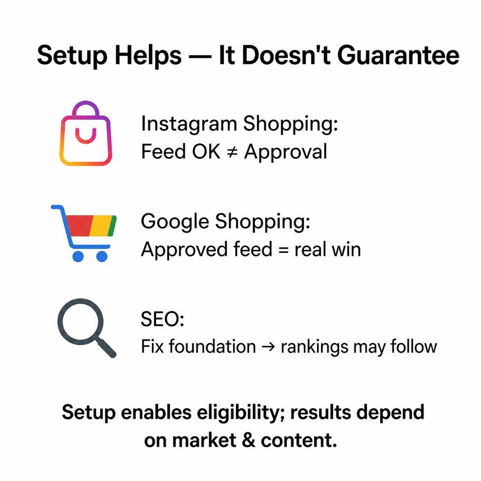
Instagram Shopping: a clean catalog submission is necessary but not sufficient. Eligibility depends on Meta's own review queue and can stay pending regardless of how correct the feed is. We remove the technical blockers; we can't fast-track Meta's approval.
Google Shopping: getting the feed approved and error-free is a direct, measurable win. Whether products then rank and convert depends on pricing, competition, and bids - the setup makes products eligible, not guaranteed winners.
SEO rankings: fixing schema, metadata, and crawlability removes what's holding rankings back. Actual ranking gains still depend on content quality, backlinks, and time for Google to recrawl and reindex.
Bottom line: the work does exactly what it promises - correct integrations, an approved feed, and a clean technical SEO foundation. What that turns into commercially depends on the marketing and merchandising built on top of it.
Strengths and Limitations
What Worked Well
Scoped cleanly. No unnecessary rebuild - just the sales channel connections, catalog sync, and SEO the store actually needed.
Feed errors resolved at the root. We audited against Google's and Meta's real requirements instead of submitting and hoping, so approvals held.
Tracking verified, not assumed. Events were confirmed firing in Events Manager and GA4, so downstream ad and analytics data is reliable.
SEO fixes that matter. We flagged issues actively hurting rankings - like missing Product schema - rather than running a generic checklist.
Where to Keep Expectations in Check
Meta review is out of our hands. Instagram Shopping can stay pending in Meta's queue no matter how clean the submission is.
Setup isn't demand. Approved feeds and clean SEO make products discoverable; they don't create traffic or sales on their own.
Rankings take time. Technical fixes clear the path, but Google still needs to recrawl and reindex before gains show up.
Some fixes need merchant action. Missing GTINs or policy issues at the product level may require input from the store owner.
Who Should Actually Do This
Is a Shopify Integration and SEO Setup Right for Your Store?
Makes sense for:
- Merchants with a finished Shopify store that isn't yet connected to Meta and Google
- Stores whose products aren't shoppable on Facebook, Instagram, or Google Shopping
- Anyone facing Merchant Center disapprovals or stalled Instagram Shopping eligibility
- Stores that need a technical SEO audit without any design or development changes
- Teams that want tracking (Pixel, CAPI, GA4, Search Console) verified, not just installed
Probably not the right fit for:
- Stores that actually need design or development work (that's a different project)
- Merchants expecting setup alone to generate traffic or sales
- Stores already fully integrated with clean feeds and healthy SEO
Deliverables
What Does the Finished Project Include?
- Facebook & Instagram catalog working correctly, with Instagram Shopping enabled where the account is eligible
- Google Merchant Center connected and the product feed approved, with Google integration complete
- Technical SEO issues resolved across metadata, alt tags, schema, sitemap, robots.txt, canonicals, and crawlability
- A written report covering what was completed, the status of each integration, and recommendations for anything needing merchant action
The real value here isn't an overnight sales spike; it's a launch-ready store with correct integrations, trustworthy tracking, and a clean SEO foundation to build on.
Final Take
Is the Shopify Integration and Technical SEO Setup Worth Doing?
This project solves one specific, real problem: taking a finished Shopify store from designed to fully connected and search-ready, across Meta, Google, and technical SEO. It does that job cleanly, with no rebuild.
What it isn't is a growth campaign. It won't manufacture traffic, force Meta's approval, or guarantee rankings on its own. Those depend on bigger factors like marketing, merchandising, and each platform's own review process.
If your store is designed but not yet shoppable across channels or clean on SEO, this is exactly the work worth doing before you spend on ads.
For everyone else, it's the solid technical foundation that quietly makes every later marketing effort work better.