-1.png?width=134&height=66&name=amwhiz-logo%20(1)-1.png)


Why 'Just Switch Everything On' Falls Apart "We've got Zoho One. Let's switch everything on." It's...
How Many Tabs Does One Question Take You?
Here's a test. In your business right now, how many places would you have to look to answer one simple question: what is this customer worth to us?
For a lot of businesses the answer is grim. Sales in the CRM. Invoices in the accounting tool. Support in a help desk. Marketing somewhere else entirely. To see the whole customer, someone has to open four tabs and stitch the story together in their head, and by the time they've done it, it's out of date.
Building one connected business on Zoho One is the answer to that mess. Not fifty apps for their own sake, one business that finally acts like a single organism. Here's the complete guide to getting there, the way we approach it at Amwhiz.
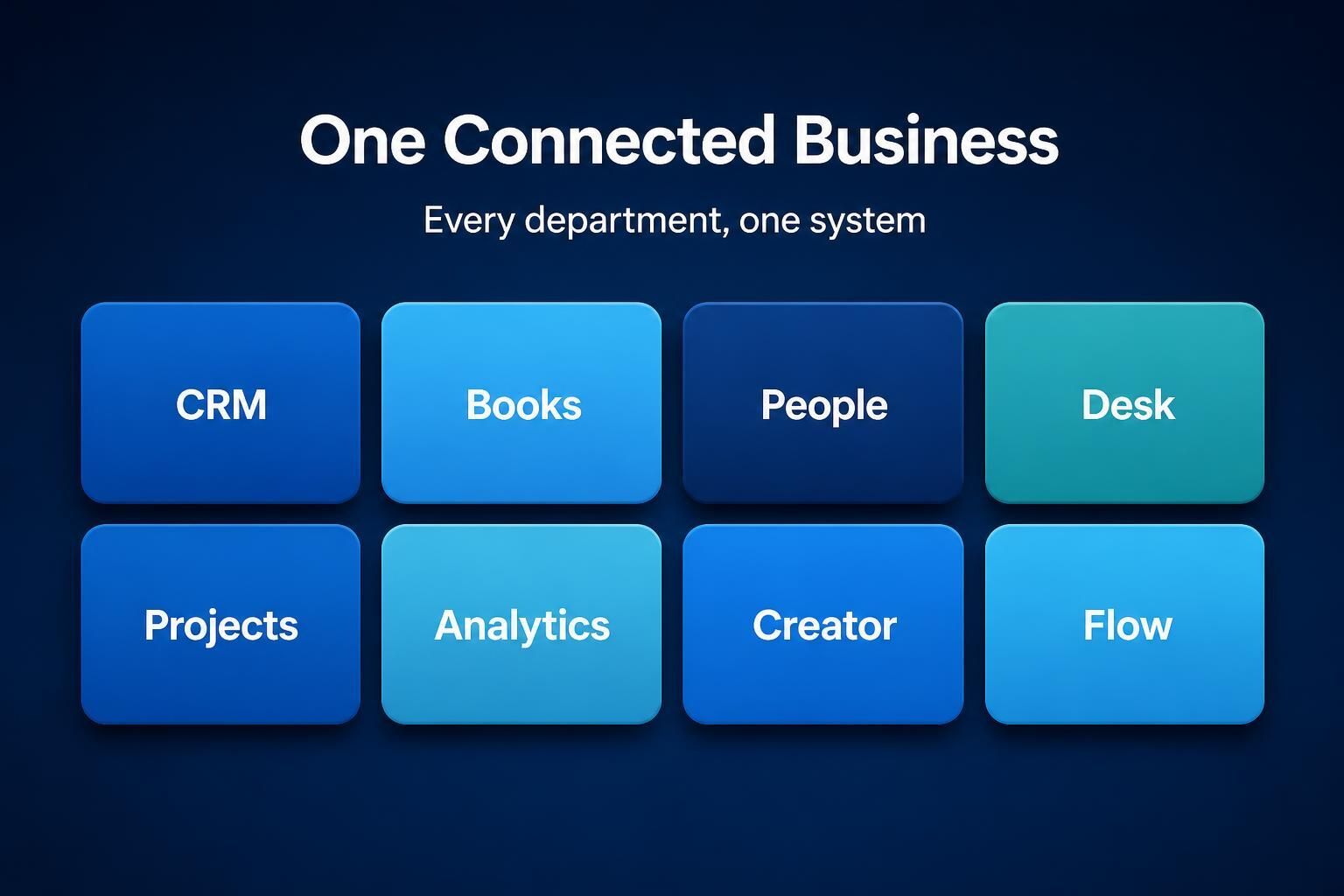
Every department, one system, one shared record of the customer.
What "Connected" Actually Means
A connected business isn't one that owns a lot of software. It's one where the software shares. Where a lead in marketing becomes a deal in sales becomes an invoice in finance becomes a support ticket, and it's the same customer, the same record, the whole way through, with nobody re-typing anything at the joins.
That's the prize Zoho One offers. Fifty-plus apps matter far less than the fact that they all talk to each other. The connection is the product.
Start With the Core, Not Everything
The instinct to switch on all fifty apps at once is exactly the instinct to resist. A connected business is built, not flipped on.
You begin with the core, usually the department in the most pain, and get it working well. Sales on Zoho CRM, say. Clean, adopted, delivering value. That first solid win becomes the anchor everything else connects to, and it earns the trust to keep going.
Connect the Next Department
With the core live, you bring in the next department and, this is the crucial part, wire it to the first. Finance on Zoho Books, connected so a won deal flows toward an invoice. Support on Zoho Desk, connected so agents see the customer's full history. HR on Zoho People. Each new piece isn't a standalone tool, it's another organ joining the same body.
Do this deliberately, department by department, and the connections accumulate into something genuinely powerful, without ever overwhelming the team.
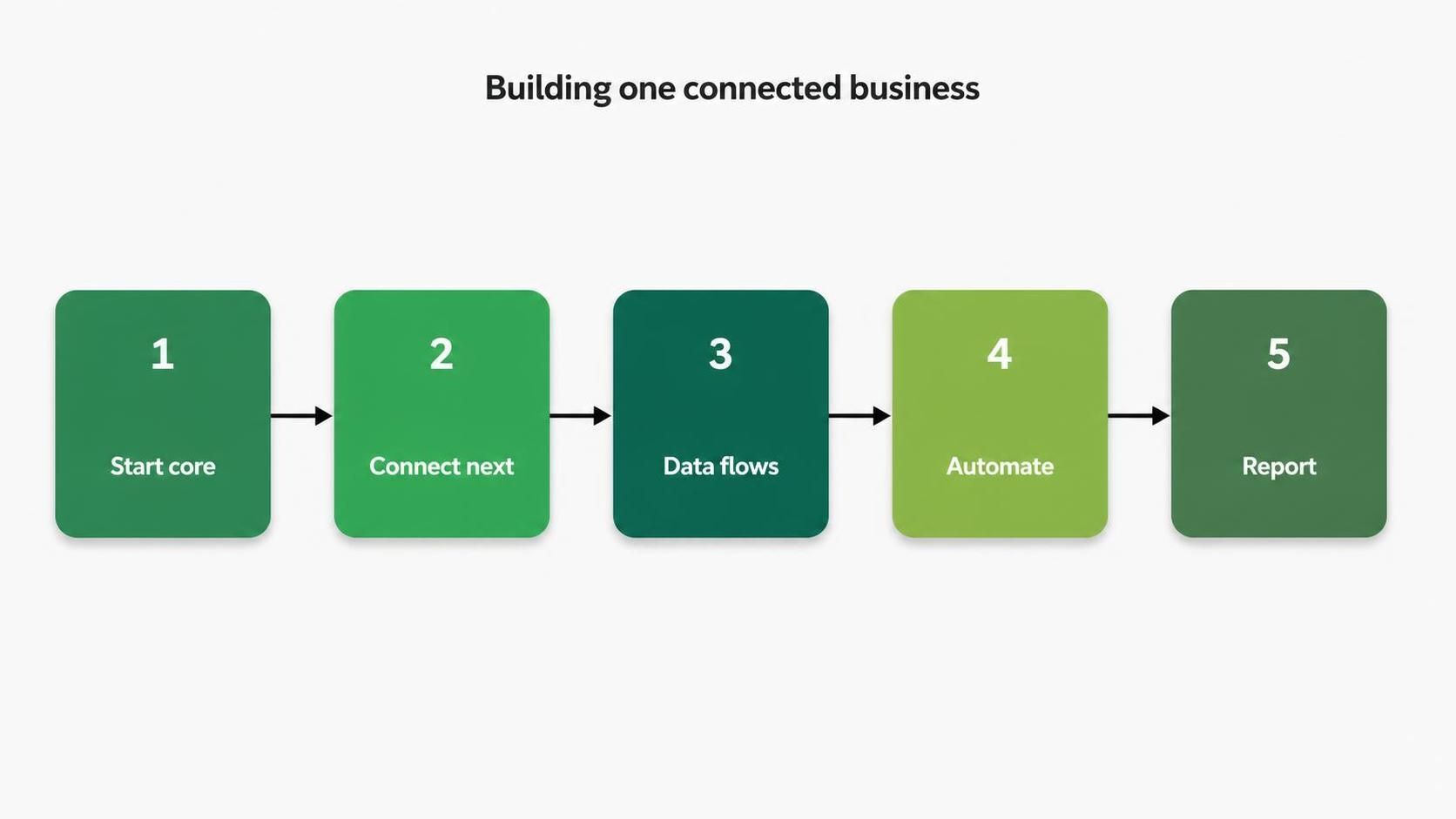
Start with the core, connect the next department, let data flow, automate across apps, report on everything.
Let the Data Flow
As departments come online, the real magic is the data moving between them without human hands. A customer's details, entered once in sales, are known everywhere. An address change updates for everyone. A support issue is visible to the account manager. This shared, single version of the truth is what kills the four-tabs problem for good.
It's also what makes everyone's job easier in a way they feel daily. No more asking another team for information that should already be on their screen.
Automate Across the Whole Thing
Once the apps are connected, Zoho Flow lets you automate across them, and Zoho Creator lets you build the bespoke bits that no standard app covers. Now a single event, a new order, a won deal, a signed contract, can trigger a whole chain of actions across departments automatically. The business starts doing work on its own.
This is the stage where "connected" turns into "efficient." The connections carry data; the automation puts that data to work without anyone lifting a finger.
Report on Everything, Together
Finally, with everything in one connected system, Zoho Analytics can show you the whole business at once. Sales next to finance next to support. That customer-worth question you couldn't answer at the start? Now it's a single dashboard, live, drawn from every corner of the business.
This whole-picture view is only possible because the underlying business is connected. It's the payoff that makes the journey worth taking.
What Usually Gets in the Way
If building a connected business is so clearly worth it, why doesn't every company have one? A few very human reasons.
The first is the big-bang temptation, trying to do it all at once, overwhelming everyone, and stalling. The second is treating each department's tool as its own project and never wiring them together, so you end up with tidy silos instead of a connected whole. The third is neglecting adoption, building beautiful connected systems that people don't actually use, which leaves you with an expensive diagram and no benefit.
All three are avoidable, and noticing them is half the battle. Build in phases, design the connections in deliberately, and obsess about whether people are genuinely using each piece before adding the next. Do that and the connected business builds itself, one solid, adopted step at a time.
You Don't Have to Finish to Benefit
Here's the reassuring part. A connected business isn't a prize you only collect at the end. Every connection you make pays off immediately, the day sales and finance start sharing a customer record, that specific friction disappears, whether or not you've touched HR yet.
So this isn't a giant all-or-nothing project you have to complete before seeing value. It's a series of steps, each one making the business a little more joined-up and a little easier to run. You can stop wherever it makes sense for you, and everything you've connected so far keeps working. That's what makes the journey approachable rather than daunting.
How Amwhiz Builds Connected Businesses
Amwhiz is an authorized Zoho partner, and building one connected business on Zoho One is exactly what we do. We start with your core, get it adopted, then connect each department to the last, let the data flow, automate across the apps, and give you reporting over the whole thing. Deliberately, in phases, so it actually lands.
The result isn't a shelf of fifty apps. It's a business that behaves like a single, connected system, where information moves on its own and you can finally see the whole picture. That's the difference between owning Zoho One and running your business on it.
Frequently Asked Questions
What makes a business "connected" on Zoho One?
The apps sharing data, so a customer is one record across sales, finance, support and more, with nothing re-typed between departments. The connection matters more than the number of apps.
Should I switch on all the apps at once?
No. Build it in phases, starting with the core department and connecting each new one to the last. Big-bang launches overwhelm teams and stall adoption.
Where should I start?
Usually with the department in the most pain, often sales on Zoho CRM. That first solid win becomes the anchor everything else connects to.
How does automation fit in?
Once apps are connected, Zoho Flow automates across them and Zoho Creator handles the bespoke parts, so a single event can trigger actions across departments on its own.
How long does it take to build?
It's a phased journey rather than a one-off project, paced to your capacity. Each department is a manageable step, and the connected whole grows over time.
The Short Version
Building one connected business on Zoho One means starting with your core department, connecting each new one to the last, letting data flow, automating across the apps with Flow and Creator, and reporting over everything with Analytics. The goal isn't fifty apps, it's a business that acts like a single connected system.
Book a free Zoho One strategy consultation.
Amwhiz, an authorized Zoho partner, will help you build one connected business on Zoho One, phase by phase. Visit amwhiz.com or email sales@amwhiz.com.