-1.png?width=134&height=66&name=amwhiz-logo%20(1)-1.png)


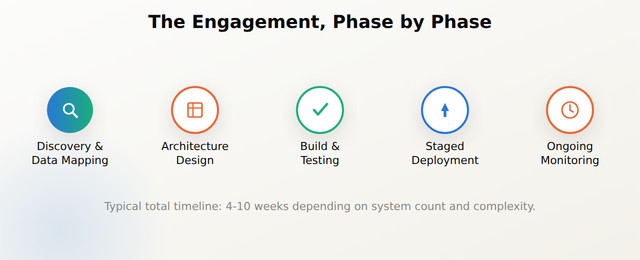
A custom integration engagement with Amwhiz covers five phases: discovery and data mapping, architecture design, build and testing, deployment, and ongoing monitoring, not just the API connection itself. Full scope details are on the custom integration services page. This post walks through what happens in each phase, what deliverables you get, and what typically drives timeline and cost.
What's Included in a Custom Integration Engagement?
The Short Answer
A complete custom integration engagement includes a discovery phase that maps data flows between systems, an architecture design that defines sync direction and error handling, the actual build with automated testing, a staged deployment with rollback planning, and a monitoring period after go-live to catch edge cases real usage surfaces. Engagements that skip discovery or monitoring tend to produce integrations that work in the demo but break on messy real-world data.
Phase 1: Discovery and Data Mapping
Before any code gets written, the engagement starts by mapping exactly what data needs to move between systems, in which direction, and under what conditions. This phase typically covers:
- Auditing the systems involved, CRM, ecommerce platform, ERP, or custom tools, and their data models
- Identifying the "source of truth" for each data field to avoid sync conflicts
- Documenting edge cases: duplicate records, partial data, and what happens on API failures
- Defining success criteria before any build work starts
This mirrors the approach behind integrations like the one in this Apollo.io and Zoho CRM integration case study, where duplicate-safe sync logic had to be designed upfront, not patched in after launch.
Phase 2: Architecture Design
With data mapped, the engagement defines the technical architecture: whether sync runs in real time via webhooks or on a scheduled batch, how conflicts get resolved when both systems change the same record, and what happens when an API call fails. This is also where authentication, rate limits, and data volume get planned for, so the integration doesn't hit a wall once real traffic hits it.
Phase 3: Build and Testing
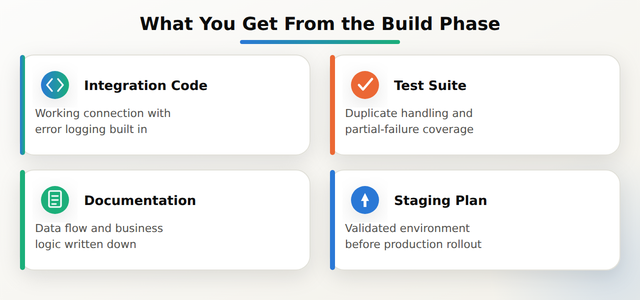
The build phase implements the architecture with automated tests covering the edge cases identified in discovery, not just the happy path. Deliverables typically include:
- Working code or middleware connecting the systems, with error logging
- A test suite covering duplicate handling, partial failures, and data validation
- Documentation of the data flow and any business logic applied during sync
Phase 4: Staged Deployment
Rather than flipping a switch in production, a proper engagement deploys to a staging environment first, validates with real (or realistic sample) data, and rolls out with a plan to revert if something goes wrong. This is the phase generic HubSpot custom integration work often skips, which is where "it worked in testing" integrations go sideways in production.
Phase 5: Ongoing Monitoring
After go-live, the engagement typically includes a monitoring window to catch issues that only show up with real usage, unexpected data formats, volume spikes, or third-party API changes, plus a defined support arrangement for after that window closes.
How Amwhiz Helps
Amwhiz runs custom integration engagements through all five phases above, with discovery and testing treated as core deliverables rather than corners to cut, so the integration holds up once it's handling real data and real volume.
Frequently Asked Questions about Custom Integration Engagements
How long does a custom integration engagement take?
Most engagements run 4-10 weeks from discovery to deployment, depending on how many systems are involved and how complex the data mapping and business logic are.
What's the difference between a custom integration and a pre-built connector?
A pre-built connector offers fixed, generic sync logic between two popular tools. A custom integration is designed around your specific data model, business rules, and edge cases, which matters once your workflow doesn't match the connector's assumptions.
Do I need to provide technical documentation of my systems upfront?
Not necessarily, discovery typically includes auditing the systems involved as part of the engagement, though existing documentation or API access speeds that phase up considerably.
What happens if the integration breaks after launch?
A proper engagement includes a post-launch monitoring window and a defined ongoing support arrangement, so issues from real-world data or third-party API changes get caught and fixed rather than left to surface as customer complaints.
Can a custom integration connect more than two systems?
Yes. Multi-system integrations, for example CRM, ecommerce platform, and accounting software all syncing together, are common, though they typically add to both timeline and cost due to the added data mapping complexity.
What does a custom integration typically cost?
Cost scales with the number of systems, data complexity, and testing requirements; simple two-system integrations commonly start in the low thousands, while multi-system engagements with custom business logic run higher. A scoped discovery phase is the most reliable way to get an accurate estimate.
Conclusion
A custom integration engagement is more than writing code to connect two APIs, the discovery, architecture, testing, and monitoring phases are what determine whether the integration actually holds up in production. Understanding the full scope upfront helps set realistic expectations for timeline, cost, and what "done" actually means.
Amwhiz scopes and delivers custom integration engagements across all five phases so systems stay connected reliably, not just on launch day. Visit amwhiz.com or email sales@amwhiz.com to get started.