-1.png?width=134&height=66&name=amwhiz-logo%20(1)-1.png)




How to Create a High-Performance Revenue Operations System in HubSpot Your company has sales team,...
How to Create a Seamless Handoff Between Marketing, Sales, and Service in HubSpot
A prospect becomes a lead. Marketing nurtures them. Sales closes them. They become a customer. Customer success onboards them. Support helps them when issues arise. Each handoff is a critical moment. If executed poorly, customers slip through cracks.
Without proper handoffs, marketing and sales argue about lead quality. Sales complains marketing sends unqualified leads. Sales and success have disconnects about customer status. Success and support don't coordinate. Customer experiences fragmentation.
A seamless handoff process in HubSpot keeps customers moving smoothly between teams. Marketing to sales. Sales to success. Success to support. Everyone has context. Everyone knows what happened before. Customers experience continuity.
Why Handoffs Determine Customer Experience
Every handoff is a moment of truth. If handoff goes well, customer feels taken care of. If handoff is messy, customer feels neglected. "Why am I being asked the same question twice?" "Why doesn't this team know what we discussed?" Bad handoffs frustrate customers.
Smooth handoffs also make teams more efficient. Sales doesn't waste time on unqualified leads. Success doesn't waste time onboarding customers who aren't ready. Support doesn't re-gather information they already have.
The Four Critical Handoffs
Handoff 1: Marketing to Sales
Lead is ready for sales. Marketing passes lead to sales. Sales needs to know: how did this lead come in? What do they know about our product? What was their engagement history? Are they qualified? Marketing owns this handoff by providing context.
Handoff 2: Sales to Success
Deal closes. Customer signs. Success takes over. Success needs to know: what was promised in the deal? What are customer's success metrics? Who are the key stakeholders? What's the implementation timeline? Sales owns this handoff by documenting deal specifics.
Handoff 3: Success to Support
Customer is live and succeeding. But they'll have support needs. When customer contacts support, support needs context. What's their implementation status? What are they trying to do? What have we already helped them with? Success owns this handoff by keeping support informed.
Handoff 4: Support Back to Success
Support resolves an issue. But that issue might indicate bigger problem. Support needs to alert success. "This customer is struggling with feature X." "This customer has scaling issues." Success owns the ongoing relationship. Support alerts success to problems.
Setting Up Seamless Handoffs in HubSpot
Step 1: Define Clear Criteria for Each Handoff
Marketing to sales: what makes a lead sales ready? Engagement level? Budget confirmed? Timeline? Document criteria. Only pass leads meeting criteria. Sales respects marketing because leads are qualified.
Sales to success: what information does success need? Deal amount? Stakeholders? Success plan? Create checklist. Sales completes checklist before handing off.
Step 2: Create Handoff Workflows
When lead qualifies, workflow alerts sales rep. Includes lead context. When deal closes, workflow creates service ticket in success. Includes deal information. When success completes onboarding, workflow notifies support. Automation ensures nothing falls through cracks.
Step 3: Build Context Documents
Each contact or deal has a context document. Marketing compiles lead context: source, engagement, interactions. Sales compiles deal context: stakeholders, budget, timeline, implementation plan. Success compiles customer context: adoption status, key metrics, known issues. Context document travels with the customer.
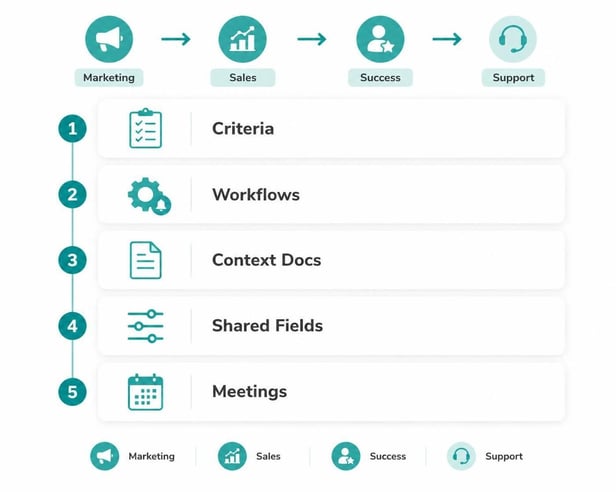
Step 4: Create Shared Properties
Some properties are owned by marketing. Lead source. Engagement score. Some by sales. Deal size. Close date. Some by success. Onboarding status. Implementation timeline. Some by support. Issue count. NPS score. All teams can see all properties. Everyone has full context.
Step 5: Schedule Handoff Meetings
Weekly marketing to sales meeting: review qualified leads. Discuss what's working and what's not. Sales to success meeting: review new customers. Make sure success team is ready. Success to support meeting: review customer status and escalation issues. These meetings keep teams aligned.
Best Practices for Smooth Handoffs
Over Communicate
Send more context than you think necessary. The receiving team always has questions. Better to over communicate than under communicate. Include links to relevant information. Summarize key points.
Make It Easy for Receiving Team
Don't make sales dig for lead information. Put it in front of them. Don't make success hunt for deal details. Automate the handoff. Make it effortless for receiving team to get what they need.
Hold Handing Team Accountable
If marketing passes unqualified lead, sales should send it back. If sales forgets to document deal details, success should hold them accountable. Accountability improves handoffs.
Measure Handoff Success
Track metrics: what percentage of leads does sales accept versus reject? How long does sales take to contact qualified leads? How complete is deal documentation at handoff? How quickly does success get customer live? These metrics show whether handoffs are working.
Iterate and Improve
Handoffs are never perfect. They evolve as business grows. Quarterly review: are handoffs working? What's frustrating receiving teams? What's missing? Make adjustments. Smooth handoffs are a process of continuous improvement.
FAQ About Seamless Handoffs
Who owns the handoff process?
Depends on the handoff. Marketing to sales: marketing owns quality, sales owns follow up speed. Sales to success: sales owns documentation, success owns onboarding. Success to support: success owns escalation, support owns resolution. Both teams own the handoff. Neither can blame the other for problems. Shared responsibility drives better handoffs.
What if receiving team doesn't like what they receive?
That's feedback. Sales doesn't like quality of leads? Discuss with marketing. What's missing? What criteria aren't being met? Success doesn't like deal documentation? Ask sales to improve. Feedback loop improves handoffs. Some friction is normal. But persistent problems require process changes.
How do I prevent leads from bouncing between teams?
Clear handoff criteria prevent bouncing. If lead meets criteria, sales is committed to working it. If lead doesn't meet criteria, sales returns it. Marketing should take returned leads back to nurture. Don't let leads bounce. Either marketing nurtures or sales works. Not both, not neither.
What if customer needs service before sale is complete?
This happens. Customer gets demo. Has technical question. Support should help answer but alert sales that customer has technical concerns. Sales and support coordinate. Success doesn't take over until customer is official. But support and sales work together.
How do I know if my handoffs are working?
Ask each team. Are they getting what they need? Are they frustrated? Are customers experiencing continuity? Track metrics: time between stages, error rates, customer satisfaction. If teams are happy and metrics look good, handoffs are working. If teams are frustrated and metrics are bad, handoffs need fixing.
Should I use automation or manual handoffs?
Both. Automate what you can: lead routing, deal creation, ticket creation. Manual handoffs for things that need human judgment: sales deciding whether to take lead, success planning with customer, support escalating issue. Automation handles routine. Humans handle judgment calls.
What information must travel with handoff?
At minimum: customer contact info, context of what happened before, next steps, key contacts, any sensitive information. For marketing to sales: lead source, engagement history, any objections mentioned. For sales to success: deal details, stakeholders, budget, timeline. For success to support: customer status, known issues, past solutions. Don't make receiving team re-gather basic information.
How do I handle complex deals with multiple stakeholders?
Document all relationships. Who's the champion? Who's the economic buyer? Who's the technical decision maker? Pass this to success. Success needs to know who to contact about what. Who do you call if implementation is delayed? Who do you call if customer wants to expand? Clear stakeholder map makes handoff smooth.
What if customer wants something unexpected during handoff?
Escalate. If lead wants something outside sales scope, escalate to sales leader. If customer wants something outside success scope, escalate to success leader. Have clear escalation path. Don't let confusion at handoff turn into bigger problem downstream. Escalate early and often.
Ready to Create Seamless Handoffs?
Seamless handoffs are the difference between fractured customer experience and unified experience. When handoffs work, customers feel taken care of. Teams are efficient. Revenue grows.
At Amwhiz, we're a HubSpot Diamond Solution Partner specializing in cross team alignment and handoff processes.
Book a HubSpot consultation with Amwhiz today. We'll audit your current handoffs and design processes that keep customers moving smoothly between teams.