-1.png?width=134&height=66&name=amwhiz-logo%20(1)-1.png)


HubSpot migration pricing in 2026 is driven primarily by data volume, the number of custom fields and workflows to remap, how many integrations need to be rebuilt, and how many hubs are involved, simple single-hub migrations commonly run in the low thousands, while complex multi-hub migrations with heavy customization and integrations can reach well into five figures. Amwhiz prices migrations against these same cost drivers, detailed on our HubSpot migration services page, so clients can see exactly what's pushing their quote up or down.
What Drives HubSpot Migration Pricing in 2026?
The Short Answer
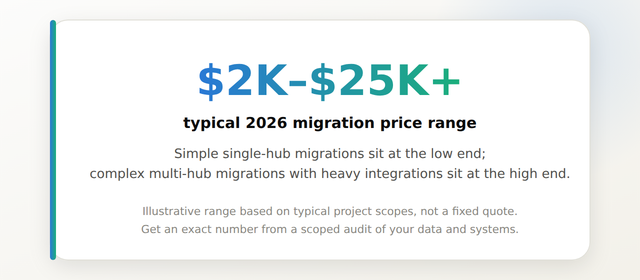
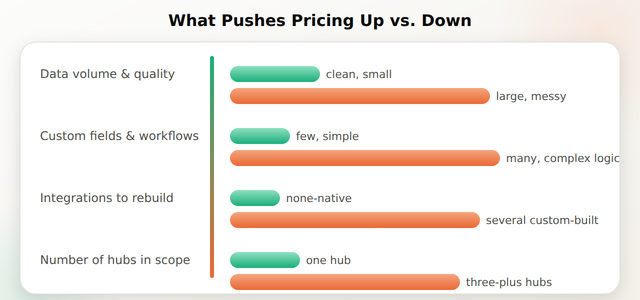
Four factors drive most of the variance in HubSpot migration pricing: data volume and quality (more records and messier data cost more to clean and validate), the number of custom fields and workflows that need remapping (not just copying), how many third-party integrations need to be rebuilt or repointed, and how many hubs are in scope. As a rough illustrative range, a simple single-hub migration with clean data and no integrations commonly falls in the low thousands of dollars, a mid-complexity migration with some customization and one or two integrations often lands in the mid-to-high thousands, and a complex multi-hub migration with heavy customization and several integrations can run into five figures.
Cost Driver 1: Data Volume and Data Quality
More records generally means more migration work, but volume alone isn't the biggest factor, data quality is. A clean 50,000-contact database with consistent fields migrates faster and cheaper than a messy 10,000-contact database full of duplicates, inconsistent formatting, and missing required fields. Cleanup work is typically priced separately from the migration itself, since it's genuinely a different task requiring its own time estimate.
Cost Driver 2: Custom Fields and Workflow Remapping
Migrating a custom field is not the same task as migrating a standard one, it requires deciding how the field type maps into HubSpot, whether historical values need transformation, and whether any workflow logic depends on it. Workflows themselves are usually priced per workflow or per bundle, since each one needs its trigger and action logic manually rebuilt rather than copy-pasted. Portals with dozens of legacy workflows accumulated over years cost meaningfully more to migrate than a lean, recently-built setup, see our breakdown of what breaks most often during a HubSpot migration for why this remapping work matters.
Cost Driver 3: Integrations
Every third-party system connected to your current CRM, Shopify, Zoho, WhatsApp, a custom internal tool, needs to either be rebuilt against the new HubSpot portal or repointed and retested. Simple, well-documented integrations (like HubSpot's native app connections) are relatively inexpensive to migrate. Custom-built integrations with bespoke logic are considerably more expensive, since they require the same development effort as building a new integration, not just a configuration change. Amwhiz's HubSpot custom integration services are commonly priced as a distinct line item within a migration project for exactly this reason.
Cost Driver 4: Number of Hubs in Scope
Migrating only your CRM data and Sales Hub configuration is a narrower, cheaper project than migrating Marketing Hub campaign history, Service Hub ticket pipelines, and Sales Hub deals simultaneously. Each additional hub in scope adds its own data model, workflows, and reporting considerations, which is why multi-hub migrations occupy the higher end of typical pricing ranges.
What Tends to Keep Pricing Down
The migrations that land at the lower end of the range share a few traits: clean source data with minimal duplicates, a modest number of custom fields and workflows, native or well-supported integrations rather than heavily custom ones, and a single hub in scope. Investing a little time cleaning source data before migration begins is one of the most reliable ways to reduce overall cost, since it shrinks the most variable line item. See this Salesforce to HubSpot migration case study for an example of how scope decisions affected a real project's cost and timeline.
How Amwhiz Helps
Amwhiz scopes every migration quote against these four cost drivers explicitly, so clients see exactly what's inflating or reducing their price before committing. Our HubSpot migration services start with a scoped audit that produces a transparent, itemized estimate rather than a flat guess.
Frequently Asked Questions About HubSpot Migration Pricing in 2026
What's a realistic starting price for a simple HubSpot migration?
Simple single-hub migrations with clean data and no custom integrations commonly start in the low thousands of dollars. This assumes minimal cleanup work and few or no custom workflows to rebuild.
What can push a HubSpot migration into five-figure pricing?
Multiple hubs in scope, a large volume of messy or duplicate data requiring cleanup, dozens of custom workflows that need manual rebuilding, and several custom-built (non-native) integrations are the factors most likely to push a migration to the higher end of the range.
Is data cleanup included in migration pricing, or is it separate?
It's typically priced as a separate line item, since cleanup (deduplication, formatting, filling gaps) is a distinct task from the migration itself and its scope depends entirely on how messy the source data is.
Does migrating multiple hubs cost proportionally more, or does it scale differently?
It's not strictly linear, some setup and audit work is shared across hubs, but each additional hub still adds its own data model, workflows, and reporting considerations, so total cost does increase meaningfully with hub count.
How can we reduce our HubSpot migration cost?
The most effective lever is cleaning and deduplicating source data before migration starts, since messy data is one of the biggest cost drivers. Narrowing hub scope and simplifying integrations before migration (rather than during) can also meaningfully reduce cost.
Should I get more than one quote for a HubSpot migration?
It's reasonable to, but make sure each quote breaks pricing down by the same cost drivers, data volume/quality, fields and workflows, integrations, and hub count, so you're comparing like-for-like scope rather than just comparing bottom-line numbers.
Conclusion
HubSpot migration pricing in 2026 isn't arbitrary, it moves predictably with data volume and quality, the number of custom fields and workflows, how many integrations need rebuilding, and how many hubs are in scope. Understanding these drivers is the fastest way to get an accurate quote and to find real opportunities to bring cost down.
Amwhiz prices HubSpot migrations transparently against these exact cost drivers so there are no surprises once the project starts. Visit amwhiz.com or email sales@amwhiz.com to get started.