-1.png?width=134&height=66&name=amwhiz-logo%20(1)-1.png)


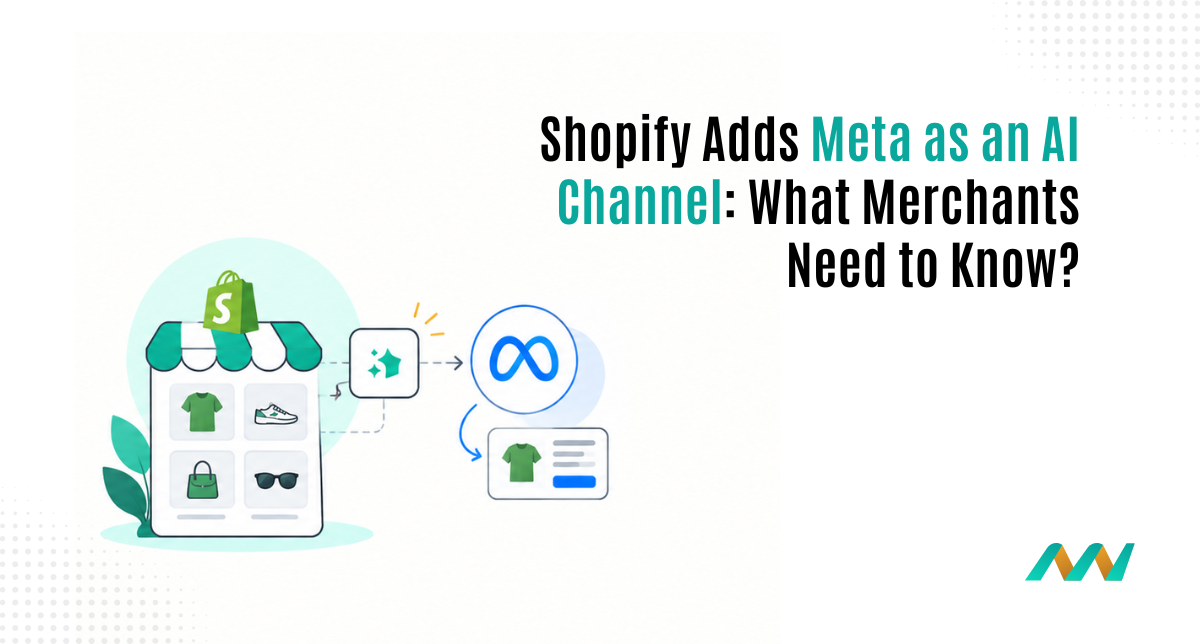
Shopify is making another significant move into AI-powered commerce by adding Meta as an AI channel within its Agentic Storefronts ecosystem. The update gives eligible Shopify merchants another route for getting products discovered through emerging AI shopping experiences and, where supported, allowing customers to complete purchases through Meta.
For ecommerce businesses, the important story is bigger than the addition of another sales channel. Shopify is changing the role of the product catalog. Product information that once existed primarily to support a website visitor, Google search, or a shopping feed is increasingly becoming the data layer used to help AI systems understand what a merchant sells.
That shift deserves attention from every Shopify brand investing in organic growth, paid acquisition, social commerce, or conversion optimization.
Shopify Is Building a Wider Distribution Layer for Products
The traditional Shopify growth model is relatively familiar. A merchant builds a store, attracts visitors through search, advertising, social media, email, referrals, and marketplaces, and then tries to convert those visitors on the website.
AI introduces another layer between discovery and purchase.
Instead of beginning with a conventional search query, consumers can increasingly describe what they need in natural language. An AI-powered experience can interpret the request, identify relevant products, compare available options, and potentially move the customer toward a transaction.
Shopify's addition of Meta fits directly into this transition.
The company is creating infrastructure that allows eligible merchants to make product information available to AI-driven commerce environments without rebuilding their entire ecommerce operation around each individual platform.
For Shopify merchants, this creates a much more important question internally: Is your product catalog ready to be interpreted by machines as effectively as it is presented to people?
That is where many stores still have work to do.
Meta Adds Another Route From Product Discovery to Checkout
Meta already plays a major role in ecommerce through Facebook, Instagram, advertising, creator content, product catalogs, and social shopping.
Adding Meta to Shopify's AI channel strategy extends that relationship into a more conversational shopping environment.
Eligible Shopify merchants can make products available through Shopify Catalog, while eligible stores can support direct checkout within supported Meta experiences. Merchants can also choose to send shoppers back to their Shopify storefront instead.
This distinction matters because merchants do not have to treat every AI shopping interaction as an identical conversion path.
A brand selling straightforward consumer products may benefit from reducing the distance between discovery and checkout. A premium retailer with a highly considered purchase may prefer bringing the customer back to its own website, where it controls merchandising, storytelling, upselling, customer data collection, and the broader conversion experience.
The right decision will depend on the business model rather than a universal preference for one checkout path.
The Current Numbers Put the Opportunity Into Perspective
The rollout has several important commercial and technical boundaries. Merchants should understand these before changing their ecommerce strategy.
| Factor | Current Shopify and Meta Opportunity |
|---|---|
| AI commerce channel | Meta |
| Product information source | Shopify Catalog |
| Direct checkout | Available for eligible merchants |
| Current direct checkout markets | United States, Canada, Mexico |
| Product synchronization | Facebook and Instagram by Meta |
| Standard payment processing | Applies |
| Additional Meta selling fee for direct checkout | None |
| Google Analytics during Meta direct checkout | Does not fire |
| Custom client-side pixels during direct checkout | Do not fire |
| Subscriptions | Currently unsupported for direct Meta checkout |
| Product bundles | Currently unsupported |
| Customizable products | Currently unsupported |
| B2B-only products | Currently unsupported |
The market availability is especially relevant for U.S. Shopify merchants. The United States is currently among the supported markets for direct Meta checkout, making the update particularly relevant for brands whose primary customer base is American consumers.
However, eligibility does not mean every product will automatically receive exposure. Merchants still need strong product information, appropriate catalog configuration, eligible products, and a compelling customer experience.
That distinction is important for setting realistic expectations.
Your Product Catalog Is Becoming a Revenue Asset
This is where Shopify merchants should pay the closest attention.
Many ecommerce businesses still treat product data as an administrative responsibility. Product titles are entered, descriptions are written, images are uploaded, pricing is added, and the merchandising team moves on to the next SKU.
That approach is becoming outdated. Your product catalog is increasingly responsible for communicating product meaning across multiple digital environments.
Consider a product titled: "Women's Running Shoes"
Now compare it with: "Women's Lightweight Trail Running Shoes With Cushioned Grip for Outdoor Running"
The second description provides substantially more context. It communicates the audience, product type, use case, positioning, and characteristics.
That context matters when an AI system is trying to determine whether a product matches a shopper's request.
The same principle applies to descriptions. A product page should explain what the product is, who it serves, how it is used, relevant specifications, materials, dimensions, compatibility, limitations, and other details that influence the purchase decision.
This is where SEO, GEO, and ecommerce merchandising begin to overlap.
GEO Strategy Starts With Better Product Information
Generative Engine Optimization should not become another exercise in stuffing keywords into product pages.
For Shopify stores, a practical GEO strategy starts with making product information exceptionally clear.
Imagine a customer asking an AI shopping assistant:
"I need a carry-on suitcase for a five-day business trip that is lightweight and has enough space for a laptop."
A product page that only says "Premium Carry-On Suitcase" provides limited context.
A page that explains dimensions, weight, laptop compatibility, storage capacity, wheels, materials, airline suitability, and intended use gives an AI system considerably more information to work with.
This is where ecommerce teams should direct their effort.
Instead of asking how many times a target keyword appears on a product page, ask whether the page clearly communicates the product's identity and relevance.
That is a much more sustainable approach to AI search optimization.
Search Intent Is Moving From Keywords Toward Context
Traditional SEO often begins with keyword research.
AI-powered discovery increasingly begins with intent.
A customer might search Google for:
"best leather backpack for men"
But an AI shopping interaction may sound more like:
"Find me a durable leather backpack for commuting that can fit a 16-inch laptop and doesn't look too formal."
The second request contains considerably more commercial context.
Shopify merchants should therefore expand their content strategy beyond individual keywords. Product pages, collection pages, buying guides, comparison content, FAQs, and supporting blog articles should collectively explain the situations in which products make sense.
That creates a stronger information ecosystem around the store.
It also gives search engines and AI systems more context when determining relevance.
AEO Gives Product Pages Another Job
Answer Engine Optimization is also becoming increasingly relevant to ecommerce.
AEO focuses on making information easy for answer engines to understand and use when responding to user queries.
For Shopify stores, that means product pages should answer practical questions directly.
How much does the product weigh?
What materials are used?
What size should a customer choose?
What devices are compatible?
What problem does the product solve?
Who is the product designed for?
What is included?
How long does shipping take?
What is the return policy?
The answers should be written naturally within the page rather than assembled as artificial blocks of SEO copy.
This approach also improves conversion because customers receive the information they need without having to search through multiple pages.
Good AEO content and good ecommerce UX increasingly reinforce each other.
Direct Checkout Creates a New Analytics Challenge
There is one area where Shopify merchants should proceed carefully.
Direct checkout through Meta changes the way traditional website analytics can capture customer activity.
During Meta's direct checkout experience, Google Analytics and custom client-side pixels do not operate in the same way they do on a merchant's regular Shopify checkout.
That means an ecommerce team could potentially see revenue attributed to Meta within Shopify while its existing analytics setup does not capture the complete customer journey.
This is more than a technical inconvenience.
Marketing teams make budget decisions based on attribution. If AI-assisted discovery generates revenue that is not properly represented in reporting, the channel may appear weaker or stronger than it actually is.
Before expanding investment, ecommerce teams should establish a clear reporting framework covering Shopify revenue, Meta-attributed orders, direct checkout transactions, website conversions, average order value, conversion rate, and customer acquisition cost.
AI commerce should be measured as a distinct acquisition and conversion pathway rather than forced into an old reporting structure.
Not Every Shopify Product Is Ready for AI Commerce
Merchants should also resist the temptation to push their entire catalog into every new channel without reviewing product eligibility.
Straightforward D2C products are generally easier to represent in an AI shopping environment. Products involving complex customization, subscriptions, bundles, or B2B-specific purchasing conditions can create additional constraints.
That makes product selection an important part of the rollout.
For a store with 10,000 SKUs, there is little reason to begin by auditing every product equally.
Start with the products that already generate meaningful revenue and organic demand.
Review their titles, descriptions, images, pricing, inventory, variants, categories, specifications, and customer-facing information. Once the strongest products are properly structured, apply the same standards to the broader catalog.
This approach gives the ecommerce team a manageable starting point and creates a repeatable catalog optimization process.
Shopify SEO and AI Commerce Should Be Managed Together
There is a tendency to treat traditional SEO and AI optimization as separate marketing disciplines.
For Shopify merchants, that would create unnecessary complexity.
Technical SEO remains important. Product pages need to be crawlable. Internal linking needs to make sense. Duplicate URLs should be controlled. Structured information should be accurate. Pages need useful content and strong user experience.
At the same time, product information needs to be sufficiently descriptive for AI-driven discovery.
These objectives generally support one another.
A technically accessible page with thin product information is still weak.
A detailed product page that search engines cannot properly crawl is also weak.
The opportunity is to build product pages that satisfy both requirements.
The Product Page Is Becoming the New Commerce Data Hub
The biggest strategic implication of Shopify's Meta AI channel is the changing role of the product page.
Previously, the product page was primarily a destination.
Now it can also function as a structured source of commercial information that feeds multiple discovery environments.
That means ecommerce teams should stop thinking about product descriptions as small blocks of copy written once and forgotten.
Product content should evolve with customer behavior.
If customers repeatedly ask about compatibility, add compatibility information. If sizing creates returns, improve the sizing explanation. If customers want to know whether a product works for a particular use case, address that use case directly.
This creates a valuable feedback loop between merchandising, SEO, customer support, and conversion optimization.
The Best Strategy Starts With Your Highest-Value Products
For most Shopify merchants, the first step should be a focused catalog audit.
Select the top products by revenue, organic traffic, conversion rate, or strategic importance. Then evaluate whether each product contains enough information for a customer or AI system to understand its purpose immediately.
The audit should examine product naming, descriptions, attributes, images, specifications, pricing, inventory, variants, reviews, FAQs, internal links, structured information, and policy details.
Then identify the information gaps.
A product page that ranks well but converts poorly may need better commercial information. A product that converts well from paid traffic but receives little organic visibility may need stronger content and discoverability. A product with strong demand but inconsistent inventory may need operational attention before additional traffic is generated.
The goal is not to optimize everything at once.
The goal is to identify where better product information can produce measurable commercial value.
What Shopify Merchants Should Prioritize in 2026
The Shopify and Meta development should push ecommerce teams toward a more connected growth model.
| Priority | Merchant Action | Business Impact |
|---|---|---|
| Product data | Improve titles, descriptions, specifications, and attributes | Stronger product understanding |
| SEO | Strengthen product and collection page architecture | Better organic discovery |
| GEO | Build content around natural-language shopping intent | Greater AI discovery potential |
| AEO | Answer product and buying questions clearly | Better answer-engine visibility |
| Catalog | Maintain accurate price and inventory information | Better customer trust |
| Analytics | Separate AI and direct-checkout performance | More accurate attribution |
| Conversion | Improve product information and purchase confidence | Higher conversion potential |
| Content | Build supporting comparison and buying content | Wider topical coverage |
This is where Shopify merchants can gain a practical advantage.
The objective should not be to chase every new AI feature as soon as it appears. The objective should be to build an ecommerce foundation that performs well regardless of which discovery platform becomes dominant.
The Next Competitive Advantage Will Be Product Context
AI-powered shopping is still developing, and no merchant can predict exactly how consumers will shop several years from now.
What is already becoming clear is that product context matters.
AI systems need to understand what a product is, who it is for, how it differs from alternatives, what attributes it has, and whether it satisfies a particular customer requirement.
Merchants that provide weak information make that interpretation harder.
Merchants that build detailed, accurate, commercially useful product data give their products a stronger foundation for discovery.
That makes product content a strategic ecommerce asset rather than a routine publishing task.
Final Takeaway for Shopify Merchants
Shopify adding Meta as an AI channel is another indication that the ecommerce customer journey is becoming increasingly distributed.
A shopper may discover a product through search, social media, an AI assistant, a recommendation engine, a creator, or a conversational shopping experience. The merchant still needs one reliable source of truth behind all of those interactions.
That source is the product catalog.
For Shopify brands, the immediate opportunity is to improve the quality of that catalog, strengthen product-level SEO, create content around real buying intent, make important information easy for answer engines to understand, and establish measurement that accurately reflects where sales originate.
The brands that do this well will be better prepared as AI becomes a larger part of product discovery.
Your Shopify store is no longer competing only for clicks. It is competing to be understood.
Frequently Asked Questions
What is Shopify's Meta AI channel?
Shopify's Meta AI channel connects eligible Shopify products with Meta's emerging AI-powered commerce experiences. Products can be made available through Shopify Catalog, with eligible merchants also able to support direct checkout through Meta.
Is Shopify's Meta AI channel available to every merchant?
Availability depends on Shopify's eligibility requirements, the merchant's products, market, store configuration, and the specific Meta commerce functionality being used. Merchants should review their Agentic Storefront settings before assuming their entire catalog is eligible.
Can customers purchase Shopify products directly through Meta?
Yes, eligible merchants can offer direct checkout through supported Meta experiences. Direct checkout currently applies to customers in the United States, Canada, and Mexico.
Does AI commerce replace Shopify SEO?
No. Shopify SEO remains important because search engines continue to drive substantial ecommerce discovery. AI commerce adds another discovery layer, making strong product information increasingly useful across both traditional and generative search environments.
How can Shopify merchants optimize products for AI discovery?
Start with the fundamentals. Use precise product titles, detailed descriptions, accurate attributes, useful specifications, high-quality images, current pricing, reliable inventory, clear policies, and content that addresses genuine customer buying intent. Build product and supporting content around how customers naturally describe their needs rather than relying on repetitive keyword placement.