-1.png?width=134&height=66&name=amwhiz-logo%20(1)-1.png)


Your Business Runs on a Dozen Tools. They Should Act Like One. Most businesses don't run on a...
written by: Renuka M
Shopify API Integration Guide for Connecting Apps Systems and Automating Workflows
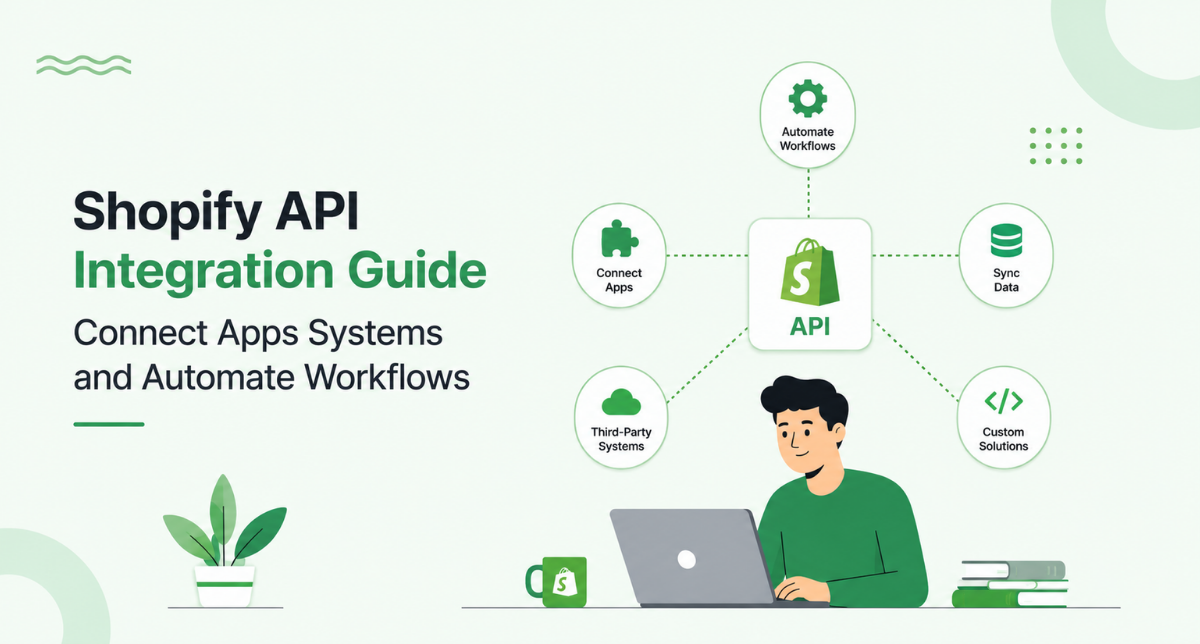
Shopify API is powerful. You can connect almost anything to Shopify. Build custom workflows. Automate tasks that currently consume hours every week.
But APIs sound complicated. You might think you need a PhD in computer science to use them. You don't. You just need the right guide.
What Shopify API Integration Actually Enables
The Shopify API is essentially a way for different software systems to talk to each other. You connect QuickBooks. Orders from Shopify flow into QuickBooks automatically. Invoices generate themselves. Accounting is done. No manual data entry.
You connect your email marketing platform. Customer purchases a product. They're automatically added to your email list. Relevant campaigns start flowing. They get re-engaged. They buy again.
You connect your inventory system. Stock levels sync in real-time. You sell out online? Your physical store knows and doesn't sell it. You restock in the warehouse? Online updates immediately.
What You Can Do With Shopify API
- Connect inventory management systems (real-time sync)
- Sync data to accounting software (QuickBooks, Xero, Wave)
- Build custom apps (your own unique software)
- Integrate marketing tools (Klaviyo, Mailchimp, Gorgias)
- Pull data for reporting (create custom dashboards)
- Automate order processing (fulfilled automatically)
- Manage customer data (centralized CRM)
- Build internal tools (dashboards, reports, analysis)
Real World Examples of Shopify API Integration
Example 1: Accounting Integration
Connect QuickBooks to Shopify via the API. Orders sync automatically. Invoices generate automatically. Customer payments are recorded. Tax is calculated. By Friday, your accounting is done. Instead of a day of manual work, it's automatic.
Example 2: Inventory Sync
Connect your warehouse system to Shopify. When you receive new stock, inventory updates automatically in Shopify. When you sell a unit online, it decrements in the warehouse system. One source of truth.
Example 3: Customer Data Central
Integrate a CRM. Customer purchases on Shopify? They're added to CRM automatically. Their purchase history syncs. Your sales team can see the full customer context. Better selling conversations.
Implementation of Shopify API Integration
Simple Integration (10-20 hours development)
One system to Shopify. QuickBooks sync. One-way data flow. Takes 1-2 weeks. Cost: $1,000-3,000.
Standard Integration (40-60 hours)
Two-way data sync. Multiple systems talking to Shopify. Full automation. Takes 4-8 weeks. Cost: $4,000-10,000.
Complex Integration (100+ hours)
Multiple systems, complex logic, error handling, redundancy. Takes 8-16 weeks. Cost: $10,000-30,000+.
FAQ About Shopify API Integration
Is the Shopify API difficult to use?
For developers, no. Well-documented, straightforward. For non-developers, yes. You need to hire someone. It's not a DIY tool for non-technical people.
Can I connect my accounting software via the API?
Yes. Most popular accounting software has Shopify integration. QuickBooks, Xero, Wave, FreshBooks, others. Many have native integrations so you don't need custom development.
Is API integration secure?
Yes. OAuth authentication is used. Data is encrypted. Shopify handles security. You're not managing payment card data or customer PII. Secure by design.
Can I integrate my custom software?
Yes. If your software can make API calls (most can), you can connect it. Hire a developer to build the connection between your system and Shopify.
How do I get started with Shopify API?
Read Shopify's API documentation. For simple projects hire freelance developer from Upwork. For complex projects hire an agency. Get references. Understand their experience.
What if the system breaks after implementation?
Bugs happen. The developer should provide some warranty and support. Negotiate 30-90 days of free support with fixes. After that, bugs cost money.
How do I know if an integration is worth building?
If it saves more than 5 hours per week of manual work, it's worth it. That's $250+ per week in labor value. Worth investing in.
Can I integrate webhooks?
Yes. Webhooks trigger external actions. Order placed? Webhook fires. Your warehouse gets notified automatically. Highly flexible.
What about data accuracy and syncing?
Well-designed integrations have error checking and logging. If something fails, you get notified. Data is validated before syncing. Professional integrations have reliability built in.
How much ongoing support do I need for API integration?
After launch, minimal. Maybe bug fixes or minor updates. Budget $500-1,500 per year for maintenance and support.