-1.png?width=134&height=66&name=amwhiz-logo%20(1)-1.png)




HubSpot’s Latest Workflow Enhancements for Complex Automation As businesses grow, so do their...
How Growing Businesses Can Standardize Processes Using HubSpot
You were a startup. Everyone wore multiple hats. Everyone did things their own way. Sales reps had different processes. Marketing had ad hoc approaches. Customer success was reactive.
Now you're growing. You have 50 people. 100 people. Each person does things differently. Sales rep A qualifies leads one way. Sales rep B does it differently. Results are inconsistent. Quality varies. Scaling becomes impossible.
Process standardization using HubSpot transforms chaos into order. Everyone follows same process. Quality is consistent. Scaling becomes possible. New team members ramp up faster. Customers get consistent experience.
Why Standardization Becomes Critical as You Grow
At startup stage, lack of process works. Small team, everyone communicates. As you grow, lack of process creates problems. Person A does it one way. Person B does it differently. When they collaborate, confusion results.
Without standardization, quality varies by person. Top rep closes 40 percent. Average rep closes 20 percent. Difference might be process, not skill. If everyone followed top rep's process, overall close rate improves.
Standardization also improves onboarding. New person joins. Here's our process. Follow it. They ramp up in weeks instead of months. Standardization reduces onboarding time and accelerates productivity.
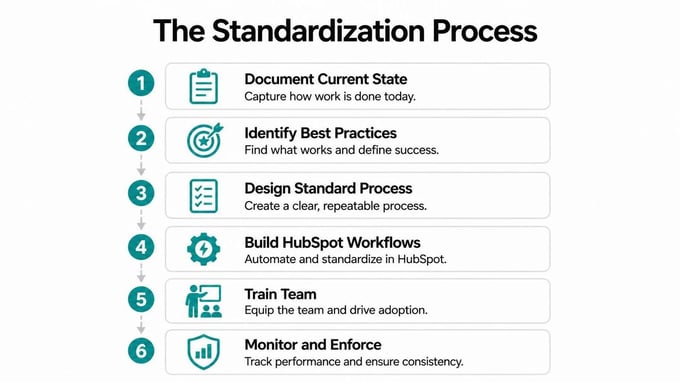
The Standardization Process
Step 1: Document Current State
Before you can standardize, understand current state. How does sales actually qualify leads? How does marketing actually nurture? How does success actually onboard? Interview top performers. Document what they do. They often have undocumented best practices.
Step 2: Identify Best Practices
Who gets best results? What do they do differently? What process leads to best outcomes? Extract best practices from top performers. These become your standard.
Step 3: Design Standard Process
Take best practices. Design repeatable process. Document step by step. Make it clear enough that anyone can follow. Test it with different people. Refine until consistent.
Step 4: Build HubSpot Workflows
Encode process into HubSpot workflows. Lead qualification process becomes lead qualification workflow. Onboarding process becomes onboarding workflow. Workflow forces process compliance. Can't skip steps.
Step 5: Train Team
Train everyone on standard process and supporting workflows. Explain why this is the standard. Show how workflows enforce it. Address concerns. Get buy in.
Step 6: Monitor and Enforce
Monitor compliance. Are people following process? Are workflows executing? Reward compliance. Address non compliance. Consistently enforce until standardization becomes culture.
Core Processes to Standardize
Lead Qualification Process
Everyone qualifies leads the same way. Use same criteria. Ask same questions. Score the same. Consistency means qualified leads are actually qualified. Everyone understands what qualified means.
Sales Process
Sales follows same sales process. Discovery. Demo. Proposal. Negotiation. Close. Consistent process means predictable timeline. Deals move through pipeline consistently. Forecasting becomes reliable.
Onboarding Process
All customers get same onboarding. Same timeline. Same materials. Same check ins. Consistency means faster time to value. Higher adoption. Better retention.
Support Triage Process
All support tickets go through same triage. Same categorization. Same routing. Consistency means fast resolution. No tickets fall through cracks. SLAs are met.
Lead Nurture Process
All leads get same nurture experience. Same sequence. Same timing. Same cadence. Consistency means better engagement rates. Leads are warmed properly before sales touches them.
How HubSpot Enforces Standardization
Workflows Enforce Step Sequence
Workflow forces steps in order. Can't skip steps. Can't change order. Workflow is your process enforcement mechanism.
Field Validation Ensures Quality
Required fields prevent incomplete data. Picklists prevent inconsistent values. Field validation enforces data standards.
Reports Show Compliance
Reports show who is following process. Who is deviating. Reports become enforcement tool. Visibility drives compliance.
Dashboards Visualize Performance
Dashboards show performance metrics. Teams see impact of standardization. Results motivate continued compliance.
Common Standardization Challenges
Top Performers Resist
Top performers think standard process will slow them down. Show them how standard accelerates other team members. Show how it frees them from manual work. Get their buy in. They can often help design standard process.
Different Roles Need Different Processes
Sales process for enterprise is different from SMB. Enterprise sales rep might follow different process than SMB rep. Create role specific processes. Document them. Build separate workflows for each role.
Processes Change Over Time
Market changes. Business evolves. Your standard process needs to evolve. Quarterly review. Gather feedback. Adjust as needed. Standardization isn't set and forget. It requires maintenance.
Enforcement Gets Lax
Initially you enforce compliance. Over time, enforcement gets lax. People revert to old ways. Without ongoing enforcement, standardization breaks down. Consistent enforcement is key.
FAQ About Process Standardization
Does standardization kill creativity?
No. Standardization establishes foundation. Everyone knows base process. Within that foundation, people innovate. Salesperson creates new angle for their territory. Marketing experiments with new channel. Standardization provides consistency while allowing individual initiative.
How do I handle processes that are industry specific?
Some industries have very specific processes. Financial services have compliance requirements. Healthcare has patient privacy requirements. Incorporate industry specifics into standard. Make compliance built in. Don't treat industry requirements as exceptions. Treat them as standard.
What if a process isn't working?
Feedback loop. If standard process isn't working, gather feedback. Why isn't it working? Adjust process. Don't abandon standardization. Refine it. Continuous improvement keeps processes relevant.
How do I measure standardization success?
Track compliance rate. What percentage of records follow process? Track outcome consistency. Are results similar across team? Track time to completion. Does standardized process reduce cycle time? These metrics show if standardization is working.
How quickly does standardization show ROI?
Initial setup takes 4 to 8 weeks. But once running, ROI comes quickly. Onboarding time drops 30 percent. Sales cycle shortens. Support resolution time decreases. Most organizations see ROI within 90 days of full rollout.
Should I standardize everything?
No. Only standardize processes where consistency drives value. Lead qualification absolutely. Sales process absolutely. Support triage absolutely. But maybe not creative processes. Some processes benefit from individual approach. Be selective.
What if different departments need different processes?
Create department specific standards. Sales process is different from support process. That's expected. But within sales, everyone follows same process. Within support, everyone follows same process. Standards can be department specific.
How do I get team buy in for standardization?
Involve team in design. Don't impose standard from top. Gather input. Get feedback. Show how standard helps them. Show results. When team sees benefits, buy in follows. Participation drives adoption.
Can I standardize processes that involve external partners?
Harder but doable. Channel partners might resist. Customers might not want to follow your process. But you can standardize internal processes. How you handle partner interactions. How you track partner activities. You can't force partners to standardize but you can standardize your side.
Ready to Standardize Processes as You Grow?
Standardization is the bridge between startup chaos and enterprise order. It enables growth without compromising quality. It creates culture where consistency is valued and enforced through systems.
At Amwhiz, we're a HubSpot Diamond Solution Partner specializing in process standardization and operational excellence for growing businesses.
Book a HubSpot consultation with Amwhiz today. We'll audit your current processes, identify what needs standardization, and build HubSpot workflows that enforce consistent execution.