-1.png?width=134&height=66&name=amwhiz-logo%20(1)-1.png)


Your CRM, Your Store, and Your Chat App Don't Talk to Each Other by Default
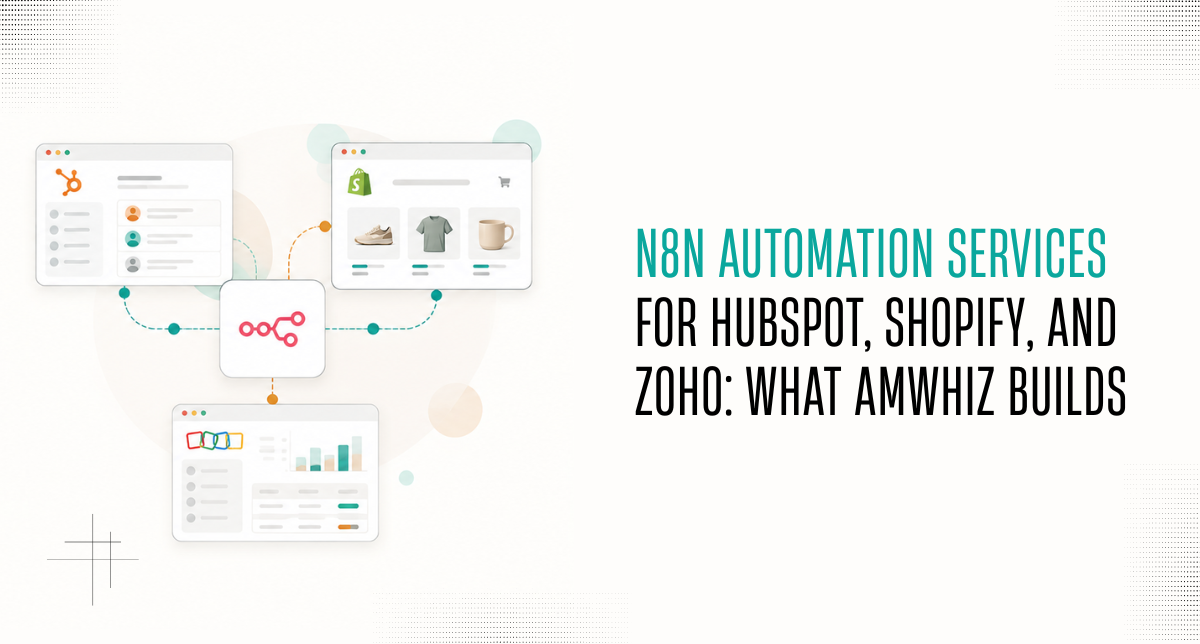
Most teams don't have a data problem. They have a connection problem: a lead sits in HubSpot while the order that qualified them sits in Shopify, and neither system knows what the other just did. Amwhiz builds n8n automation services that close that gap, connecting HubSpot, Shopify, Zoho, and WhatsApp Business into workflows that move data and trigger actions the moment something changes, without a developer rebuilding the connection from scratch every time a platform ships an API update. This post covers what we actually build, how we scope a project, and when n8n workflow automation is the right call instead of a platform's native automation tools.
What Are n8n Automation Services?
The Short Answer
n8n automation services means designing, building, and maintaining workflows on n8n, an open-source workflow automation platform, so that systems like HubSpot, Shopify, Zoho, and WhatsApp Business exchange data and trigger actions automatically instead of relying on manual exports, copy-paste updates, or an engineer writing one-off integration code. A typical build connects two or more platforms through a trigger (a new deal, a new order, an incoming message), applies logic (filtering, scoring, formatting), and pushes the result to wherever it needs to go, whether that's another CRM, a spreadsheet, a Slack channel, or a customer's phone. Amwhiz scopes, builds, and supports these workflows for clients running any combination of HubSpot, Shopify, Zoho, and WhatsApp, including self-hosted n8n deployments for teams that want full control over their data.
The misconception worth flagging directly: n8n automation isn't just "connect App A to App B." The value is in the logic between the trigger and the output: deduplication, error handling, conditional branching, and retries when an API call fails. A workflow that only moves data without that logic breaks the first time a field is empty or an API rate-limits a request.
Why Businesses on HubSpot, Shopify, and Zoho Need n8n
Every platform ships its own native automation tools, HubSpot Workflows, Shopify Flow, Zoho Flow, and each is genuinely good within its own system. The gap shows up between systems, and that's where most operational friction lives:
- A native workflow in one platform generally can't read data from, or write data to, a different vendor's platform without a pre-built (and often limited) app-store connector.
- App-store connectors sync standard fields well but rarely handle custom objects, custom fields, or business-specific logic like scoring a lead differently depending on which product it came from.
- When a connector breaks or a platform changes its API, teams relying on a third-party app have no visibility into why, and no way to fix it themselves.
n8n workflow automation sits above all of these platforms and talks to each one through its API directly, which means the logic isn't limited by what a pre-built connector supports. If HubSpot, Shopify, Zoho, and WhatsApp can each expose the data through an API, n8n can move it, transform it, and route it according to rules specific to your business.
What Amwhiz Builds With n8n
1. Cross-Platform CRM and Order Sync
Keeping HubSpot deals, Shopify orders, and Zoho records aligned in real time, so a purchase in Shopify updates a contact's lifecycle stage in HubSpot without a nightly batch job or a person doing it by hand.
2. WhatsApp Automation Tied to CRM Events
Triggering WhatsApp Business messages (order confirmations, abandoned cart nudges, support follow-ups) from events in HubSpot or Shopify, with replies routed back into the CRM as logged activity instead of disappearing into a separate inbox.
3. AI Workflow Automation With n8n
AI workflow automation with n8n is where we connect n8n to Claude or GPT models for tasks like drafting content, scoring leads, summarizing support tickets, or checking AI-generated content for plagiarism and AI-detection risk before it publishes. We use this pattern internally for our own blog production, and we build the same kind of pipeline for clients who want AI in the loop with a human still gating anything that goes live.
4. Reporting and Alerting Across Systems
Pulling data from HubSpot, Shopify, and Zoho into a single report or dashboard on a schedule, and firing Slack or email alerts when a metric crosses a threshold, without waiting on someone to manually export and combine spreadsheets.
5. Custom Object and Field Sync
Handling the custom objects and fields that standard app-store connectors usually ignore, mapping business-specific data (loyalty tiers, service contracts, custom deal stages) between systems so nothing has to be re-entered by hand.
How We Scope and Build an n8n Automation
We start by mapping the manual handoff that's actually causing pain, not by picking a platform to automate first. From there, the build follows the same shape regardless of which systems are involved: identify the trigger, define the logic and edge cases (What happens if a field is missing? What happens if the API call fails?), build and test the workflow against real data, then hand off with documentation so your team can see what the workflow does without opening n8n itself. For clients who want it, we also set up monitoring so a failed run alerts someone instead of silently dropping data.
n8n vs Native Automation Tools: When Each Makes Sense
Native tools like HubSpot Workflows or Shopify Flow are the right call when the automation stays inside one platform: a HubSpot workflow that changes a lead's lifecycle stage based on form fills doesn't need n8n. n8n earns its place when a workflow needs to cross platforms, needs logic a native tool doesn't support, or needs to call an external API (an AI model, a plagiarism checker, a custom internal system) as part of the process. Most clients end up running both: native tools for what stays inside one platform, n8n for everything that crosses the boundary between systems.
How Amwhiz Helps
Amwhiz is a certified HubSpot, Shopify, and Zoho implementation partner that also designs and builds custom n8n automation services for clients running any mix of these platforms alongside WhatsApp Business. Whether you need one workflow connecting two systems or a full automation layer across your stack, we scope the logic first and build around the checks that keep it reliable, not just the connection itself.
Frequently Asked Questions About n8n Automation Services
What is n8n and how is it different from Zapier or Make?
n8n is an open-source workflow automation platform that can be self-hosted, giving teams full control over their data and no per-task pricing ceiling. Zapier and Make are cloud-only and typically charge per task or per operation, which can get expensive at scale. n8n's visual node-based editor also supports more complex branching logic and custom code steps than most no-code alternatives.
Can n8n connect HubSpot, Shopify, and Zoho at the same time?
Yes. n8n connects to each platform through its API, so a single workflow can read from Shopify, check or update a record in HubSpot, and log an activity in Zoho, all in one run.
Do we need our own developer to maintain an n8n workflow after it's built?
Not necessarily. We document every workflow we build and can hand off ownership to your internal team, or keep it under a support arrangement where we monitor and maintain it. Which approach makes sense depends on how often the workflow needs to change.
Is self-hosted n8n more secure than the cloud version?
Self-hosted n8n keeps your workflow data and credentials on infrastructure you control, which matters for teams with strict data residency or compliance requirements. n8n Cloud is easier to stand up and maintain, and is a reasonable choice when those constraints don't apply. We help clients weigh this based on what's actually flowing through the workflow.
What does an n8n automation project typically cost?
It depends on how many systems are involved and how much custom logic the workflow needs, a simple two-platform sync is a much smaller build than a multi-system pipeline with AI steps and error handling. We scope and quote each project after mapping the actual workflow, rather than pricing by a flat rate that doesn't reflect the complexity.
Conclusion
The platforms you're already running, HubSpot, Shopify, Zoho, WhatsApp, each automate well inside their own walls. The manual work that's actually slowing your team down usually lives in the handoffs between them, and that's exactly what n8n automation services are built to remove.
If a process on your team still depends on someone manually moving data between systems, that's the workflow worth scoping first.
Book a free consultation to scope an n8n automation for your stack.
Amwhiz is a certified HubSpot, Shopify, and Zoho implementation partner that also builds custom n8n automations for content, sales, and ops workflows. Visit our integration services page or email sales@amwhiz.com to get started.