-1.png?width=134&height=66&name=amwhiz-logo%20(1)-1.png)


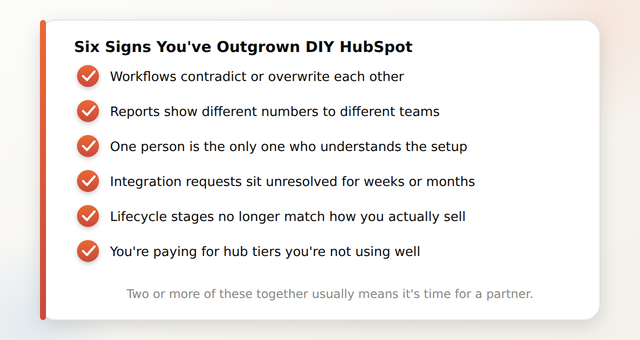
You've outgrown DIY HubSpot when workflows conflict with each other, reporting no longer matches reality, no one on your team fully understands why a given automation exists, or every new integration request stalls for weeks. These are the six clearest signals it's time for a consulting partner rather than another internal fix. Amwhiz works with teams at exactly this inflection point, if any of the signs below sound familiar, our HubSpot consulting services are built to untangle and rebuild on top of what you already have.
What Are the Signs You've Outgrown DIY HubSpot?
The Short Answer
The most reliable signs are: workflows that contradict or duplicate each other, reports that different teams no longer trust, a "bus factor" of one person who understands the setup, integration requests that pile up unresolved, lifecycle stages that no longer reflect your actual sales process, and a growing gap between what HubSpot could do for your team and what it's actually doing. Any one of these alone is manageable; two or more together usually means the cost of staying DIY has quietly exceeded the cost of bringing in a partner.
Sign 1: Workflows Are Fighting Each Other
Early on, workflows get built one at a time to solve one problem at a time. Eighteen months later, it's common to find three different automations touching the same lifecycle stage field, occasionally overwriting each other, and nobody remembers which one is "the real one." If your team has started avoiding building new workflows because you're not sure what they'll break, that's not a minor annoyance, it's a structural sign the system needs a rebuild, not another patch.
Sign 2: Reporting No Longer Matches Reality
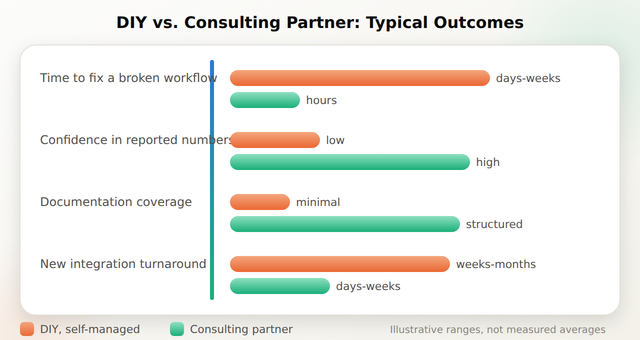
When marketing, sales, and leadership each pull a different revenue number out of HubSpot for the same quarter, the root cause is almost always upstream, inconsistent property use, duplicate records, or attribution that was never configured correctly. DIY teams tend to patch this with a new dashboard rather than fixing the data model underneath it, which just adds a fourth number to the pile. This is one of the most common triggers for bringing in outside help, alongside HubSpot CRM migration mistakes that never got cleaned up after the initial move.
Sign 3: You Have a "Bus Factor" of One
If a single person built most of your automations and that person leaves, goes on leave, or simply gets busy, does the system keep working? Many DIY setups pass this test poorly. A consulting partner's job isn't just to build, it's to document the system so it survives personnel changes, which is a structural risk DIY builds rarely account for.
Sign 4: You're Paying for Features You Don't Use
Teams often upgrade hub tiers to unlock a specific feature, custom report builder, sequences, workflows with more actions, and then use only a fraction of what the tier offers. A consulting partner's audit typically surfaces this quickly: either you're overpaying for an unused tier, or you're underusing a tier you already have and don't need a partner for tooling, just configuration.
Sign 5: Integration Requests Keep Stalling
If HubSpot needs to talk to Shopify, Zoho, WhatsApp, or a custom internal tool and that request has been "on the list" for months, it's usually not a prioritization problem, it's a skills gap. Custom integration work sits outside what most internal marketing or RevOps generalists are equipped to build safely. Amwhiz's HubSpot custom integration services exist specifically for this gap, and our HubSpot integration case study shows what unsticking a stalled integration backlog looks like in practice.
Sign 6: Growth Has Outpaced the System's Design
A HubSpot setup built for 15 reps and one product line rarely scales cleanly to 60 reps and four product lines without a redesign. If your team has grown significantly since the portal was first configured and nobody has revisited the underlying structure, pipelines, territories, permission sets, the system is quietly working against your growth rather than supporting it.
How Amwhiz Helps
Amwhiz specializes in coming in after a DIY build has hit its limits, auditing what exists, keeping what works, and rebuilding what doesn't without forcing a rip-and-replace. Our HubSpot consulting services start with exactly the kind of audit described above, so you know precisely what's broken before anything gets rebuilt.
Frequently Asked Questions About Outgrowing DIY HubSpot
How do I know if it's a DIY problem or just a training problem?
If the issue is one or two people not knowing a feature exists, that's training. If the issue is structural, conflicting workflows, untrustworthy reporting, no one who understands the full setup, training won't fix it, because there's no longer a single correct version of the system to train people on.
Do I have to throw out my existing HubSpot setup to bring in a consultant?
No. Most engagements start with an audit that identifies what's working and preserves it, rebuilding only the parts causing problems. A full rebuild is sometimes recommended, but it's the exception, not the default approach.
What size company typically outgrows DIY HubSpot first?
There's no fixed employee count, it's more about workflow and data complexity than headcount. Teams commonly hit this point somewhere between 10 and 50 employees, when the number of pipelines, integrations, and hands touching the CRM grows faster than any one person's ability to track it all.
Is hiring a consulting partner cheaper or more expensive than staying DIY long-term?
It depends on what DIY is currently costing you in lost deals from bad data, staff time spent firefighting, and missed automation opportunities. For teams with several of the warning signs above, the ongoing cost of staying DIY often exceeds a defined consulting engagement once those hidden costs are counted.
Can a consulting partner work alongside our existing internal HubSpot admin?
Yes, and this is common. Many engagements are structured to upskill the internal admin rather than replace them, the consultant handles the rebuild and heavier technical work, and the internal admin owns day-to-day management afterward with better documentation to work from.
How long does it take to fix a DIY HubSpot setup once you bring in help?
A focused cleanup and rebuild of core pipelines, workflows, and reporting commonly takes 4-8 weeks depending on how much needs to be untangled. Larger, multi-hub rebuilds with heavy integration work can take longer.
Conclusion
None of these six signs mean your team did anything wrong, DIY HubSpot setups almost always start reasonably and drift over time as the business grows faster than the system. The signal to act on is when two or more of these signs show up at once and internal fixes keep falling short.
Amwhiz helps teams recognize exactly where a DIY HubSpot setup has hit its ceiling and rebuilds it into something that scales with the business. Visit amwhiz.com or email sales@amwhiz.com to get started.