-1.png?width=134&height=66&name=amwhiz-logo%20(1)-1.png)




Introduction What if your store could reply to every customer instantly, recover abandoned carts,...
What It Comes Down To
Shopify post-launch support typically costs Rs. 5,000-Rs. 15,000/month for basic bug-fix retainers, and Rs. 20,000-Rs. 80,000/month for ongoing development retainers that include new features and regular updates. Many developers offer a free initial support window (commonly 15-30 days) covering launch-related bugs before moving to a paid retainer. Amwhiz includes an initial support window as part of onboarding after every flat-rate, 7-day build, with clear terms on what happens once that window closes.
Why Post-Launch Support Is Often Overlooked
Store owners frequently focus entirely on the build and launch phase, then get caught off guard when something breaks two weeks later: an app update conflicts with the theme, a checkout edge case surfaces under real customer traffic, or a new feature request comes up out of nowhere. Post-launch support isn't optional insurance, it's a near-certainty for any active store, and understanding the cost and structure upfront saves you from unpleasant surprises later.
Common Post-Launch Support Models
1. Free Initial Support Window
Many developers and agencies include a complimentary support period, typically 15-30 days after launch, covering bugs directly related to the original build. This is standard practice, and it's worth confirming explicitly before signing any agreement.
2. Bug-Fix Retainer
Cost: Rs. 5,000-Rs. 15,000/month
Covers reactive fixes. Something breaks, you report it, it gets fixed within an agreed response time. Doesn't typically include new feature development or proactive improvements on top.
3. Development Retainer
Cost: Rs. 20,000-Rs. 80,000/month
Includes a set number of hours monthly for both bug fixes and new feature work, theme updates, new sections, app integrations, ongoing conversion optimization. This suits stores in active growth mode that need regular iteration, not just occasional patching.
4. Pay-As-You-Go / Hourly
Cost: Rs. 800-Rs. 3,000/hour
No monthly commitment, you pay only when you need something done. Works fine for stores with infrequent, unpredictable support needs, but it lacks the priority response times a retainer typically guarantees.
What a Proper Support SLA Should Specify
Before agreeing to any support arrangement, confirm these details in writing:
- Response time. How quickly will a reported issue get an initial response? Same-day, 24 hours, 48 hours?
- Resolution time, separate from response time. How quickly will the issue actually get fixed, especially for critical issues like a broken checkout?
- Scope of coverage. Does support include theme bugs only, or also app conflicts, third-party integration issues, and minor content updates?
- Escalation path. What happens for genuinely urgent issues, site down, checkout broken, outside normal response windows?
- What's explicitly excluded. New feature development, major redesigns, and third-party app costs are typically separate from standard support retainers.
Red Flags in Support Agreements
- No specific response time commitment. "We'll get to it soon" isn't a real SLA, no matter how it's phrased.
- Vague scope. Ambiguity about what's covered leads to disputes exactly when you need support most urgently.
- No free initial window. Being asked to pay for a retainer just to fix bugs in a build you already paid for is a reasonable point to push back on.
- No visibility into request status. A support process with no ticketing or tracking system makes it hard to know if anything's actually being worked on.
What to Expect Realistically in the First 30 Days
The first month after launch is when most real-world issues surface. Actual customer traffic, real payment transactions, and genuine mobile device variety often reveal edge cases that internal testing simply didn't catch. A reasonable expectation is a handful of minor fixes, small display issues, edge-case checkout behavior, content adjustments, during this window. That's normal, not a sign of a poorly built store.
How Amwhiz Structures Post-Launch Support
Every flat-rate, 7-day build from Amwhiz includes an initial support window as part of onboarding, covering fixes for issues directly related to the build itself. Beyond that window, ongoing support needs, whether occasional bug fixes or regular feature development, get discussed transparently based on your store's actual usage and growth, instead of defaulting into an unclear or overpriced retainer nobody asked for.
A Realistic First-30-Days Timeline
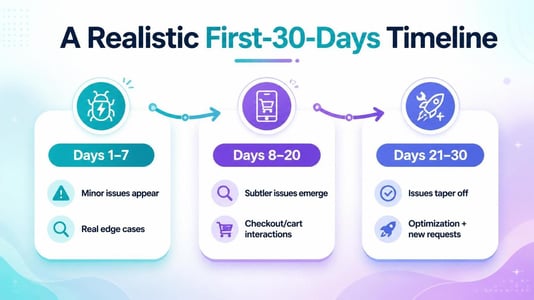
Understanding what typically happens in the weeks right after launch helps set realistic expectations. Days 1-7: real customer traffic surfaces the first round of minor issues, an image not rendering correctly on a specific device, a shipping rule edge case for an unusual address format. Days 8-20: as more customers move through checkout, subtler issues emerge, a discount code interaction bug, a mobile menu quirk on an older device. Days 21-30: issues typically taper off quite a bit as the initial wave of edge cases gets addressed, and the conversation shifts from bug fixes toward optimization and new feature requests. This pattern is normal for any freshly launched store, not a sign of a poorly executed build, and it's exactly why a defined initial support window matters in the first place.
Questions to Ask Before Your Support Window Ends
As your included support period approaches its end, have a specific conversation about what comes next. What's your actual expected volume of future requests, occasional small fixes versus regular ongoing feature work, and does a bug-fix retainer or a development retainer better match that pattern? Getting this sorted before the free window closes avoids a gap where an urgent issue comes up with no support arrangement yet in place to handle it.
Frequently Asked Questions
Is post-launch support usually included in the initial build price?
An initial window (commonly 15-30 days) is standard, but ongoing support beyond that is typically a separate arrangement. Always confirm this explicitly before signing anything.
What's a reasonable monthly retainer for a small store?
For basic bug-fix coverage, Rs. 5,000-Rs. 15,000/month is typical. Stores wanting regular new feature development should budget higher, in the Rs. 20,000-Rs. 80,000/month range.
What should I do if something breaks and I have no support agreement?
Most developers will still quote hourly work for urgent fixes, but response time isn't guaranteed without a retainer or SLA in place, which is exactly the risk of skipping this conversation upfront.
Does Amwhiz offer ongoing support after the initial window?
Yes, ongoing support and development retainers are available and scoped based on your store's specific needs after the included initial onboarding support window.
Is it normal to find bugs in the first month, even with a well-built store?
Yes. Real customer traffic and device variety reveal edge cases that no amount of internal testing fully anticipates. A defined support window exists specifically to handle this normal pattern.
What's the difference between a bug-fix retainer and a development retainer?
A bug-fix retainer covers reactive fixes to existing functionality only, while a development retainer includes hours for new features and proactive improvements alongside those fixes.
Launch With a Real Support Plan, Not an Afterthought
A store isn't done the day it goes live, it needs a clear plan for what happens next. Amwhiz builds your store at a flat rate in 7 days, with a genuine support window included and transparent options beyond it. Reach out to get the full picture before you launch.