-1.png?width=134&height=66&name=amwhiz-logo%20(1)-1.png)



Why the Feature Charts Won't Decide This for You Ask the internet "Zoho Commerce or Shopify?" and...
Why 'Free' Isn't Always the Cheapest Option
Zoho is designed to be approachable. You can sign up, poke around, and start building things yourself this afternoon. Which raises a fair question: why would anyone pay an authorized Zoho partner when they could just do it themselves for free?
It's a good question, and it deserves an honest answer rather than a sales pitch. Sometimes DIY genuinely is the right call. Sometimes it's the most expensive "free" you'll ever pay for. The trick is knowing which situation you're in.
So let's lay it out plainly, including the cases where we'd tell you to skip the partner entirely. Yes, even though we are one, here at Amwhiz.
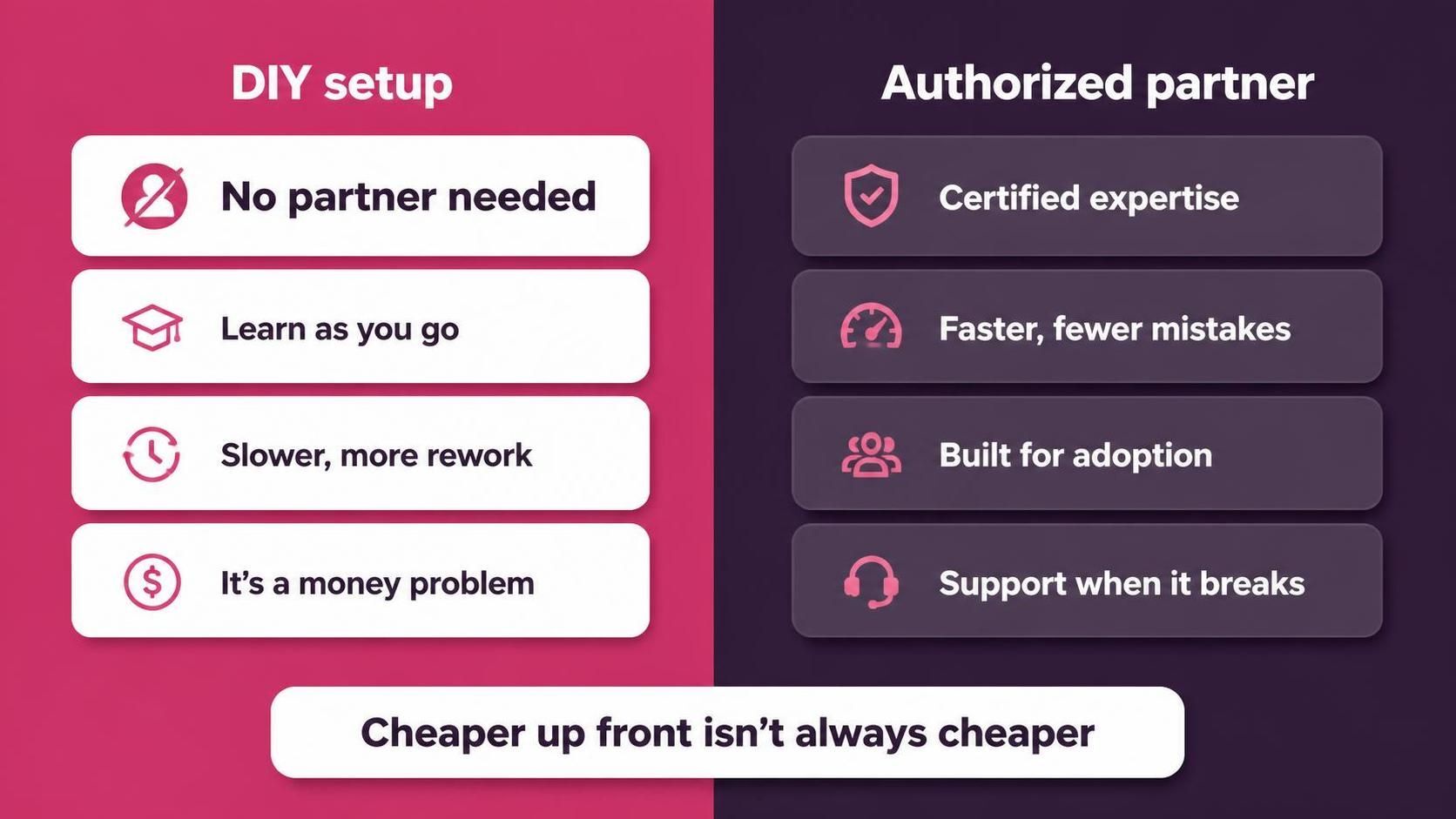
No partner fee looks cheaper. Whether it actually is depends entirely on the complexity of your setup.
When DIY Is the Right Call
Let's start here, because it's real. If you're a small team with a simple need, one app, not much data, no tricky integrations, doing it yourself is completely sensible. Zoho's tools are usable, the learning curve for the basics is gentle, and paying a partner to set up something straightforward would be overkill.
If that's you, save your money and build it. A partner adds value on complexity, and if there's no complexity, there's less to add.
Where DIY Quietly Gets Expensive
The trouble is that "free" DIY has hidden costs, and they don't show up until later.
There's the time your team spends learning instead of doing their actual jobs. There's the rework when the first attempt doesn't fit and has to be rebuilt. There's the messy data migration that poisons trust in the system. And there's the big one: low adoption, when a well-meaning but rough setup means the team never really takes to it, and the whole investment underdelivers. None of these appear on an invoice, which is exactly why they're easy to underestimate.
What a Partner Actually Brings
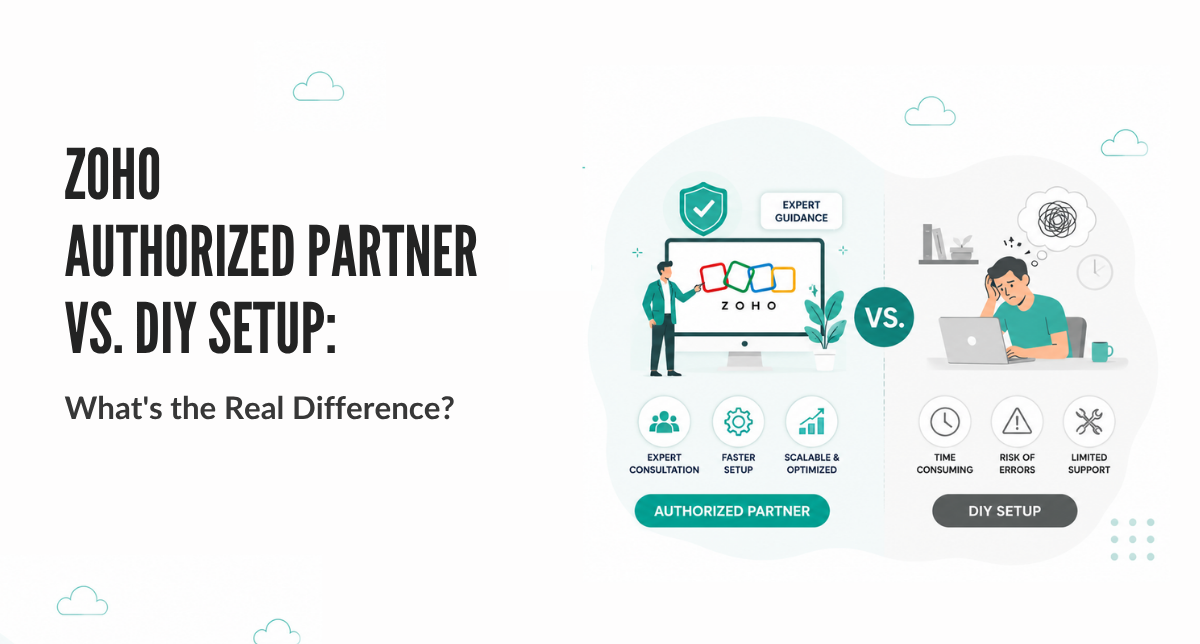
An authorized Zoho partner isn't just someone who knows the buttons. Authorization means the team is Zoho-certified, works inside the official partner programme, and is held to a standard for expertise and training. In practice, that shows up as judgement, the accumulated sense of what to do first, what to keep simple, and what mistakes to avoid.
Here's where that judgement earns its fee:
- Clean data migration, done once, instead of a mess you fight for months.
- Right-sized licensing, so you don't over-buy or under-buy.
- Proper automation and configuration that fits how you actually work.
- Complex integrations that hold up when things get weird.
- A build designed for adoption, which is what protects the whole investment.
- Someone to call when it breaks, who already knows your setup.
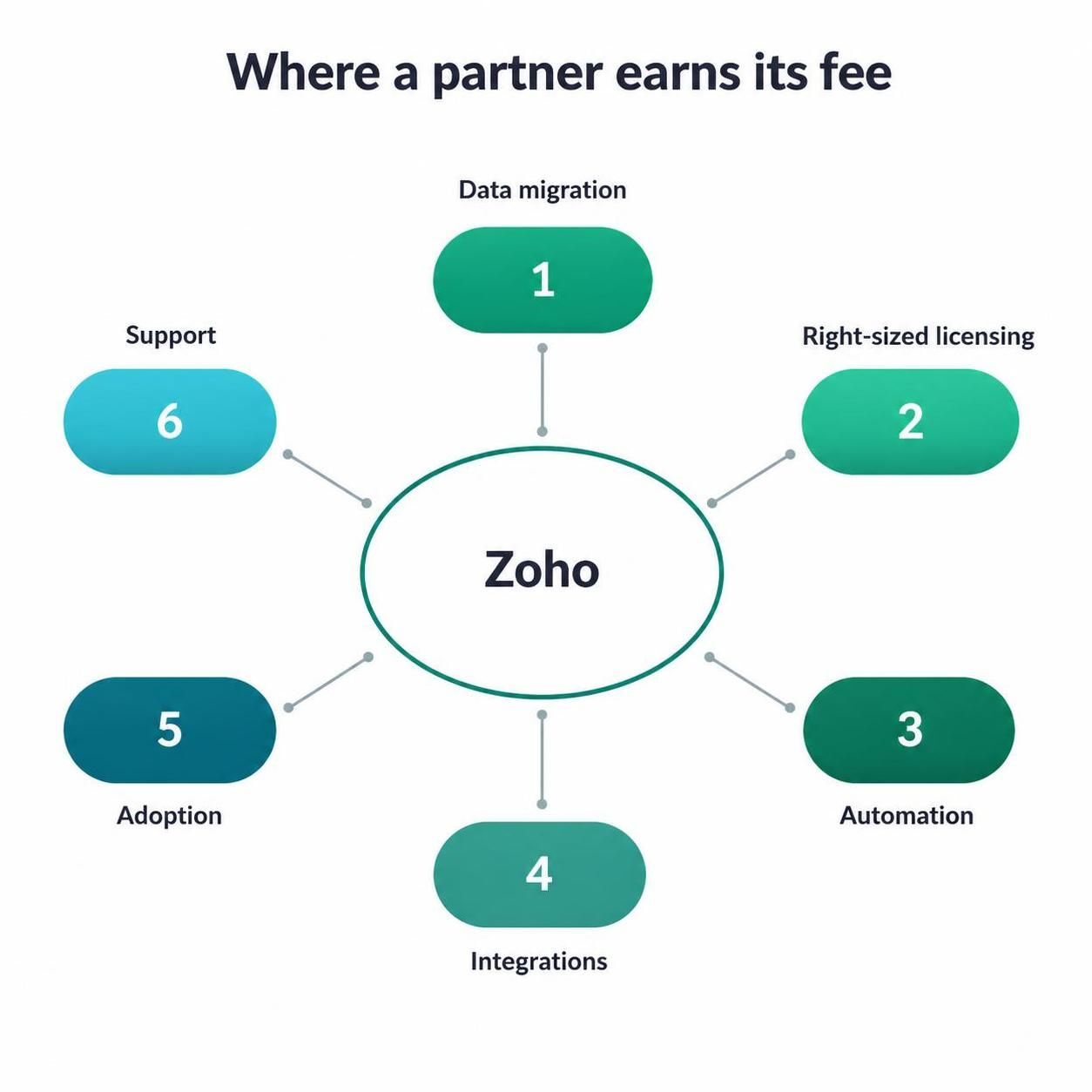
Migration, licensing, automation, integrations, adoption, support. The harder these are, the more a partner is worth.
The Speed and Adoption Difference
Two things separate a partner build from a DIY one more than anything else: how fast you get there, and whether people use it.
A team that has done this a hundred times gets you live faster, with fewer false starts, than one learning as it goes on your budget. And because they build for adoption from the start, the system actually gets used, which is the entire point. A cheap setup that nobody adopts isn't cheap. It's a total loss with a small price tag.
The Honest Rule of Thumb
Simple need, one app, clean data, no integrations? DIY, happily. Real data to migrate, multiple pipelines or departments, integrations, or a rollout that has to succeed because you can't afford another failed attempt? That's where a partner stops being an expense and starts being cheaper than the alternative.
The mistake isn't choosing one or the other. It's assuming "free" is automatically cheapest, when for a complex setup the rework and lost adoption usually cost far more than the fee would have.
There's a Middle Path, Too
It's easy to frame this as all-or-nothing: build it entirely yourself, or hand the whole thing to a partner. In reality there's a comfortable middle.
Plenty of businesses have a partner handle the hard, high-stakes parts, the data migration, the tricky integrations, the initial architecture, then take the day-to-day running in-house once it's built properly. You get the expertise where it genuinely matters and keep control (and cost) where it doesn't. Some go the other way: build the basics themselves, then bring in a partner to fix what's gone wrong or to add the complex piece they can't crack.
The point is that "partner versus DIY" isn't a single binary choice for the whole project. You can split it by task, using help for the parts that carry real risk and doing the rest yourself. For a lot of businesses, that blend is the sweet spot.
The Question to Ask Yourself
When you're genuinely unsure, one question usually settles it: what happens if this setup goes wrong? If the honest answer is "we'd lose a bit of time and tidy it up," DIY is a fine bet. If it's "we'd lose data, or trust, or months of momentum we can't afford," that's the risk a partner exists to remove. Match the level of help to the size of the downside, and you'll rarely regret the call in either direction.
How Amwhiz Approaches It
Amwhiz is an authorized Zoho partner, and we'll give you a straight answer about whether you even need us. For simple setups, we'll happily point you toward doing it yourself. For anything with real data, integrations, or an adoption risk you can't afford, we bring the certified expertise, the speed, and the adoption focus that make the difference.
Our aim is the outcome that genuinely serves you, which sometimes means saying you don't need a partner at all. That honesty is what makes the recommendation worth having when you do.
Frequently Asked Questions
Can I really set up Zoho myself?
For a simple, single-app setup with clean data, yes. Zoho is approachable, and a partner would be overkill. Complexity is what tips the balance toward getting help.
What does "authorized partner" actually mean?
It means the team is Zoho-certified and works within the official partner programme, held to a standard for expertise and ongoing training, rather than just being self-taught.
Isn't DIY always cheaper?
Not once you count the hidden costs, learning time, rework, messy data, and low adoption. For complex setups those usually exceed a partner's fee.
When is a partner clearly worth it?
When you're migrating real data, connecting multiple systems, running several departments, or simply can't afford a rollout that fails and has to be redone.
Will a partner tell me if I don't need one?
A good one will. Recommending help you don't need is a fast way to lose trust, so honest partners are happy to point simple cases toward DIY.
The Short Version
DIY Zoho setup is right for simple needs with clean data and no integrations. An authorized Zoho partner earns its fee on complexity, clean migration, right-sized licensing, proper automation, tricky integrations, and above all adoption. The real difference is that "free" DIY carries hidden costs that, for a complex setup, usually outweigh the fee.
Book a free honest assessment.
Amwhiz, an authorized Zoho partner, will tell you straight whether you need a partner, and deliver it properly if you do. Visit amwhiz.com or email sales@amwhiz.com.