-1.png?width=134&height=66&name=amwhiz-logo%20(1)-1.png)



One Question That Cuts Through the Pricing Page Zoho has a slightly awkward superpower: there's a...
Why the Feature Charts Won't Decide This for You
Ask the internet "Zoho Commerce or Shopify?" and you'll drown in feature tables. Rows and rows of ticks and crosses, as if the winner is whoever collects the most ticks.
That's the wrong way to choose. The right question isn't which platform has more features. It's which one fits the way your business already works. And the honest answer changes depending on what the rest of your stack looks like.
So let's skip the tick-boxes and talk about who each one is actually for. We help businesses make this call at Amwhiz, and it's rarely as close as the comparison charts pretend.
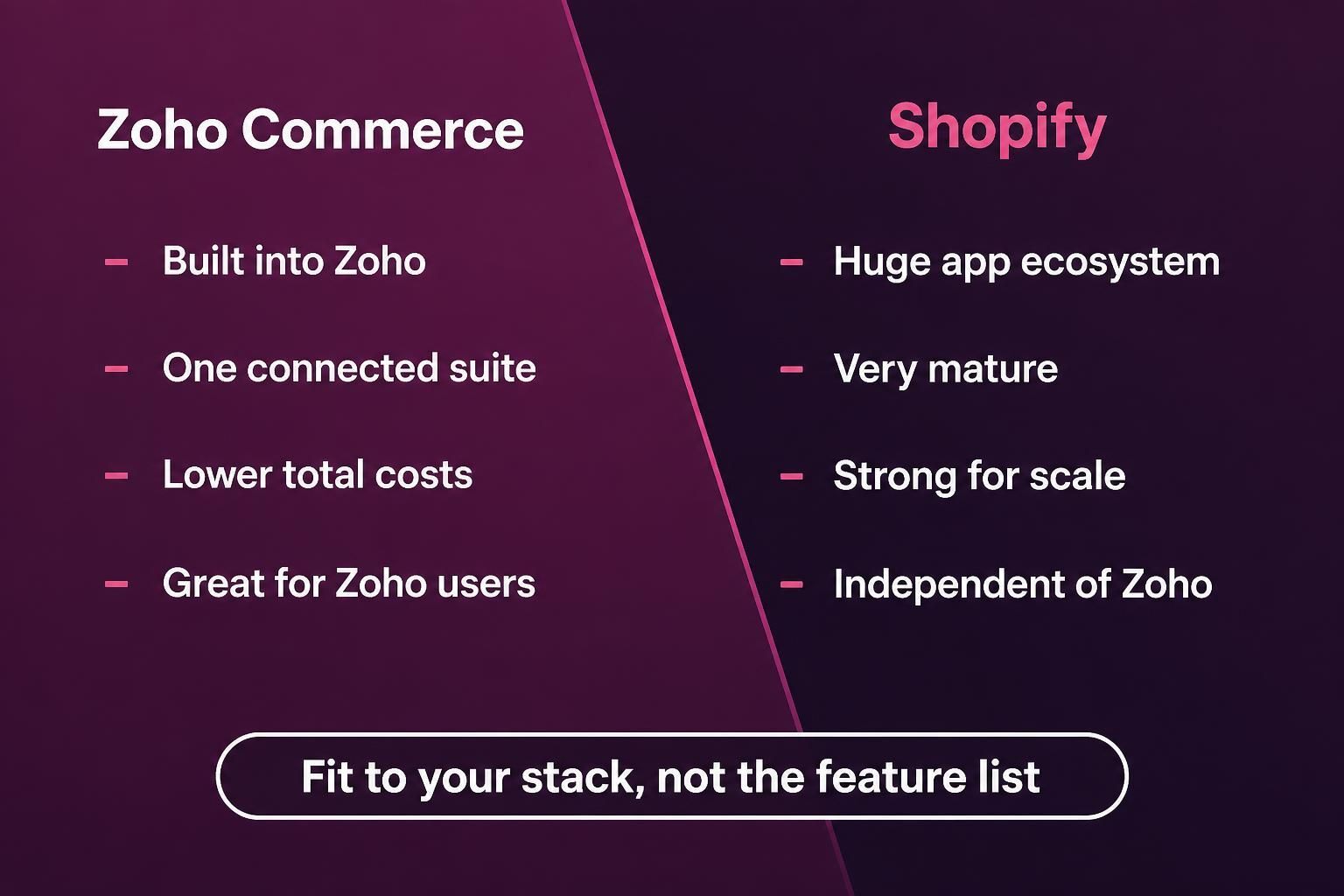
Both are capable. The tiebreaker is usually your existing stack, not the feature list.
The Honest One-Liner
If you already run your business on Zoho, Zoho Commerce is usually the better fit because it's part of the same connected suite. If you want the biggest app ecosystem on the planet and you're not tied to Zoho, Shopify is hard to beat.
That's most of the decision right there. The rest is detail.
Where Zoho Commerce Wins
The killer advantage of Zoho Commerce isn't a feature. It's belonging. Your store sits inside the same ecosystem as your CRM, your books, your inventory, your marketing. An order doesn't have to be dragged through a connector to reach your accounts, it's already home.
For a business already on Zoho, that changes the maths. You get:
- Native connection to Zoho Books, Inventory and CRM, no third-party glue.
- One suite, one login, one vendor, one bill.
- Lower total cost, especially if you're paying for Zoho already.
- Customer, order and stock data flowing without anyone copying it.
Where Shopify Wins
Let's be fair, because Shopify is genuinely excellent. It's one of the most mature ecommerce platforms in existence, with an app store so vast that whatever niche thing you need, someone's probably built it. It scales beautifully, and it doesn't care whether you use Zoho or not.
If your business is built around a huge catalog of apps and integrations, sells at serious volume, or simply isn't a Zoho shop, Shopify's ecosystem and polish are real reasons to choose it. Pretending otherwise would be doing you a disservice.
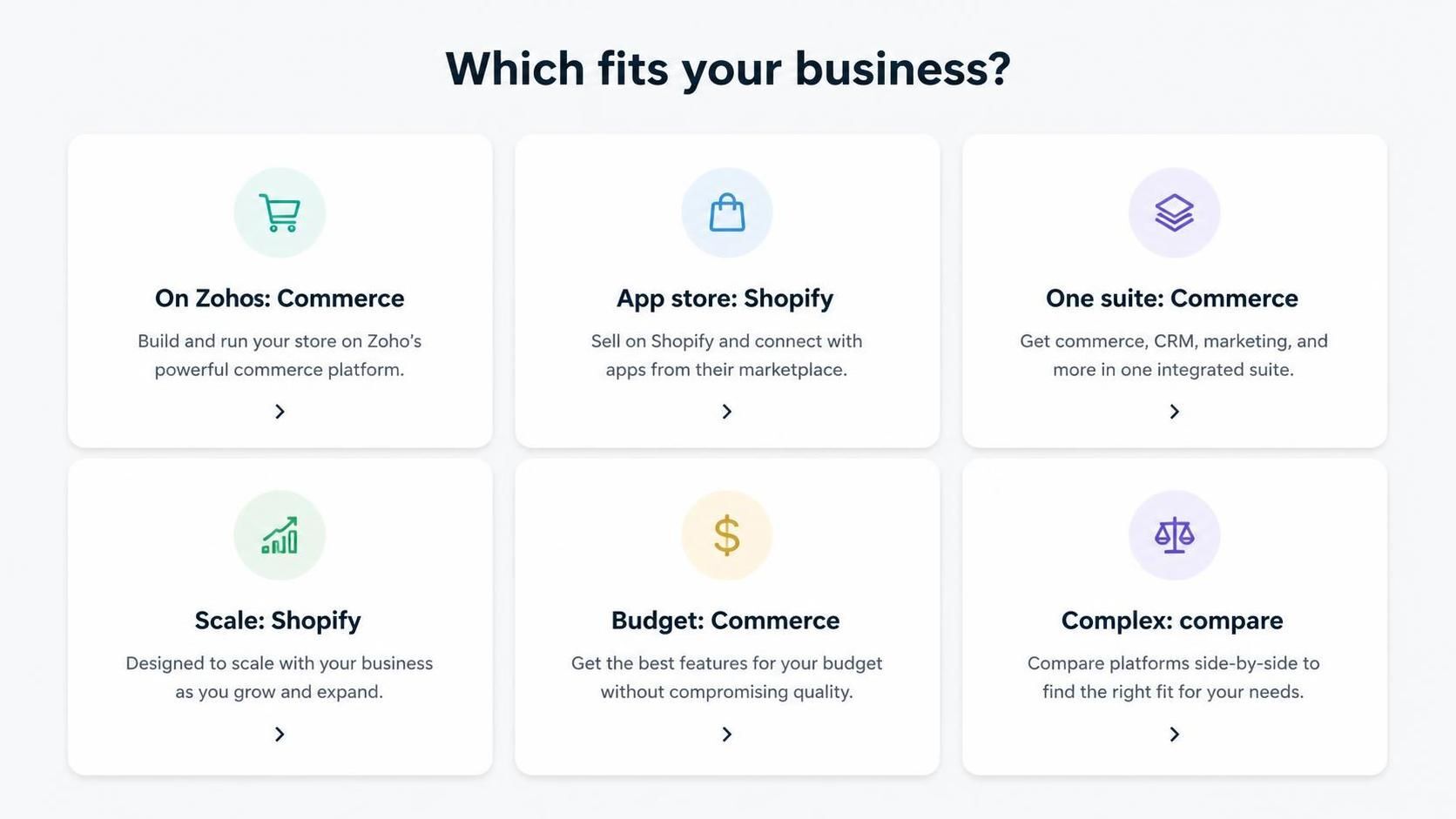
Already on Zoho? Commerce. Need the vast app store or huge scale? Shopify. Most cases aren't close.
The Question That Settles It
Forget the features for a second and ask yourself this: where does the rest of your business live?
If the answer is "Zoho, mostly," then Zoho Commerce saves you the endless integration headache of bolting an outside store onto your operation. If the answer is "we're not really a Zoho business, and we lean hard on specific apps," Shopify is probably your platform. The store should fit the business, not the other way round.
What About Cost?
Sticker prices are close enough that they're not the real story. The real cost is total cost. On Shopify, a lot of what you need arrives as paid apps and the connectors to sync it with your accounting. On Zoho Commerce, that syncing is built in because it's the same suite. For a Zoho business, that quietly makes Commerce the cheaper path once you count the glue.
Don't Forget the Switching Cost
One thing the feature charts never mention: if you already have a store, moving it is not free.
Migrating products, customers, order history and SEO from one platform to another takes effort, and a botched migration can cost you search rankings you spent years earning. So if you're already running smoothly on Shopify and only mildly curious about Zoho Commerce, the honest advice is often to stay put unless the integration savings are genuinely large. Switching for a small gain rarely pays off once you count the disruption.
The calculus is different if you're starting fresh, or if your current store is a constant source of integration pain. Then a move to the platform that fits your stack can pay for itself quickly. Either way, factor the switch itself into the decision, not just the destination.
How to Actually Test the Decision
If you're genuinely torn, here's a simple way to break the tie. Write down the five things your store absolutely must do, and the five tools it must talk to. Then check each platform against that specific list, ignoring everything else.
Most of the time, one platform answers your real list more cleanly than the other, and the "winner" of the generic feature comparison turns out to be irrelevant to you. A business already deep in Zoho will usually find Commerce ticks its integration boxes effortlessly. A business built around specific Shopify apps will find the opposite. Your list decides it, not the internet's.
How Amwhiz Helps You Choose
Amwhiz is an authorized Zoho partner, so yes, we know Zoho well. But we'll tell you straight if Shopify is the better fit for your business, because recommending the wrong platform helps nobody. We look at where your operation already lives, how you sell, and what you actually need, then point you at the platform that fits.
And if Zoho Commerce is the right call, we build it connected to your Books, Inventory and CRM from day one, so your store is part of the business rather than a bolt-on. That connection is the whole point of choosing it.
Frequently Asked Questions
Is Zoho Commerce as good as Shopify?
For most small and mid-sized stores, it's a very capable platform, and its edge is native integration with the Zoho suite. Shopify leads on app ecosystem and scale.
I already use Zoho. Should I just use Zoho Commerce?
Usually yes. The native connection to your existing Books, Inventory and CRM removes a lot of cost and hassle you'd otherwise carry with an outside store.
Can Shopify connect to Zoho?
Yes, Shopify can be integrated with Zoho apps, but it relies on connectors rather than being one native suite. That works well; it's just more moving parts.
Which is cheaper?
Sticker prices are similar. Total cost often favours Zoho Commerce for existing Zoho users, because the syncing and integration are built in rather than bought as apps.
Which scales better for high volume?
Shopify has a strong reputation at large scale and a deep app ecosystem to support it. For high-volume, integration-heavy retail, it's worth comparing the two closely.
The Short Version
Choose Zoho Commerce if your business runs on Zoho, because it's part of one connected suite and saves you the integration grief. Choose Shopify if you want the biggest app ecosystem, sell at serious scale, or aren't a Zoho shop. Fit your platform to your business, not to a feature chart.
Book a free ecommerce platform consultation.
Amwhiz, an authorized Zoho partner, will help you pick the platform that fits, and build it connected to the rest of your business. Visit amwhiz.com or email sales@amwhiz.com.