
Shiprocket (an aggregator) suits stores that want many couriers, easy setup and no volume commitments. Delhivery direct suits stores with steady volume that want better negotiated rates and a direct relationship with one major carrier. A custom shipping integration suits brands with multiple warehouses, several direct courier contracts, or rules that off-the-shelf apps can't handle.
Key takeaways
- Aggregators give flexibility and courier choice; direct contracts give better rates at volume.
- COD remittance speed and RTO handling matter as much as per-shipment price.
- Courier allocation rules (by pincode, weight, COD/prepaid, performance) drive cost and delivery success.
- Custom integrations make sense when you use several direct couriers or warehouses.
- Pair shipping with COD confirmation on WhatsApp to cut RTO.
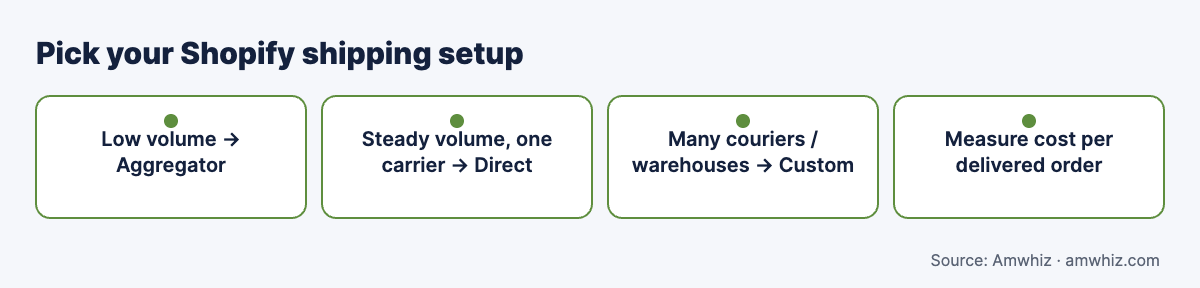
Pick your Shopify shipping setup.
The three options at a glance
| Factor | Shiprocket (aggregator) | Delhivery (direct) | Custom integration |
|---|---|---|---|
| Couriers | Many | One (Delhivery) | Any you contract |
| Setup | Shopify app, quick | App/API, moderate | 3 to 8 weeks |
| Rates | Aggregated rates | Negotiated at volume | Your contracts |
| Volume commitment | Low | Usually expected for best rates | Depends on contracts |
| Courier allocation | Rules + recommendation | Single carrier | Fully custom |
| COD remittance | Via aggregator | Direct from carrier | Direct from each carrier |
| Multi-warehouse | Supported | Supported | Fully custom |
| Best for | Early to mid-stage D2C | Steady volume, single main carrier | Scaled brands, complex ops |
When Shiprocket (or another aggregator) makes sense
- You ship under a few thousand orders a month
- You want pincode coverage across many couriers
- You don't want to negotiate with multiple carriers
- You need quick setup with label printing, tracking and NDR tools
When going direct with Delhivery makes sense
- Volume is steady enough to negotiate better rates
- One carrier covers most of your pincodes well
- You want direct support and faster COD remittance
- You're comfortable managing exceptions with one partner
When a custom shipping integration makes sense
- You have direct contracts with two or more couriers (e.g. Delhivery, Blue Dart, Xpressbees, Ekart, regional carriers)
- Orders ship from multiple warehouses or 3PLs
- You need rules like "COD above ₹3,000 via courier A", "metro prepaid via courier B"
- You want shipping data in your ERP, Zoho or HubSpot
- You need custom tracking pages and WhatsApp updates
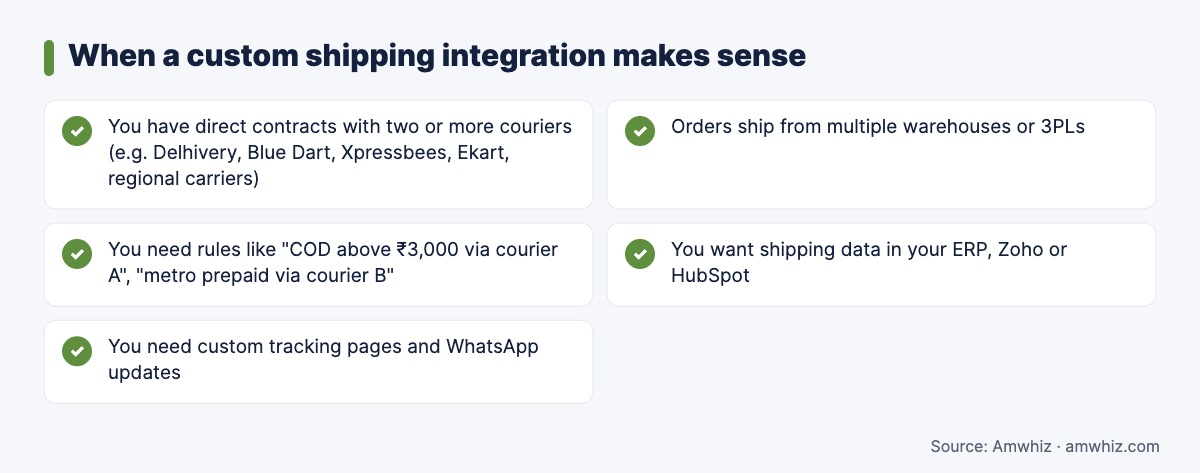
When a custom shipping integration makes sense
Features to compare
- Pincode serviceability and COD availability
- Rate calculation at checkout (live rates or flat)
- Automatic courier allocation rules
- Label and manifest generation
- NDR (non-delivery report) management
- RTO tracking and reasons
- COD remittance cycle
- Weight discrepancy handling
- Tracking page branding and WhatsApp notifications
- Returns and reverse pickup
Reducing RTO for COD orders
High RTO on COD is the biggest hidden shipping cost for Indian D2C brands. Tactics:
- Confirm COD orders on WhatsApp before dispatch (guide)
- Offer a prepaid discount or partial COD
- Block or verify high-risk pincodes and repeat RTO customers
- Act on NDRs within hours with automated WhatsApp messages
- Allocate COD orders to couriers with the best delivery rate in that zone
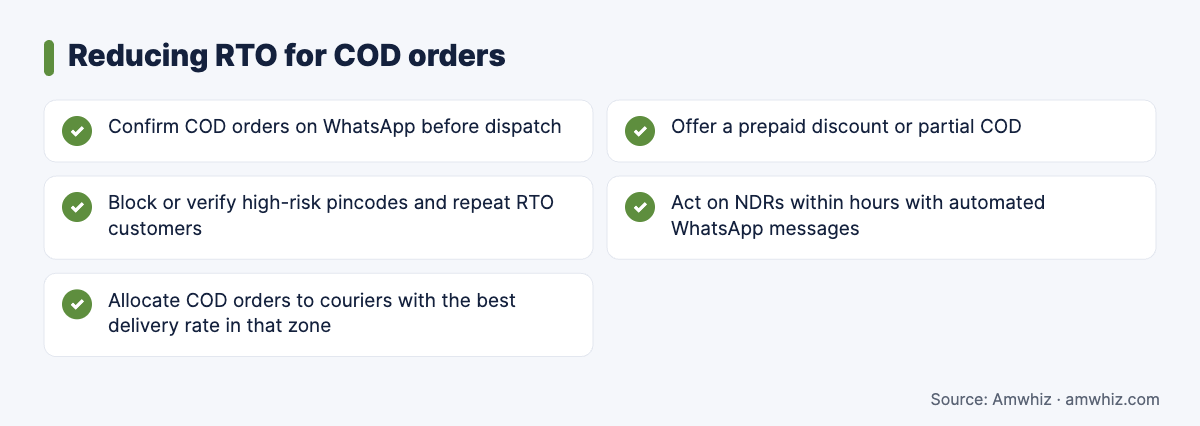
Reducing RTO for COD orders
Cost comparison approach
Don't compare only per-shipment price. Compare cost per delivered order:
Cost per delivered order = (shipping + COD fees + RTO costs + weight disputes) ÷ delivered orders
A cheaper courier with higher RTO is often more expensive overall.
Building a custom shipping integration
- List couriers, contracts and serviceable pincodes
- Define allocation rules by zone, weight, payment mode and performance
- Connect courier APIs for rates, AWB generation, labels and tracking
- Build a Shopify app or middleware to push orders and update fulfilment
- Add webhooks for tracking events → Shopify, WhatsApp, CRM
- Build dashboards for delivery rate, RTO and remittances
See Shopify shipping integration services and costs.
Why choose Amwhiz?
Amwhiz builds Shopify shipping integrations for Indian and GCC brands, from aggregator setups to multi-courier custom apps with allocation rules, WhatsApp tracking and ERP sync. We help you measure cost per delivered order, not just shipping rates.
Want help with this? Book a free shipping setup review with the Amwhiz team.
Related guides
- Shopify B2B Wholesale Portal for Indian Distributors: Setup and Pricing Tiers
- How to Integrate Shopify With an ERP: SAP Business One, Odoo, Tally and Zoho Compared
- WhatsApp Chatbot Development Cost in India 2026: Templates, AI and Integrations
- Shopify Arabic Store Setup: RTL Themes, Translation and Local Payments
Frequently asked questions
Is Shiprocket better than Delhivery for Shopify?
It depends on volume and needs. Shiprocket offers many couriers and easy setup; Delhivery direct can give better rates and service at steady volume.
Can I use multiple couriers on Shopify in India?
Yes, through an aggregator like Shiprocket or a custom integration with several direct courier contracts.
How can Shopify stores reduce RTO?
Confirm COD orders on WhatsApp, encourage prepaid payments, manage NDRs quickly and allocate orders to couriers with better delivery rates.
What is NDR in shipping?
A non-delivery report is raised when a courier fails to deliver. Fast follow-up with the customer reduces returns.
When should I build a custom shipping integration?
When you have multiple direct courier contracts, multiple warehouses or allocation rules that apps can't handle.
Leave a comment
Your email address will not be published. Comments are reviewed before they appear.