-1.png?width=134&height=66&name=amwhiz-logo%20(1)-1.png)



Amwhiz, an authorized Zoho partner, builds hire to retire HR systems on Zoho, where the entire...
Amwhiz, an authorized Zoho partner, sets up Zoho Payroll to take over the repetitive payroll work your accountant probably still does by hand. This guide lists exactly what it automates, and why that matters for accuracy as much as time.
What Payroll Work Does Zoho Payroll Automate?
The Short Answer
Zoho Payroll automates salary calculations, statutory deductions, tax computations, payslip generation, and the journal entries that post payroll into your accounts. Much of this is work an accountant or admin currently does manually in spreadsheets each month, and automating it removes both the effort and the errors that come with hand calculation.
The point is not to replace your accountant. It is to free them from repetitive processing so their time goes to work that actually needs judgement, while payroll itself runs reliably and on time every cycle.
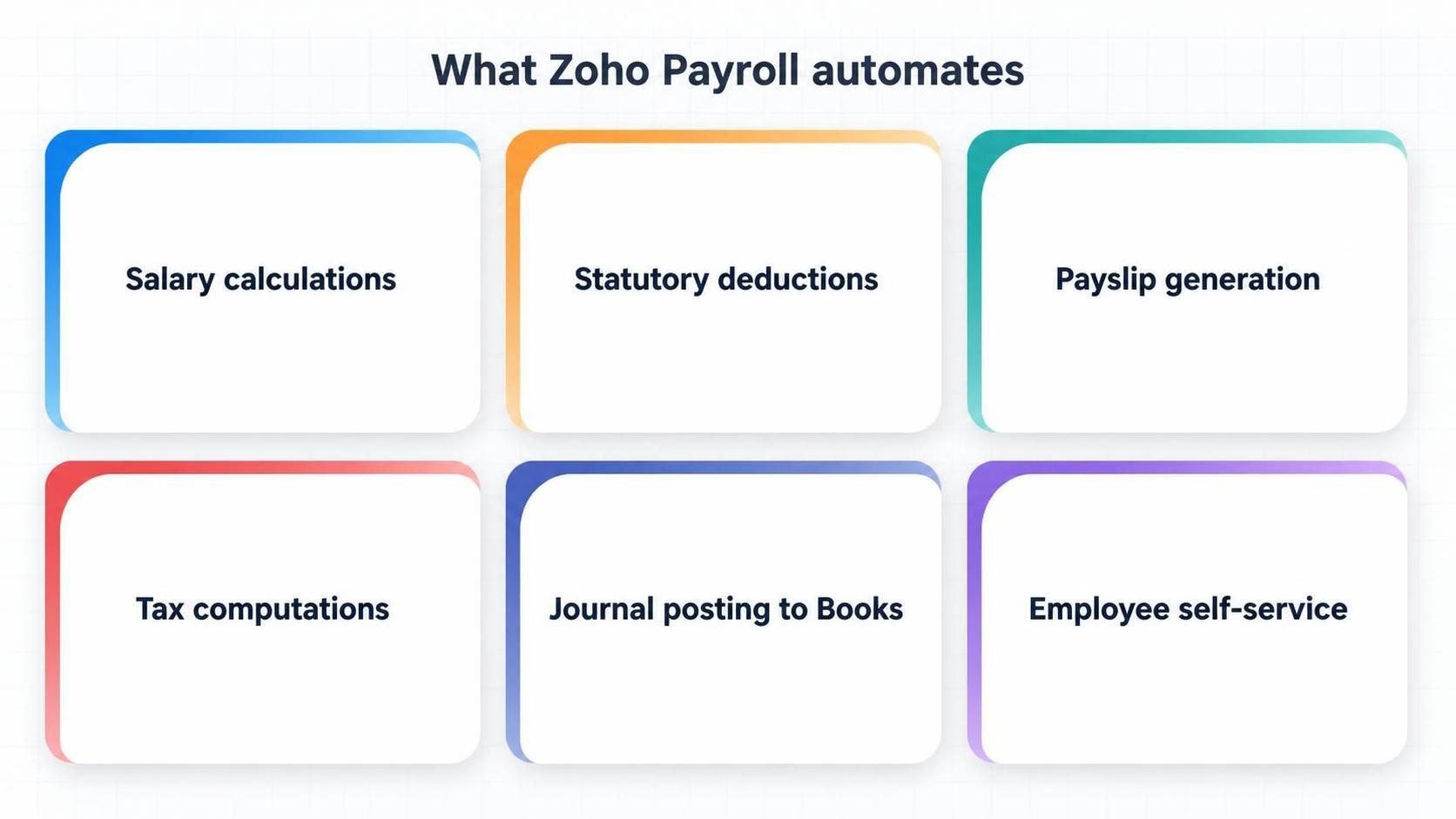
Zoho Payroll automates salary runs, deductions, payslips, tax, and journal posting to Zoho Books.
Salary Runs Without the Spreadsheet
For many small businesses, payroll still lives in a spreadsheet that someone updates every month. Zoho Payroll replaces that with a structured system where salaries, allowances, and deductions are defined once and calculated automatically each cycle. The monthly run becomes a review-and-approve task rather than a rebuild-from-scratch task.
This matters because spreadsheet payroll is fragile. A single broken formula or copied-down error can mispay staff or miscalculate deductions, and those mistakes damage trust and can create compliance problems. Automating the calculation removes that fragility.
Statutory Deductions and Compliance
Statutory deductions are where manual payroll gets risky. Getting contributions and tax withholdings right, every month, for every employee, is exactly the kind of repetitive precision that humans get wrong under time pressure. Zoho Payroll calculates these automatically based on the rules you configure, so compliance is built into every run rather than checked afterwards.
Because the rules live in the system, changes are applied consistently across all employees. That consistency is hard to guarantee when each payslip is calculated by hand, and it is the difference between confident compliance and month-end anxiety.
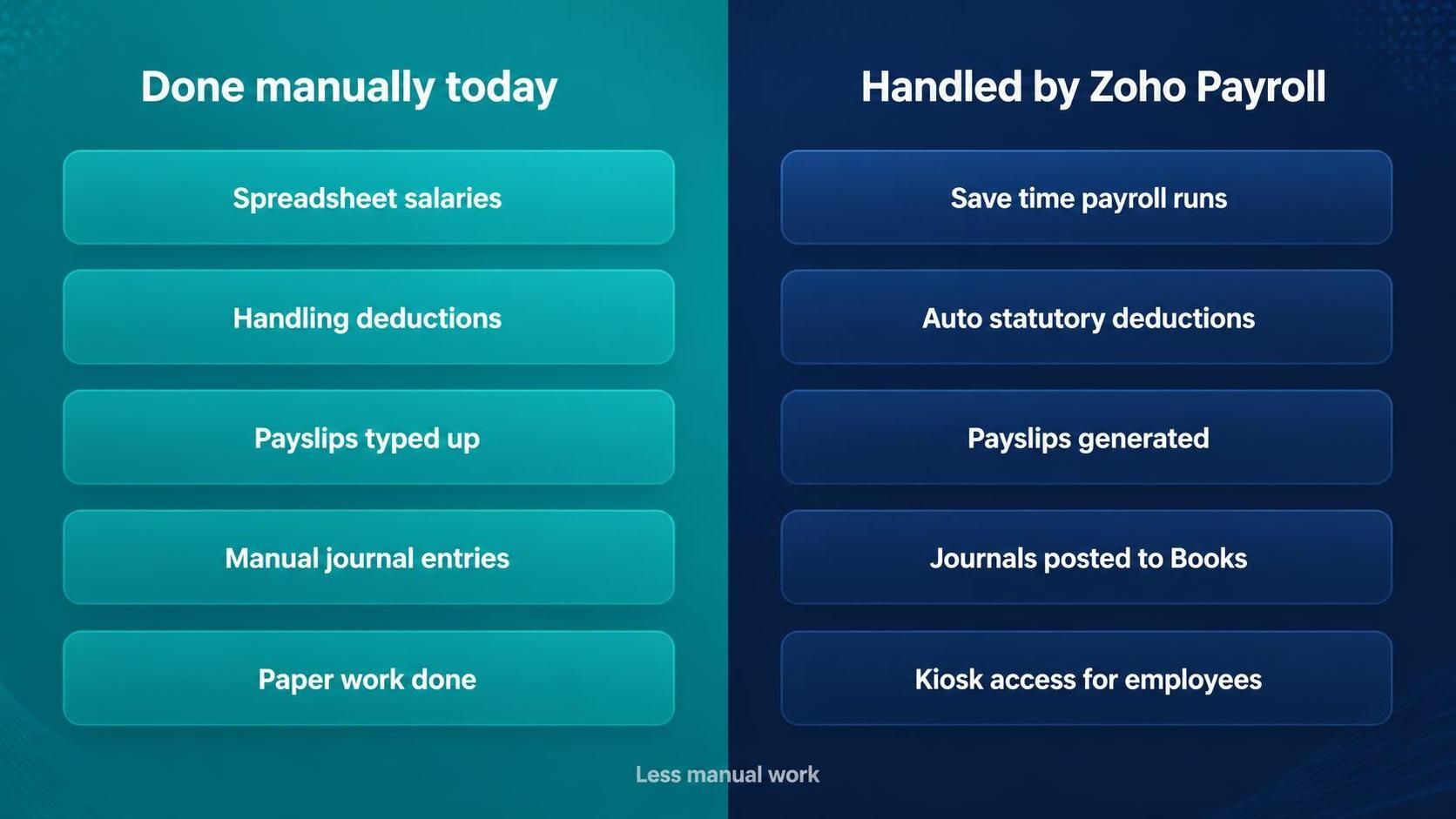
Zoho Payroll takes over the salary runs, deductions, payslips, and journals accountants often do by hand.
Payslips and Employee Self-Service
Generating and distributing payslips is a quiet time sink. Zoho Payroll produces payslips automatically and gives employees a self-service portal to view them, download tax documents, and check their details. That removes a stream of routine requests from your admin or accountant, who no longer has to produce and email documents one by one.
Self-service also improves the employee experience. Staff get instant access to their own information instead of waiting for someone to send it, which reduces friction and the small frustrations that add up over time.
The Journal Entry That Posts Itself
One of the most valuable automations is the least visible. Every payroll run has to be recorded in the accounts, and doing that manually means an accountant creating journal entries each month. Because Zoho Payroll integrates with Zoho Books, it posts the payroll journal automatically, so the accounting is done the moment payroll is approved.
- Salary and deduction totals posted to the right accounts automatically.
- No manual journal entry to create or reconcile each month.
- Payroll and accounting always in agreement.
- A clear audit trail from payslip to ledger.
What Your Accountant Does Instead
Freeing your accountant from manual payroll does not reduce their value; it raises it. Instead of spending days on calculations and data entry, they can focus on reviewing exceptions, advising on cost, and the higher-value financial work that actually needs a human. Automation handles the routine so expertise goes where it counts.
The Real Cost of Manual Payroll
Manual payroll looks cheap because nobody invoices for it, but the cost is real and it hides in several places. There is the direct time, often a full day or more each month, spent building the spreadsheet, checking figures, and producing payslips. There is the risk cost of errors, which range from underpaying staff and damaging morale to miscalculating statutory deductions and creating compliance exposure. And there is the opportunity cost of a skilled accountant doing data entry instead of analysis.
Add those together and manual payroll is rarely as cheap as it seems. The monthly hours compound across a year, the occasional error can be expensive to fix and costly to trust, and the misused expertise is perhaps the biggest waste of all. Automating payroll is not just about convenience; it is about stopping a quiet, recurring drain that most businesses never properly measure.
Who Benefits Most From Automating Payroll
Any business running payroll manually benefits, but the case is strongest for a few groups. Growing teams feel it first, because manual payroll gets harder with every new hire, and the spreadsheet that worked for five people becomes a liability at twenty-five. Businesses with variable pay, such as overtime, commissions, or shift allowances, benefit hugely because those are exactly the calculations most prone to manual error. And any business where a senior person currently runs payroll gains by handing that time back to higher-value work.
If your payroll is simple, unchanging, and tiny, manual handling may be tolerable a while longer. But the moment payroll starts consuming real time or introducing real risk, automation stops being optional and becomes an obvious win.
How Amwhiz Sets Up Zoho Payroll
Amwhiz is an authorized Zoho partner, and we implement Zoho Payroll so the repetitive work stops being manual. We configure your salary structures, statutory deductions, and tax rules, connect Payroll to Zoho Books so journals post automatically, set up the employee self-service portal, and run parallel cycles to confirm everything calculates correctly before you rely on it. The result is payroll that runs on time with far less manual effort.
We also link Payroll with Zoho People where it helps, so attendance, leave, and employee data flow into payroll without re-entry. The more of the employee lifecycle that shares one system, the less manual reconciliation your team does, and the more reliable each payroll run becomes.
Payroll Accuracy and Employee Trust
There is a human dimension to payroll that spreadsheets put at risk. Getting people paid correctly and on time is one of the most basic promises an employer makes, and every error chips away at trust. An underpayment, a late payslip, or a wrong deduction is not just an admin slip to the person affected; it is a signal that the business is disorganised with something that matters deeply to them. Automating payroll protects that trust by making accuracy the default rather than the hope.
Consistency matters just as much as accuracy. When every employee is paid on the same schedule, with deductions calculated the same way, and payslips available instantly through self-service, people stop worrying about payroll and simply trust it. That quiet confidence is worth far more than the hours saved, because a workforce that trusts it will be paid correctly is a workforce free to focus on its actual job.
Frequently Asked Questions About Zoho Payroll
Does Zoho Payroll Integrate With Zoho Books?
Yes. Zoho Payroll posts payroll journals directly into Zoho Books, so the accounting is recorded automatically each cycle with no manual entry.
Can Employees Access Their Own Payslips?
Yes. The employee self-service portal lets staff view payslips, download tax documents, and check their details, reducing routine requests to your admin team.
Will Zoho Payroll Handle Statutory Deductions?
It calculates statutory deductions automatically based on the rules you configure, applying them consistently across all employees every run.
Does This Replace My Accountant?
No. It removes the repetitive processing so your accountant can focus on review, advice, and higher-value work. Automation supports them rather than replacing them.
How Do I Move From Spreadsheet Payroll?
A partner configures your salary structures and rules, migrates employee data, and runs parallel cycles to confirm accuracy before you switch over, so the transition is safe.
Is Employee Data Secure in Zoho Payroll?
Payroll data is sensitive, and Zoho Payroll applies role-based access so only authorised people see it, with the self-service portal limiting each employee to their own records. Proper permission setup during implementation keeps this tight, which is far safer than payroll spreadsheets circulating by email.
Can Zoho Payroll Handle Variable Pay and Bonuses?
Yes. Overtime, commissions, allowances, and one-off bonuses can all be built into the payroll run, calculated automatically each cycle. These variable elements are exactly where manual payroll makes the most mistakes, so automating them is where accuracy improves most.
Conclusion
Zoho Payroll automates the salary runs, statutory deductions, payslips, tax, and journal entries that many accountants still do by hand. That saves time, reduces errors, and frees your accountant for work that actually needs judgement. The manual monthly grind becomes a quick review-and-approve.
Book a free Zoho Payroll assessment.
Amwhiz, an authorized Zoho partner, will show you exactly which manual payroll tasks Zoho Payroll can take over. Visit amwhiz.com or email sales@amwhiz.com to get started.