-1.png?width=134&height=66&name=amwhiz-logo%20(1)-1.png)



Building a Scalable Customer Prioritization Framework with HubSpot Automation As businesses expand...

written by: Madhan
HubSpot CRM automation,
HubSpot Workflow Automation,
HubSpot onboarding automation,
Customer onboarding workflow,
Business process automation,
CRM automation,
Task automation
Overview
What happens when customer onboarding requires multiple teams to complete tasks in a specific sequence, but the entire process depends on manual coordination?
As the property management company expanded its operations, onboarding new clients became increasingly complex. Multiple teams were involved throughout the onboarding journey, with each activity dependent on the successful completion of a previous task.
Managing this process manually created inefficiencies. Team members were responsible for creating follow up tasks, assigning ownership, monitoring progress, and ensuring that onboarding activities were completed in the correct order.
As onboarding volumes increased, maintaining consistency became more difficult and administrative overhead continued to grow.
To support business growth and improve operational efficiency, the company required a structured onboarding framework that could automate task management while maintaining visibility and accountability across every stage of the process.
Business Requirements
The organization needed a scalable onboarding process that could support multiple stakeholders while ensuring a consistent customer experience.
The key requirements included:
- Automatic creation of onboarding tasks
- Task assignments based on team responsibilities
- Consistent onboarding progression across all clients
- Real time visibility into onboarding status
- Reduced dependency on manual coordination
- Clear ownership of onboarding activities
- Prevention of stage progression before task completion
- Scalability to support future onboarding growth
The objective was to establish an automation framework that could manage onboarding activities from start to finish with minimal manual intervention.
Challenges
Manual Task Management
Every onboarding milestone required employees to manually create subsequent tasks. This repetitive process consumed valuable time and increased the possibility of missed actions.
Inconsistent Onboarding Execution
Without a standardized automation framework, onboarding experiences varied depending on the individual managing the process.
Missed Follow Up Activities
Important onboarding tasks could occasionally be delayed or overlooked, creating bottlenecks and impacting customer onboarding timelines.
Limited Visibility Across Teams
Managers lacked a centralized view of onboarding progress, making it difficult to identify pending activities and operational bottlenecks.
Heavy Dependence on Internal Communication
Progress often relied on emails, messages, and manual follow ups between departments, slowing down the onboarding lifecycle.
Lack of Controlled Task Sequencing
The business required assurance that onboarding activities would only progress after required tasks had been completed successfully.
Implementation Strategy
To address these operational challenges, Amwhiz designed and implemented a fully automated onboarding framework using HubSpot.
The solution was built using:
- HubSpot CRM
- HubSpot Workflows
- HubSpot Tasks
- Custom Properties
- Automated Task Assignment
- Pipeline Automation
- Conditional Branching Logic
- Delay Until an Event Occurs Workflow Actions
The framework was designed to automatically create tasks, assign ownership, monitor completion, and advance onboarding stages based on real time task activity.
Automation Workflow
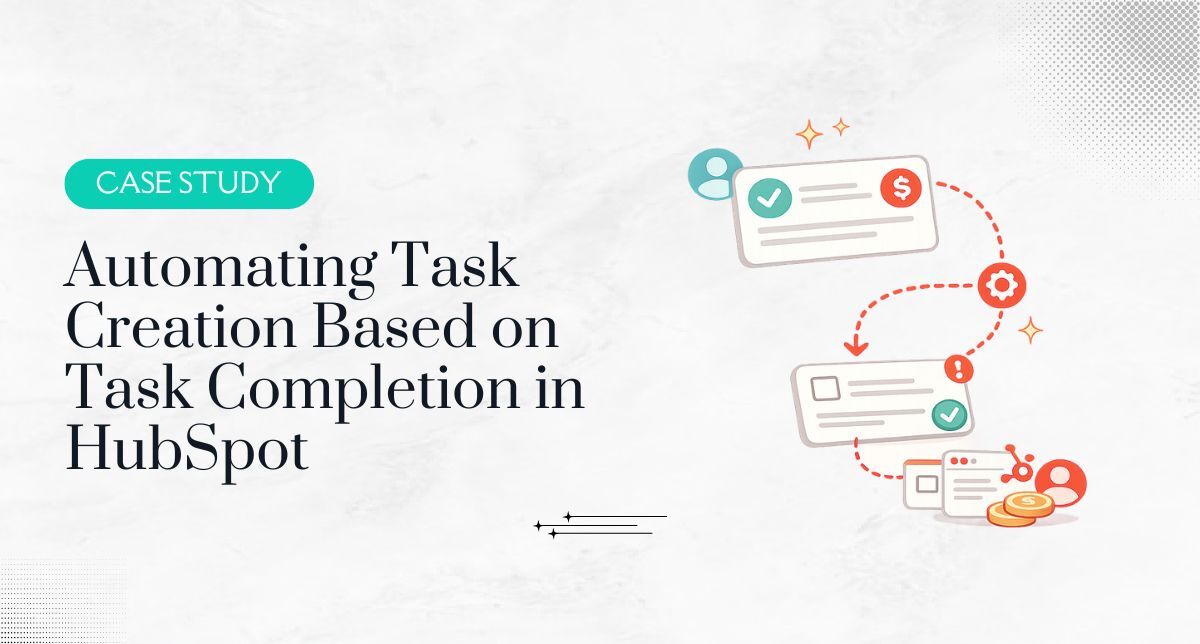
Step 1: Task Completion Detection
The workflow begins when an onboarding task is marked as Completed within HubSpot.
As soon as task completion is detected, HubSpot automatically triggers the next stage of the workflow.
This eliminates the need for team members to manually initiate subsequent onboarding activities.
Step 2: Onboarding Status Update
Once triggered, the workflow updates the onboarding stage associated with the customer record.
This ensures all stakeholders have immediate visibility into onboarding progress and current status.
Step 3: Automatic Task Generation
Based on predefined onboarding requirements, HubSpot automatically creates the next task in the onboarding sequence.
Tasks are generated according to business rules established during implementation.
This ensures every onboarding follows the same structured process.
Step 4: Intelligent Task Assignment
Newly created tasks are automatically assigned to the appropriate team member, department, or onboarding specialist.
This removes the need for manual delegation while improving accountability and ownership.
Step 5: Event Based Progress Monitoring
A critical component of the implementation involved HubSpot's Delay Until an Event Occurs workflow action.
To ensure onboarding activities were completed in the correct order, the workflow pauses immediately after creating a task and continuously monitors task activity.
Rather than progressing automatically, the workflow waits for a specific event before continuing.
The workflow is configured to proceed only when:
- The task property value changes
- The task status is updated to Completed
HubSpot continuously monitors the task and remains in a waiting state until the completion criteria are satisfied.
This event driven approach ensures every onboarding task is completed before the next activity is created, preventing records from advancing prematurely and maintaining process integrity throughout the onboarding journey.
Step 6: Workflow Continuation
Once task completion is confirmed, the workflow automatically resumes.
HubSpot updates onboarding progress, creates the next required task, assigns ownership, and continues monitoring subsequent activities.
Step 7: Completion of the Onboarding Journey
The automation cycle repeats until all onboarding requirements have been fulfilled successfully.
The result is a fully automated onboarding framework capable of managing complex onboarding processes with minimal manual oversight.
Advanced Workflow Features
Event Driven Progression
Onboarding stages only advance when required tasks are completed successfully.
This prevents records from moving through the process prematurely.
Automated Task Monitoring
HubSpot continuously tracks task activity and completion status without requiring manual review.
Conditional Workflow Branching
Different onboarding paths can be triggered based on service packages, customer requirements, or onboarding scenarios.
Escalation and Timeout Controls
Additional workflow controls can be configured to identify overdue tasks and ensure unresolved activities receive timely attention.
Centralized Process Visibility
Managers gain real time visibility into onboarding progress, task completion, and operational performance.
Results and Business Impact
Automated Task Creation
Follow up tasks are generated automatically without requiring manual effort.
Improved Operational Consistency
Every customer follows the same onboarding process, improving service delivery and reducing process variations.
Faster Onboarding Completion
Removing delays between onboarding activities significantly improves onboarding efficiency.
Increased Accountability
Automatic task assignments create clear ownership at every stage of the onboarding process.
Enhanced Visibility
Teams and managers can monitor onboarding progress in real time.
Reduced Administrative Overhead
Employees spend less time managing tasks and more time delivering value to customers.
Lower Risk of Missed Activities
Workflow automation ensures critical onboarding actions are never overlooked.
Scalable Operations
The framework can support increasing onboarding volumes without requiring additional administrative resources.
Conclusion
By implementing a task driven onboarding automation framework in HubSpot, Amwhiz helped the property management company streamline operations, improve onboarding consistency, and increase overall efficiency.
The automated workflow creates and assigns tasks, monitors completion status, and advances onboarding stages only when required activities are completed successfully.
Through HubSpot's event driven workflow automation capabilities, the organization gained a scalable onboarding system that reduces manual effort, improves accountability, and supports long term business growth.
With onboarding automation managing operational workflows behind the scenes, teams can focus on delivering exceptional customer experiences while maintaining complete visibility and control throughout the onboarding lifecycle.
Transform Your HubSpot Processes with Automation
Manual processes can slow growth, create operational inefficiencies, and increase administrative workload.
Whether you need onboarding automation, workflow optimization, CRM process improvements, task automation, or custom HubSpot integrations, Amwhiz can help you build scalable systems that support business growth.
Email: sales@amwhiz.com
Phone: +91 91500 65500