
EDITOR – MERGE: This topic overlaps an existing published post: /blog/how-to-choose-the-right-hubspot-partner-for-your-implementation. Recommended: move the best sections of this draft into the existing post (keep its URL), then delete this draft. Do not publish both.
To choose a HubSpot partner, check four things: proven experience with your hubs and your industry, a clear scope with fixed deliverables, a named team with HubSpot certifications, and a plan for what happens after go-live. Ask every shortlisted partner the same 12 questions below and compare written answers, not sales calls.
Key takeaways
- Partner tier (Gold, Platinum, Diamond, Elite) shows how much HubSpot a partner has sold and retained, not whether they fit your project.
- The best predictor of success is a partner who has already built your use case: same hubs, similar data volume, similar integrations.
- Ask for a written scope that lists objects, properties, pipelines, workflows, integrations and reports, with acceptance criteria.
- Red flags include no discovery phase, vague hourly estimates, no data migration plan and no named project lead.
- Plan for support after launch. Most HubSpot problems show up 30 to 90 days after go-live.
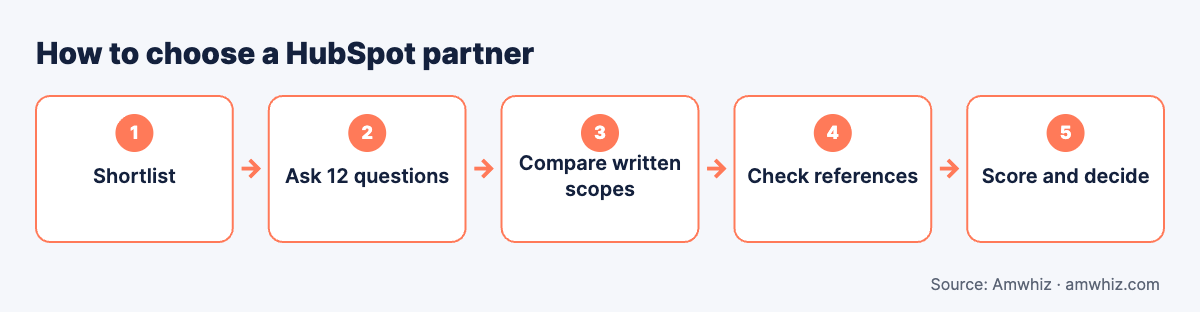
How to choose a HubSpot partner.
What does a HubSpot partner actually do?
A HubSpot Solutions Partner is an agency certified by HubSpot to sell, implement and support HubSpot software. Depending on the partner, that work includes:
- Onboarding and portal setup for Marketing, Sales, Service, Content and Data Hubs
- CRM and data migration from Zoho, Salesforce, Pipedrive or spreadsheets
- Custom integrations with ERPs, accounting tools, Shopify, WhatsApp and internal systems
- Workflow automation, lead scoring and reporting
- CMS website builds and custom modules
- Ongoing admin, training and optimisation
Not every partner does all of this well. Many are marketing agencies first and technical implementers second. Others are strong on integrations but light on campaign strategy. Knowing which kind you need is the first filter.
Do HubSpot partner tiers matter?
HubSpot ranks partners in tiers based on the revenue they manage and how well their customers stay. Higher tiers usually mean more experience and better access to HubSpot's partner support, which helps when you hit a product bug or billing issue.
| Tier | What it tells you | What it doesn't tell you |
|---|---|---|
| Gold | Partner has an active book of HubSpot customers | Depth of technical skill |
| Platinum | Larger customer base, consistent retention | Whether they've done your use case |
| Diamond | High managed revenue and strong retention | Team size assigned to you |
| Elite | Top tier, typically large agencies | Whether you'll get senior attention as a smaller client |
Use tier as a tie-breaker. Fit comes first.
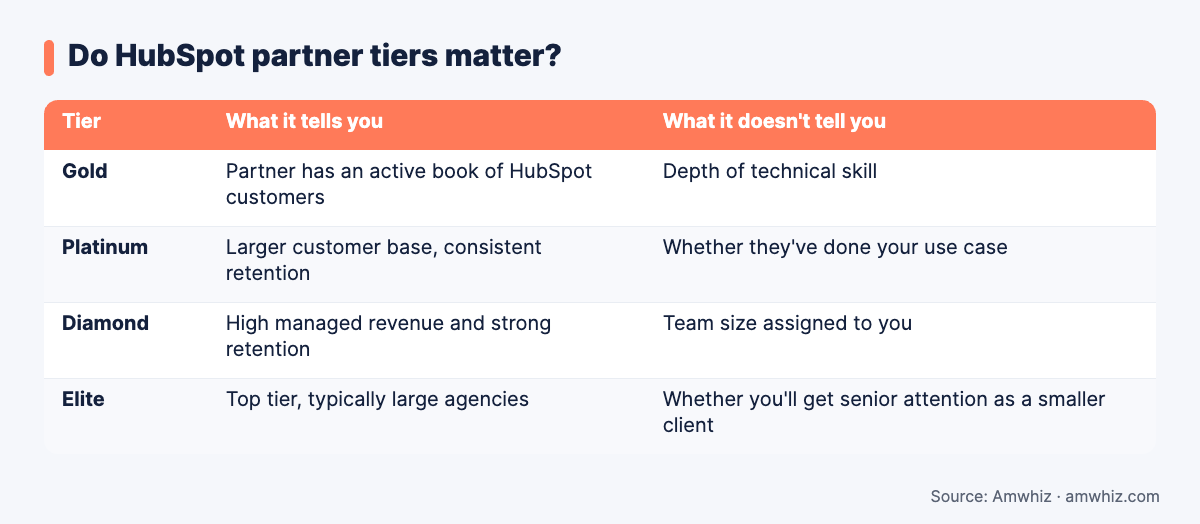
Do HubSpot partner tiers matter?
The 12 questions to ask every HubSpot partner
1. Which hubs and editions have you implemented in the last 12 months?
You want specific numbers and examples for your exact setup, such as "Sales Hub Professional with custom objects" or "Service Hub Enterprise with a customer portal".
2. Can you show a project similar to ours?
Ask for a case study or a screen-share of a live portal (with data hidden). Similar industry helps, but similar complexity matters more: number of users, records, pipelines and integrations.
3. Who will actually work on our account?
Get names, roles and HubSpot certifications. Ask whether the person on the sales call will stay involved after signing.
4. What does your discovery phase include?
Good partners map your sales process, lifecycle stages, data sources and reporting needs before quoting a fixed scope. If a partner quotes a full implementation after one 30-minute call, they are guessing.
5. How do you handle data migration?
Ask how they clean duplicates, map fields, migrate associations, and keep activity history like emails, calls and notes. Ask how they test the migration before cutover. Our guide on what breaks during a HubSpot migration covers the common failure points.
6. What integrations have you built, and how?
Find out whether they use native apps, middleware like n8n or Zapier, or custom code with the HubSpot API. Each has different costs and limits. A partner who only uses one approach will push every problem into it.
7. What exactly is in the scope?
The proposal should list deliverables by object: properties, pipelines, stages, workflows, sequences, templates, dashboards and integrations. Vague items like "CRM setup" or "automation" lead to disputes later.
8. How do you price changes outside the scope?
Ask for their change-request process and hourly rate. Fixed-price projects still change; the question is how fairly.
9. How will you train our team?
Look for role-based training: sales reps, managers, marketers and admins need different sessions. Recorded sessions and a written playbook are a plus.
10. What does support look like after go-live?
Ask about a hypercare period (typically 2 to 4 weeks), response times, and retainer options. Most adoption problems appear in the first 90 days.
11. How do you measure success?
A good partner agrees on measurable outcomes up front: adoption rates, pipeline visibility, lead response time, hours saved on manual entry.
12. Who owns the portal, the code and the documentation?
You should own your HubSpot account, any custom code, integration credentials and documentation. Avoid partners who host integrations on their own infrastructure without a handover plan.
Red flags when choosing a HubSpot partner
- No discovery, instant quote. They don't understand your process yet.
- Only hourly billing with no estimate cap. Costs can drift without limit.
- Licence upsell before process review. Buying Enterprise does not fix a broken process.
- No migration testing plan. Data issues will surface after go-live.
- One person does everything. Strategy, admin, development and training are different skills.
- No references you can call. Logos on a website are not references.
- Integrations built in the partner's own account. You lose control if the relationship ends.
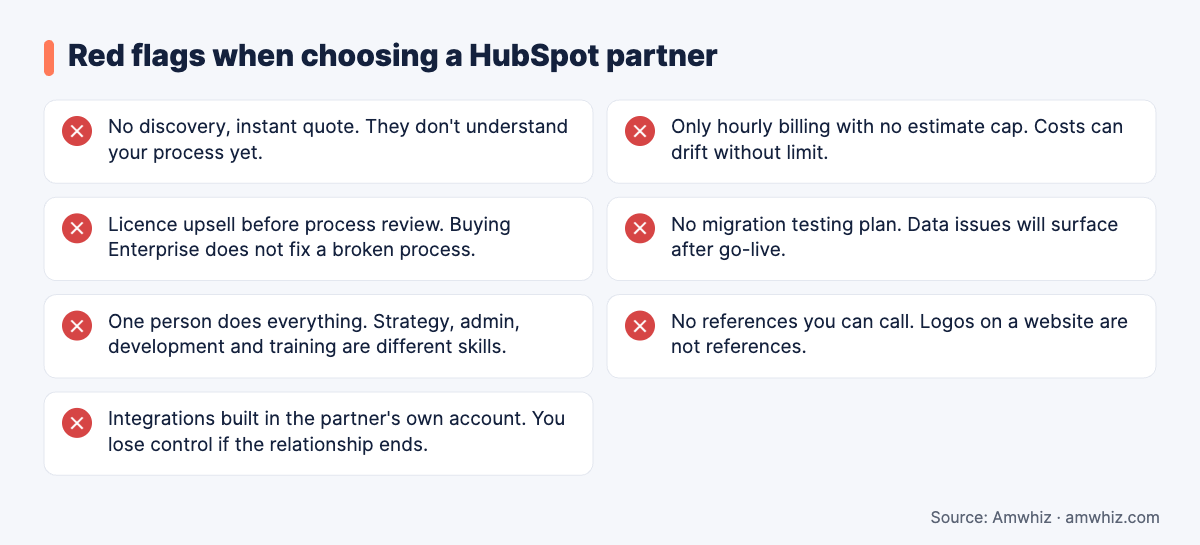
Red flags when choosing a HubSpot partner
What should a good HubSpot partner proposal include?
| Section | What to look for |
|---|---|
| Discovery summary | Your goals, current tools, data sources and pain points in your own words |
| Scope by hub | Objects, properties, pipelines, workflows, templates, reports |
| Integrations | Systems, sync direction, fields, frequency, method |
| Migration plan | Source systems, record counts, cleanup rules, test runs |
| Timeline | Week-by-week milestones and your team's responsibilities |
| Training | Sessions by role, recordings, documentation |
| Acceptance criteria | How each deliverable is signed off |
| Commercials | Fixed fees, change-request rate, retainer options |
| Support | Hypercare length and response times |
For a sample breakdown, see what's included in a HubSpot consulting engagement.
How much does a HubSpot partner cost?
Costs depend on hubs, data volume and integrations. As a planning guide:
| Project type | Typical scope | Typical range |
|---|---|---|
| Starter setup | One hub, basic pipelines, simple import | USD 1,500 to 5,000 |
| Professional onboarding | 1 to 2 hubs, workflows, reporting, training | USD 5,000 to 15,000 |
| Multi-hub implementation | Sales, Marketing and Service with migration | USD 15,000 to 40,000 |
| Complex build | Custom objects, ERP integration, multiple teams | USD 40,000+ |
Treat these as ranges for budgeting. A fixed quote should come only after discovery.
Should you hire a partner or go DIY?
DIY works for small teams with one hub, simple pipelines and no integrations. A partner pays off when you have multiple teams, data from several systems, integration needs, or a deadline. Read signs you've outgrown DIY HubSpot if you're unsure.
Why choose Amwhiz as your HubSpot partner?
Amwhiz is a HubSpot Diamond Solutions Partner that works with B2B, ecommerce and manufacturing teams across India, the Middle East, the UK and Australia. We are strongest where HubSpot meets other systems: Zoho Books, Tally, Shopify, WhatsApp and ERPs.
- Fixed-scope proposals after a structured discovery
- Named project lead and certified consultants
- In-house developers for custom integrations, UI extensions and CMS modules
- Migration testing in a sandbox before cutover
- Hypercare and optional monthly support retainer
Want help with this? Book a free partner-fit call with the Amwhiz team.
Related guides
- HubSpot Partner in India for CRM, Marketing and Sales Automation
- HubSpot Implementation Checklist for Businesses Moving to a Modern CRM
- Zoho CRM to HubSpot Migration: Field Mapping, Data Cleanup and Timeline
Frequently asked questions
What is a HubSpot Solutions Partner?
A HubSpot Solutions Partner is an agency certified by HubSpot to sell, implement and support its software. Partners are ranked in tiers based on managed revenue and customer retention.
Is a Diamond or Elite partner always better?
No. Higher tiers indicate scale and retention, but the best partner is the one with proven experience in your hubs, industry and integrations, and who assigns senior people to your account.
How long does a HubSpot implementation take with a partner?
A single-hub setup takes 2 to 4 weeks. Multi-hub implementations with migration and integrations usually take 6 to 12 weeks, depending on data quality and your team's availability.
Does buying HubSpot through a partner cost more?
Usually not. Licences cost the same through a partner, and some partners can help with onboarding fee waivers or discounts depending on HubSpot's current programme.
Can I switch HubSpot partners later?
Yes. You own your portal. Make sure you also own integration code, credentials and documentation so a new partner can take over without rebuilding.
Leave a comment
Your email address will not be published. Comments are reviewed before they appear.