-1.png?width=134&height=66&name=amwhiz-logo%20(1)-1.png)


Self-onboarding tends to work for very small teams (roughly 1-10 users) with a single simple pipeline and no data migration, while guided onboarding is the safer choice for anyone with multiple pipelines, integrations, or more than a handful of users who need consistent setup. Amwhiz offers guided onboarding for teams that have outgrown the self-service path, details are on our HubSpot onboarding services page, including how we scale the engagement to team size.
Self-Onboarding vs. Guided HubSpot Onboarding: Which Should You Choose?
The Short Answer
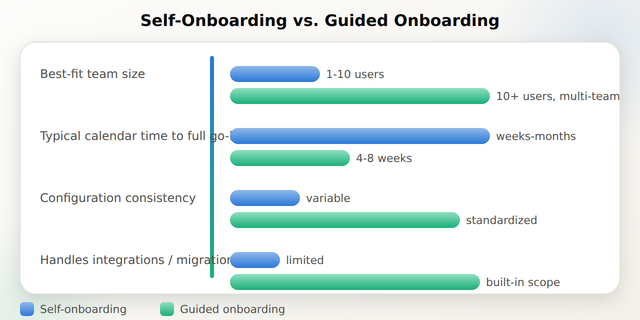
Choose self-onboarding if you're a small team (commonly under 10 users), have one straightforward sales process, minimal historical data, and no integration requirements, HubSpot's own in-app guidance and free resources can typically get you live. Choose guided onboarding once you have multiple teams or pipelines, a CRM migration, any integration beyond the basics, or more than roughly 10-15 users who need a consistent setup they didn't each configure themselves. Team size is the fastest proxy, but process complexity matters just as much.
What Self-Onboarding Actually Involves
Self-onboarding means your team configures HubSpot using in-app prompts, HubSpot Academy resources, and internal trial and error, with no outside consultant involved. It works reasonably well when the setup is genuinely simple: one pipeline, one team using the tool, and data that can be imported cleanly from a spreadsheet. The tradeoff is time and consistency, self-onboarding almost always takes longer in calendar time than a guided engagement, because it competes with everyone's day job, and configuration choices tend to reflect whoever happened to be building that week rather than a deliberate design.
When Self-Onboarding Makes Sense
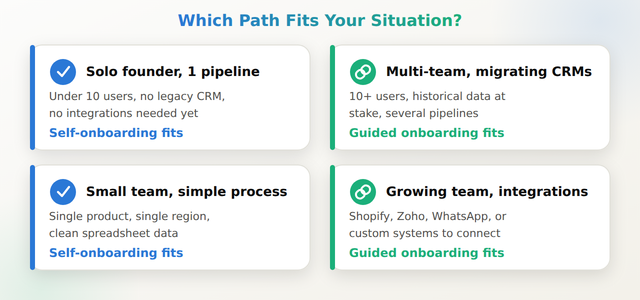
Self-onboarding is a reasonable choice for a founder-led team of a handful of people running one sales process, with no legacy CRM to migrate from and no urgent integration needs. In this situation, the risk of a slightly imperfect setup is low, and the cost of a guided engagement may not be justified yet. If this describes your team, HubSpot's own onboarding resources plus a review of your complete guide to onboarding with HubSpot checklist can be enough to get started safely.
When Guided Onboarding Is the Safer Path
Guided onboarding earns its cost once complexity increases: multiple pipelines for different products or regions, a CRM migration with real historical data at stake, any integration with ecommerce, ERP, or messaging platforms, or a team large enough that inconsistent self-configuration becomes its own problem. At this size, mistakes made during setup, a mislabeled lifecycle stage, a workflow that fires for the wrong segment, get expensive to unwind later because they've already propagated through months of data.
The Middle Ground: Hybrid Onboarding
Some teams don't fit cleanly into either camp, too complex for pure self-service, but not ready for a full multi-week engagement. A hybrid approach, where a partner configures the core structure (pipelines, key workflows, integrations) and the internal team handles day-to-day additions afterward, is common for teams in the 10-25 user range. This is often the most cost-effective option once you've outgrown pure self-onboarding but don't need a full enterprise-scale build.
What Team Size Really Predicts
Team size is a useful shorthand, but it's really a proxy for two things: how many people's habits need to align on one system, and how much is at stake if the setup is wrong. A 5-person team selling one product can self-onboard successfully. A 5-person team migrating ten years of Salesforce history with three integrations cannot, despite the small headcount, the complexity argues for guided help. Complexity, not headcount alone, is the real deciding factor.
How Amwhiz Helps
Amwhiz scales guided onboarding engagements to match team size and complexity rather than offering one fixed package, including hybrid options for teams in between. Our HubSpot onboarding services page walks through how scope adjusts based on user count, pipeline complexity, and integration needs.
Frequently Asked Questions About Self-Onboarding vs. Guided Onboarding
Can a small team still benefit from guided onboarding?
Yes, especially if the small team has complex needs, multiple pipelines, a CRM migration, or integrations. Team size matters less than process complexity, and a 5-person team with complex requirements can benefit from guided help just as much as a 50-person team.
What's the biggest risk of self-onboarding for a growing team?
Inconsistent configuration is the most common issue, different people setting up properties, pipelines, or workflows their own way over time, which makes reporting unreliable and often requires a cleanup project later that costs more than guided onboarding would have upfront.
How much does guided HubSpot onboarding typically cost compared to self-onboarding?
Self-onboarding has no direct consulting cost but consumes internal staff time over an extended period. Guided onboarding has an upfront cost but typically compresses the calendar timeline significantly and avoids costly rework, which is why many teams find it cost-effective net of staff time saved.
Can we start with self-onboarding and switch to guided later?
Yes, this is common. A partner can audit an existing self-onboarded setup and build guided onboarding on top of it rather than starting over, as long as the underlying data and structure are salvageable.
Does HubSpot itself offer guided onboarding, or only through partners?
HubSpot offers its own onboarding packages directly, and certified partners like Amwhiz also offer guided onboarding, often with more tailored scope, integration work, and ongoing support built in beyond the standard package.
How do I know if my team's process is 'simple enough' for self-onboarding?
A good test: if you can describe your entire sales or service process in a single pipeline with no exceptions, have no legacy data to migrate, and need no third-party integrations, self-onboarding is likely sufficient. If you hesitate on any of those three, guided onboarding is the safer default.
Conclusion
Self-onboarding and guided onboarding both work, the right choice depends on team size and, more importantly, process complexity. Small, simple setups can self-serve successfully; anything involving migration, integrations, or multiple teams benefits from guided help that gets the structure right the first time.
Amwhiz helps teams pick the right onboarding path for their size and complexity, then delivers guided onboarding scoped to match. Visit amwhiz.com or email sales@amwhiz.com to get started.